Halo: Reach isn't the beginning, it's the end. Sure, Microsoft might continue to churn out Halo game after Halo game, but this will be the last one that Bungie will ever have a hand in developing, or so we're told. And that's exactly how Halo: Reach feels: Like a swan song.
Halo: Reach is meant to be a prequel, the table setter for the Halo trilogy that put Bungie, and in many ways the Xbox, on the map. In it you take on the role of a faceless space marine, the newest member of the United Nations Space Command special operations unit Noble Team. As Noble 6, you're an unwelcome replacement in a unit that always seems in need of fresh blood.
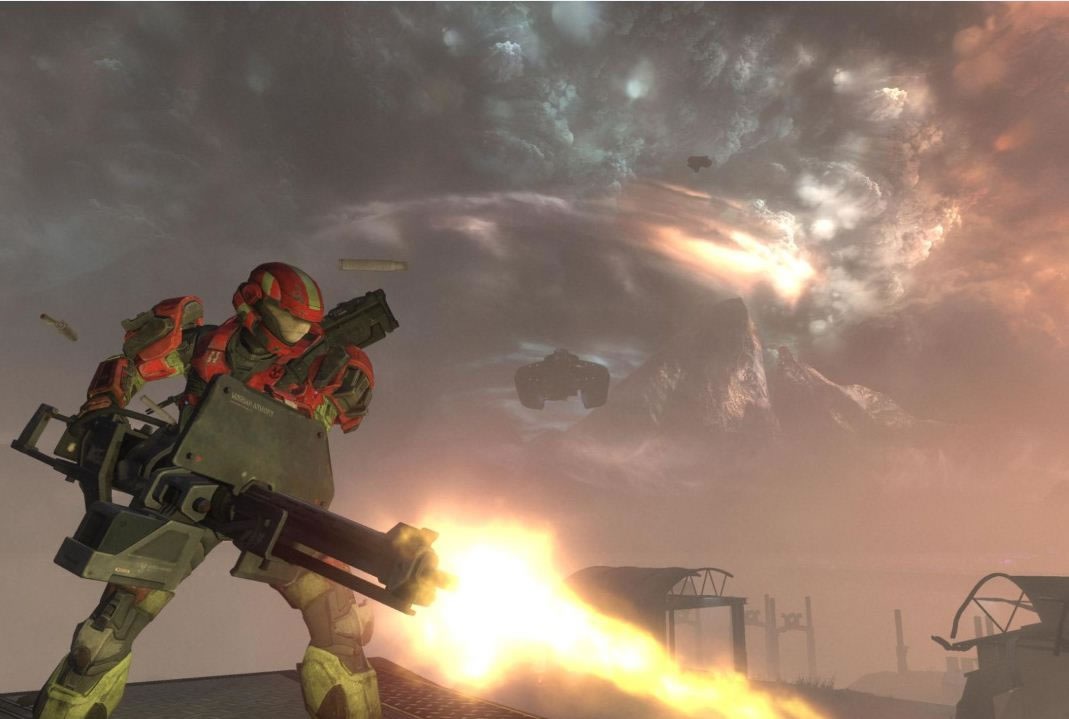
As the game opens you're given a dramatic look at the world of Reach, a planet you'll spend the next eight or so hours of gaming, fighting to defend.
Satisfying Story: I've always found that Halo's greatest weakness has been its story. The plot, the characters, even the setting have always felt a bit too sci-fi generic for my liking. Halo: Reach was Bungie's last chance to prove that they can create a game that is as evocative to experience as it is to play. While the game's story certainly doesn't sing from opening to close, it does a fine job of building up a sense of wonder and curiosity in the gamer. More importantly, it delivers a cast of characters you'll come to quickly care about, and then deftly deals with each, leaving few loose ends. If Halo 3 was a bit too much of a cliff hanger, Halo: Reach will most certainly satisfy you in the way it ties things up so neatly, so completely.
A Living Painting: There are points in Halo: Reach when the game seems to escape the confines of graphic animation, transcending the medium to become moving set pieces that look more like a pulsing Baroque painting than a video game. The blending of rich colors and dramatic presentation, cued to important moments, memorable movements in Halo: Reach is pitch perfect, used just enough to help burn the game's high points into your conscience.
Clever Enemies: The enemies of Halo: Reach are somehow even more efficient, tactical and clever than previous iterations. They use all of the new gadgets, weapons and powers this latest Halo grants them to easily parry foolish, head-on attacks and direct confrontation. Instead, players will need to use guile, speed and that wonderful ability to jet-pack through the air to run down, over and around your enemies.
Multiplayer: An entire review could be devoted to just the myriad of ways that Halo: Reach's multiplayer sings, all of the wonderful things it brings to the table. The game reworks the popular Firefight mode to allow for nearly limitless customization of the Spartans versions horde mode. Matchmaking seems to have been greatly sped up, though there weren't many people playing when I was trying the game, and there are now ways to try and find gamers who you want to play with through a set of clever filters. Online campaign matchmaking works seamlessly, allowing you to quickly find up to three other gamers to burn through the campaign with. A player Armory and the use of earned credits allows you to customize your Spartan and gives you one more reason to keep playing those online matches. And Halo: Reach's level building tool, Forge, has been retooled to be easier to use. Bungie also promises to deliver daily in-game challenges when Halo: Reach launches, which will give players another way to earn credits. Of course, there are also plenty of new modes and maps to play with, all of which are augmented by the game's new look and those wonderful class settings.
Graphics: Halo: Reach's greatest achievement is how thoroughly it reinvents the look of the storied franchise, giving everything a much grittier and more realistic aspect. The game throws out the tiring purple pallet of past Halos for an eclectic, vibrant look that doesn't use color to distract, but rather to augment the shooter's look. The developers push their use of color, taking every opportunity to make the settings vibrant and alive. From the color-leaching greys of rainstorms that roll through some levels, to the warm glow of fires and explosions, Reach is artfully depicted as a living world.
Helicopter At Dusk: There's no question that Bungie can make a solid first-person shooter. But a combat flight game? Despite slightly awkward flight controls, the game's lengthy Falcon level is a welcome change to the endless ground combat of previous Halo games.
Space Dogfights: Helicopters, sure, but space combat? I'm not sure which I enjoyed more, but I was delighted to find that the level dedicated to Sabre space combat felt incredibly different from the Falcon's helicopter combat, as it should. If anything, my only complaint about this section of the game is that there wasn't enough of it.
Turret Level: Bungie has their first-person shooter space combat down, so it's nice to see that the developer still pushes themselves to take a chance and try to deliver new experiences, not just with space combat, helicopter combat and an assortment of new weapons and enemies. One unforgettable section of the game has you running back and forth between turrets, activating them as you dodge enemy fire and defend an important position. The simple addition of turrets that need constant care, adds a new facet to the game's dynamic and helps once more to move the game along without feeling like an endless shootout.
Armor Abilities: Somehow the team of pre-Halo Spartans managed to get one considerable upgrade to their arsenal: Armor abilities. While you start off with just the ability to sprint by tapping the left bumper, as you make your way through the campaign, you'll find plenty of places where you can switch out armor abilities. Other abilities include a jet pack, a holographic decoy, active camouflage, a drop shield and armor lock. These abilities can vastly change the way you play through sections of the game, allowing gamers to tackle the challenges they face in a myriad of ways. Multiplayer too includes these abilities, plus a couple more, and when available, they have an even bigger impact on gameplay. I still spend half of my online matches trying to do mid-air take-downs of other jet pack Spartans.
The Little Things: There's nothing really to hate about Halo: Reach, but there are a few things that bugged me. Top of my list was how despite having to face incredibly smart, seemingly complex enemies, my cohorts were as dumb as a bag of hammers. They'll forget to hop into vehicles, get lost, not realize you've left to go on your next mission or, my personal favorite, get locked behind a blast shield because they apparently didn't notice it closing. While it didn't happen often, I was shocked to see that Halo: Reach does on very few occasions, chug. That is, the graphics slow down quite a bit when there's too much going on in the game. The first time I noticed this was near the end of the game when a lot of enemies were around, and we were all shooting off our weapons and something big exploded. But I've since seen it a few other times and in online matches as well. I checked it on a second console and checked in with other players and they've noticed it too. It happens so infrequently that it doesn't really mar the game, but it's not the type of issue I would ever expect to see in a Bungie title.
There is much to love about Halo: Reach, but looking back at my nearly two times through the game and a day spent playing it online, the single thing that sticks with me the most is its setting, its majestic take on a planet that doesn't exist. Bungie has outdone themselves with the game's look, stringing together set-piece after set-piece until there is nearly nothing left.
Halo: Reach is unquestionably the best of the Halo games, and that's not a small thing to say. But Bungie doesn't just match the best of every Halo game that came before it, they've improved it, streamlined it, perfected it. Gone are sections of tedium and vacuous game design, gone too is the almost cartoon look of the earlier games and the narrow vision of the places in which they took place. In many ways, Halo: Reach feels like a coming of age title, not for the characters or the universe Bungie created, but for the studio itself.
Halo: Reach was developed by Bungie and published by Microsoft Game Studios for the Xbox 360 on Sept. 14. Retails for $59.99 USD. A copy of the game was given to us by the publisher for reviewing purposes. Played through the campaign by myself on normal difficulty, and through much of the campaign with one or more friends on Heroic difficulty. Played multiple online matches in campaign, firefight and the plentiful versus modes. Messed around with Forge.

For more gaming news and reviews check out Kotaku.com.
Brian Crecente is an American journalist and columnist, the Editor-In-Chief of Kotaku, and the writer of Well Played, a weekly column internationally syndicated by McClatchy-Tribune Information Services.