also @ TechSpot: OCZ Vertex 450 Review

Rumor: Sunset planned for Sandy Bridge in Q3, makes way for Ivy Bridge

By

On June 13, 2012, 2:00 PM

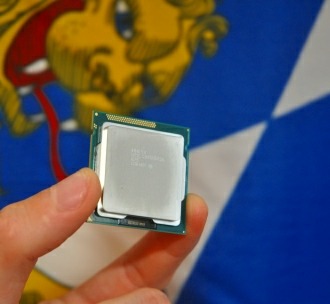
Based on information provided by industry sources, Digitimes reports that Intel will begin phasing out Sandy Bridge processors this September. Intel's recent announcement of several brand-new, dual-core processors allow Ivy Bridge to finally thrive in spaces where Sandy Bridge has remained a long-term resident, namely Ultrabooks, laptops and lower-end PCs. With that in mind, this makes good sense.

Ivy Bridge CPUs feature a 22nm design and come in three flavors: desktop (S), mobile (M) and ultra-low voltage (U) variants. The maximum thermal design power for Ivy Bridge CPUs is significantly lower than that of Sandy Bridge, ranging from a ULV low of 17W TDP  to a very respectable 77W TDP for higher-end i5 and i7 desktop models. That's roughly a 20% improvement over the TDP numbers found on most Sandy Bridge processors. As a result, Ivy Bridge has proven ideal for portable and miniature applications such as the Intel NUC.

Intel says OEMs have already been receiving shipments of third-generation Ivy Bridge CPUs. Consumers should begin to see those systems later this month. The chip maker also hinted that it expects to ship 50 percent more Ivy Bridge CPUs in six months than it did within the same period of time last year with Sandy Bridge.

However, as usual, price may prove to be a challenge. Ivy Bridge CPUs are considerably more expensive than their Sandy Bridge counterparts. According to Digitimes, the price disparity is roughly $67-100 per unit -- that's a lot of money, particularly for OEMs where razor-thin margins on mainstream products are the norm.

If Intel is indeed planning to phase out the old and phase in the new starting this September, it is reasonable to assume that OEMs and enthusiasts should be seeing some substantial price cuts this summer.

, , , , , , , , , , , , , ,

Related Products from Product Finder

Intel Core i7-3770K 3.5GHz Socket 1155

The Intel Core i7-3770K comes with an unlocked multiplier and is 100MHz faster out of the box. It also features 4 cores with 8 concurrent threads when using Hyper-Threading. The Core i7 3770K operates at 3.50GHz with a Turbo Boost frequency of 3.90GHz. The Core i7 3770K also misses out on Intel vPro/TXT/VT-d/SIPP technologies.

33 Reviews

Asus P6X58D-E

Read expert reviews, pros & cons, and product information about Asus P6X58D-E. There are 32 reviews available so far.

16 Reviews

NZXT HAVIK 140 CPU Cooler

Read expert reviews, pros & cons, and product information about NZXT HAVIK 140 CPU Cooler. There are 40 reviews available so far.

17 Reviews

CoolIT ECO A.L.C. CPU Liquid Cooler

Read expert reviews, pros & cons, and product information about CoolIT ECO A.L.C. CPU Liquid Cooler. There are 61 reviews available so far.

27 Reviews

User Comments: 1

Got something to say? Post a comment
  1. Holding a stock of chips is the opposite of holding a stock of gold. Gold always goes up in value over time, chips are constantly going down, day by day. Gold is a rare and limited element on our planet. Chips are nearly infinite in supply. I propose building chips of solid gold, and your PC will retain it's value forever.

Recently commented stories

Post a new comment

Social Login & Guest Posting TechSpot Members
Login here or sign up for free,
it takes about a minute.
Get complete access to the TechSpot community. Join thousands of technology enthusiasts that contribute and share knowledge in our forum. Get a private inbox, upload your own photo gallery and more.
TechSpot on:

Subscribe to TechSpot

Get free exclusive content, learn about new features and breaking tech news.