Welcome to the TechSpot OpenBoards. Please read the FAQ if you have any questions. Sign up or Login to participate.
|
|||||||
Begin your free trial now
Pay-as-you-go options starting at $10/user/month
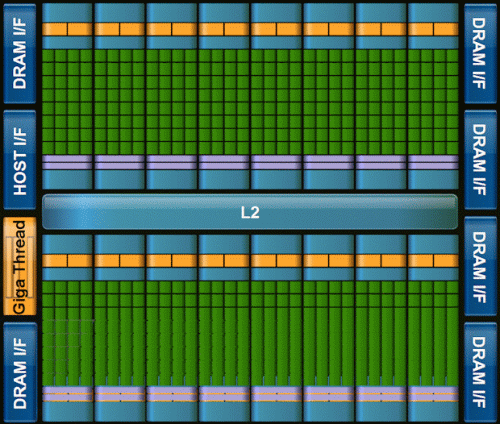
Nvidia unveils next-gen GPU architecture, Fermi
|
|
Thread Tools | Search this Thread |
|
#1
|
||||
|
||||
|
Nvidia unveils next-gen GPU architecture, Fermi
Nvidia has taken the wraps off its next generation CUDA GPU architecture, Fermi. Engineered from the ground-up, the company says Fermi delivers breakthroughs in both graphics and GPU computing. Parallel Computing Research Laboratory director Dave Patterson believes Nvidia has taken a leap toward making GPUs attractive for a broader class of programs, and thinks the company's latest technology will stand as a significant milestone.
Read the whole story
__________________
"Dependence begets subservience and venality, suffocates the germ of virtue, and prepares fit tools for the designs of ambition." -Thomas Jefferson
|
|
#2
|
||||
|
||||
|
I commented on the next gen ATI card reviewed last week or so and said I bet Nvidia will come up with something better. . . I guess I may be right, true I can't prove it yet but after researching this articles points, it just seems that nvidia is going down a route that looks like the performance of the new cards really will be better than ati's offerings.
|
|
#3
|
|||
|
|||
|
Full FPU precision? Ah I see, so it took double the work to do scaled precision computing such 128-hdr processing, and now less work is loaded on this Fermi platform due to its full support of double precision floats. The document says past GPUs only operating on 24-bit floats at a time, and weren't conforming with programming languages that dispose to the CPU dword single precision and qword double precision specifications, and now since it's ALUs fully support computation upon whole 32-bit and 64-bit floats are supported and obviously conform to the 754's precision width; this was done because applications that required only integer arithmetic relied what was available and used emulation utilized multiple 24-bit width precision float instructions. Now that such a conformity exists, programmers can easily operate on this scenario kind without worrying about needed emulation opposed to operating on floats like on the x87.
|
|
#4
|
||||
|
||||
|
All I have to say is: 8 Times the peak double precision arithmetic performance!?! No WAY!!
ATI cannot compete with that peak double precision arithmetic. Nvidia FTW!! ROFL
|
|
#5
|
||||
|
||||
|
@Adhmuz: Who cares? This card will probably cost $1000 per any way. Fanboy = fail.
|
|
|
|
#6
|
|||
|
|||
|
You're an *****. GTX 280 blew chunks at double precision, it was utterly terrible; only one unit capable of double precision per SM.
GTX 280 could crank out 78 GFLOPS, HD 4870 could do 240 GFLOPS. 8 times 78 GFLOPS would put Fermi at 624 peak GFLOPS compared to HD 5870's 544 GFLOPS. |
|
#7
|
||||
|
||||
|
Quote:
|
|
#8
|
|||
|
|||
|
Are you guys talking about double precision performance?
As you mentioned there is only one 64-bit FPU unit in the 200 series. If you are talking about games then you shouldn't care so much about double precision performance. In games single precision is often enough, in fact, it is often enough for a lot of HPC applications. The peak performance when using single precisiosn should be at least 3 TFLOPS for the new generation. //j |
![]() |
| Similar Topics | ||||
| Topic | Replies | Forum | ||
Nvidia GeForce GTX 480 Review: Fermi Arrives
|
107 | Articles and Reviews Comments | ||
Nvidia pushes back Fermi GPU to March 2010?
|
42 | TechSpot News and Comments | ||
Nvidia teases first Fermi-based GeForce graphics card
|
23 | TechSpot News and Comments | ||
Nvidia unveils Fermi-based Tesla GPUs
|
13 | TechSpot News and Comments | ||
Nvidia takes GT200 architecture to notebooks
|
3 | TechSpot News and Comments | ||
| Thread Tools | Search this Thread |
|
|
All times are GMT -4. The time now is 07:40 AM.


Nvidia GeForce GTX 480 Review: Fermi Arrives