Welcome to the TechSpot OpenBoards. Please read the FAQ if you have any questions. Sign up or Login to participate.
Collaborate in the cloud with Office, Exchange, SharePoint, and Lync
|
|||||||
Collaborate in the cloud with Office, Exchange, SharePoint, and Lync
does anyone know binary
![]() |
|
|
Thread Tools | Search this Thread |
|
#1
|
||||
|
||||
|
does anyone know binary
i just started a course at college and we are going to be learning binary, can anyone tell me what it involves?.
this is the course - http://www.nei.ac.uk/courses/Courses.asp?category=14 its the first course on the page |
|
#2
|
||||
|
||||
|
Binary is a number system with a base number of 2.
The common system humans use is base 10. We don't think of it in this manner, but the number 123 (in base 10 or decimal) is 1x10^2 + 2*10^1+3x10^0 10^2 is 10*10, or 10 to the second power or 10 squared and any base number to the zero power is always 1 Binary just changes the base number and it calculates the same way. binary has only has a zero or a one in the number range. The binary number 100 is 1x2^2+0*2^1+0*2^0 0 x anything is zero so it reduces to 1x2^2 or 4 (decimal) 5 decimal would then be 101 in binary. I'll leave the history, usage of, and follow-on number systems to the instructor. PS: computers do not use binary today. Listen carefully to find the answer :giddy: |
|
#3
|
|||
|
|||
|
Quote:
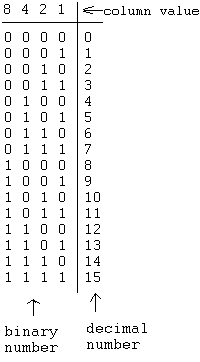
However, computers use binary at their lowest and most complicated level of operation. These days (and for a very long time now!) binary is convereted to a much more workable system for the user/programmer, being Octal (Base 8) and more often than not, Hexadecimal (Base 16). I never did learn and remember how to work in binary properly.. However, there is a cheats way From right to left in a binary sequence, the value of each digit doubles, and so...8 4 2 1 1 1 1 0 = 14 in decimal As an aside, an interesting little puzzle along such lines... Disarm the Bomb Last edited by Spike; 10-16-2005 at 01:10 PM.. |
|
#4
|
||||
|
||||
|
Quote:
range 0-9,a-f. Base16 is <> Base2 and therefore is not binary. Memory opertaions take place on 8bits and this creates a maximum value of FF(base16), or 255(base10). These are not binary. It is always true that a 'digital computer' uses binary logic cards and circuitry. If your definition of binary extends to software implementation to testing or comparing values ( if x equals y then ... ), then you're right, because that's the only way to create the code to trigger the hardware do the evaluation. There are two common character codings, ASCII and EBSDIC, both operating over the full range of Base16. A character encoding is the 'Roseta Stone' used to 'assign value' to a given number or location in the address range. For example, EBCDIC assigns the character 'A' to the location C1, while ASCII assigns 'A' to 41 There have been some recent machine that use a 7bit code known as Octal, eg: Tandem NSii. RS232 serial line coding is also 7bit chunks. Strickly speaking, Binary is a number system using Base2. |
|
#5
|
||||
|
||||
|
You are all confusing the poor chap..
etones: It will be about how to present different numbers in binary (there are several ways) and how to preform basic calculations. Nothing to it really.. Learning all numbers 1-15 in binary and powers of 2 up to ~15 will help
|
|
|
|
#6
|
|||
|
|||
|
As ever Nodsu, you are correct. We probably were confusing the poor chap.
numbers 1-15 in binary (there's a simple pattern if you look for it)...
|
|
#7
|
||||
|
||||
|
im starting to understand a bit, im sort of getting what Nodsu and Spike are posting.
ok so say i have 20 and i want to make it into binary it would be 1 0 1 0 0 so the answer is = 10100 is that right |
|
#8
|
|||
|
|||
|
It is correct. Hopefully you've also seen the pattern as you look down each column too and spotted the pattern.
One thing you need to remember though is that that is the cheats way of doing it, useful for small numbers, but ultimately useless for longer ones. |
|
#9
|
||||
|
||||
|
Binary logic
All of the above is very good and true, but might I add:
All digital logic circuits (as in computers) use 1's and 0's to determine an outcome of a True/False condition. The rules of representing decimal numbers are as given above. 10100 = 20. But part of the course should include the basic logic of 1's and 0's as applied to logic gates such as AND, OR etc. An AND gate is the symbolic logic of: If A and B, then C. So 1+1=1. You need two 1's ( a 1 at each gate input (assuming a 2 input AND for simplicity) to get a True or 1 output. So AND gate truth table looks like: Input 1 Input2 Output 0 0 0 1 0 0 0 1 0 1 1 1 This the fundamentals on making a "decision" in the machine world. The first computers were machincal, then moved to relays and then on to transistors. If fact the term "bug", as in ; " I have a bug in my code". came from a female computer engineer/mathematician in 1948 working for the Department of Defence in the USA. A two floor relay based computer was crunching numbers overnight and when she went to review the results in the morning they were all wrong. After investigating the problem she found a moth dead between one of the relay contacts. In her logbook she noted: "Bug in machine" and it became part of our vernacular. The OR gate is the logic of: If A or B then C. So 0+1=1 or 1+0=1. If EITHER condition is true then C is true! So truth table for OR gate is: Input 1 Input2 Output 0 0 0 1 0 1 0 1 1 1 1 1 Now there are many other gates such as Exclusive OR, NAND gate (negated inputs of an AND gate). All these togther make up how a computer works. The logic gates have now been replaced with a CPU, the OS controls the 100 million or so TTL (transistor-transistor logic)logic gates inside the microprocessor at any given nanosecond (X.xGHz clock frequency). Therefore the OS is making certain parts of the CPU circuit act like an AND gate for an instruction, then like an OR gate and so on. All of this is happening at billions of times a second (64bits X 2.4Ghz AMD64 processor for example) in order for me to type this response. OK now I think we confused him. My work here is done. |
|
#10
|
||||
|
||||
|
There are 10 types of people...those who understand binary and those who don't.
patio.
|
|
#11
|
|||
|
|||
|
that makes 11 of us
|
|
#12
|
||||
|
||||
|
Quote:
|
|
#13
|
||||
|
||||
|
"For a good prime call"...
I just noticed that Spike ! patio.
|
|
#14
|
|||
|
|||
|
lol... It's been there for ages
|
|
#15
|
||||
|
||||
|
It's that old age thingy...
patio.
|
![]() |
| Similar Topics | ||||
| Topic | Replies | Forum | ||
Binary Wiped Hard Drive Not Visible
|
1 | Storage and Networking | ||
Hello to the 10 people who understand binary
|
0 | Introduce yourself | ||
Personal Mail Server - Saving binary attachments
|
1 | Software Apps | ||
137 GB (128 GB binary) limit? Help?
|
13 | Processors and Motherboards | ||
Easy reading of Hex and Binary
|
2 | General Discussion | ||
| Thread Tools | Search this Thread |
|
|
All times are GMT -4. The time now is 09:06 PM.


From right to left in a binary sequence, the value of each digit doubles, and so...
Binary Wiped Hard Drive Not Visible