also @ TechSpot: Nvidia GeForce GTX 780 Review

Smarter design cuts existing SRAM power consumption by 27-85%

By

On February 25, 2013, 4:30 PM

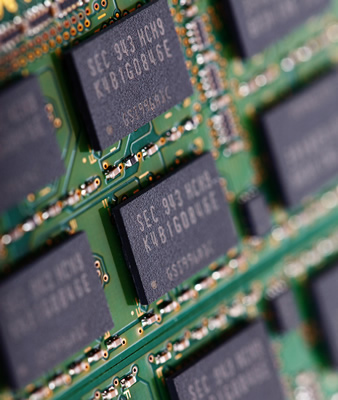
Industry giant Toshiba announced the development of a technology which promises a substantial cut in embedded SRAM power consumption. Ideal applications include smartphones, tablets and mp3 players -- essentially any portable device with a reliance on high-performance system memory, where the technology may be used to save significant amounts of battery power.

Toshiba claims embedded memory modules could have their power usage cut by 27 percent, while a device equipped with its power-saving invention is in operation. While in standby, the technology promises to shave off a whopping 85 percent of memory chip power consumption.

Interestingly, the advancement doesn't rely on a SRAM redesign or a new memory type; rather, the technology employs a few circuit changes which add temperature sensitivity, predictive capabilities and dynamically adjust memory performance accordingly. Toshiba is essentially using "smarter" circuitry to lower power consumption.

Toshiba's new technology applies a BLPC and DCRC. The BLPC predicts power consumption of bit lines by using replicated bit lines to monitor the frequency of the ring oscillator. It minimizes the active power of the SRAM in certain conditions by monitoring the current consumption of the SRAM rest circuits. The DCRC greatly decreases standby power in the retention circuit by periodically activating itself to update the size of the buffer of the retention driver.

Source: www.semicon.toshiba.co.jp

It's unclear exactly how much impact RAM has on power consumption in smartphones or other portable electronics; however, Engadget presumes RAM is one of the principal drains on a smartphone's battery. Due to RAM's volatile nature, even when your device is locked and the screen is off, its memory must remain constantly powered or the host device will cease to operate -- well, until a subsequent restart, at least. No doubt, this need hastens a smartphone or tablet battery's demise, even as it idles on someone's coffee table, untouched and locked.

Additionally, the greater amount of RAM -- the greater amount of power is consumed. Toshiba's advancement may be one way manufacturers can compensate for growing onboard memory sizes of 2GB and beyond, alongside possible future die-shrinks and other novel memory technologies. 

, , , , , , , , , , , , , , , ,

Related Products from Product Finder

Apple iPhone 5

The Apple iPhone 5 features a 4-inch display retains the same 326 PPI density as its predecessor with an effective resolution of 1,126 x 640, and a new Lightning connector. The new handset now features 802.11a/b/g/n Wi-Fi with 802.11n supporting dual-band 2.4GHz and 5GHz frequencies. Bluetooth 4.0 is back in addition to GPS and GLONASS for location services.

62 Reviews
Price: $99.99

Apple iPhone 4S

The iPhone 4S looks identical to last year's model but comes in a new 64GB flavor and upgrades the camera to include an 8-megapixel sensor with improved low-light performance and 1080p video capture. In terms of performance the new iPhone is reportedly up to 2x faster and is also capable of running on faster HSPA+ networks, reaching theoretical download speeds of up to 14.4Mbps.

93 Reviews

Google Nexus 4

The Google Nexus 4 features a 1.5GHz quad-core Snapdragon S4 processor, a 4.7-inch 1280 x 768 IPS display, 2GB of RAM, dual cameras (1.3MP front, 8.0MP back), and either 8GB or 16GB of internal storage. Google also baked in NFC support and a wireless charging feature that lets you power the phone by setting it down on an inductive “Charging Orb”.

44 Reviews

Google Nexus 10

The Google Nexus 10 features Android 4.2 with a dual-core ARM Cortex-A15 chip paired with 2GB of RAM, as well as a 10-inch screen at 2560 x 1600 resolution, clocking in at 300ppi. There’s also a 5MP camera on the back, a 1.9MP camera on the front, and a battery that Google says runs for 9 hours. Other features include microUSB, Micro HDMI and not one but two NFC chips.

26 Reviews
Price: $499.99

User Comments: 4

Got something to say? Post a comment
  1. Sounds like a very powerful improvement. There's so much that can be expanded upon, while keeping a solid battery life with this. Instead of the generally average or poor battery life of some products, especially under a really heavy use during the day to day tasks.

    Looking forward to this being a reality in new products to come. It might actually interest me in something, with some actual battery life that won't seem absolutely terrible.

  2. Sounds like a very powerful improvement. There's so much that can be expanded upon, while keeping a solid battery life with this. Instead of the generally average or poor battery life of some products, especially under a really heavy use during the day to day tasks.
    You know there would be longer battery life, if manufacturers quit packaging smaller batteries when their devices use less power. I am personally not interested in any device, that will not stay charged over a period of 24 hours usage.

  3. Hold on... aren't static RAM modules extremely expensive for large capacities due to the "large" area and amount of transistors they need per bit? That's the reason why SRAM is used for cache and small, fast access memories; for bigger capacities like 2 GB DRAM fits better, needing just 1 transistor per bit and its parasite capacitor and a refresh circuit.

    SRAM is more adecuate for small buffers, cache memory and some aid for the bigger and cheaper DRAM. Both volatile but just one of them needing refresh circuits. John Hennessy's computer architecture book back-ups me, not Wikipedia --even my former computer architecture teacher who works at Intel and gave us a more accurate current cost of the SRAM per MB, don't remember the exact amount [it was last semester] but it would cost thousands of dollars to manufacture SRAM in the order of GB.

  4. It is a pity that Toshiba do not make phones to immediately utilise this tech advancement...

Recently commented stories

Post a new comment

Social Login & Guest Posting TechSpot Members
Login here or sign up for free,
it takes about a minute.
Get complete access to the TechSpot community. Join thousands of technology enthusiasts that contribute and share knowledge in our forum. Get a private inbox, upload your own photo gallery and more.
TechSpot on:

Subscribe to TechSpot

Get free exclusive content, learn about new features and breaking tech news.