also @ TechSpot: Bill Gates is once again the richest person in the world

25-GPU cluster can brute force Windows password in record time

By

On December 10, 2012, 9:30 AM

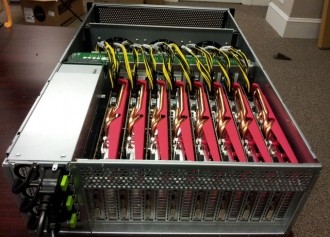
Jeremi Gosney, the founder and CEO of Stricture Consulting Group, recently showcased a GPU-based computer cluster capable of brute forcing its way through any standard eight-character Windows password (including upper- and lower-case letter, digits and symbols) in less than six hours.

The machine, powered by 25 AMD Radeon graphics cards, runs the Virtual OpenCL cluster platform. This allows all of the machines / GPUs to act as a single computer. With this configuration, Gosney was able to use a password-cracking suite called ocl-Hashcat Plus that is designed specifically for GPU computing.

The cluster uses the NTLM cryptographic algorithm included in all versions of Windows since Server 2003 and is able to generate and test 350 billion password guesses per second. Once the math is factored in, that equates to every different password combination in only five and a half hours. Gosney said they can now attack hashes about four times faster than they previously could.

VCL virtualization is essentially what makes a system like this possible. GPU computing isn’t exactly new but hardware and software limitations have thus far prevented most people from running more than eight graphics cards on a single computer.

"Before VCL people were trying lots of different things to varying degrees of success," Gosney told Ars Technica. "VCL put an end to all of this, because now we have a generic solution that works right out of the box, and handles all of that complexity for you automatically. It's also really easy to manage because all of your compute nodes only have to have VCL installed, nothing else. You only have your software installed on the cluster controller."

It’s worth pointing out that this method typically only applies to offline attacks due to the fact that most websites limit the number of incorrect password guesses before either locking the account down or enforcing a waiting period.

Either way, experts suggest using a password that is at least nine characters long and doesn’t contain names, words or common phrases.

, , , , , , ,

Related Products from Product Finder

AMD ATI Radeon HD 6990 4GB GDDR5 PCIe

The AMD ATI Radeon HD 6990 is a massive graphics card measuring in at 12 inches long (30cm) and weighing a little over 1kg. The heatsinks are separated by a blower fan which is positioned in-between them rather than at the end of the card. The Radeon HD 6990 has an impressively low 37-watt idle consumption. The GDDR5 memory works at 5000MHz (1.25GHz x 4) on this particular model and features a 4GB capacity.

32 Reviews

Sapphire Radeon HD 6990 4GB GDDR5 PCIe

Read expert reviews, pros & cons, and product information about Sapphire Radeon HD 6990 4GB GDDR5 PCIe. There are 16 reviews available so far.

5 Reviews

HIS Radeon HD 6990 Fan 4GB GDDR5 PCIe H699F4G4M

Read expert reviews, pros & cons, and product information about HIS Radeon HD 6990 Fan 4GB GDDR5 PCIe H699F4G4M. There are 7 reviews available so far.

4 Reviews

User Comments: 48

Got something to say? Post a comment
  1. It would be nice if the article said what difference would 9 characters over 8 make using this method - or 10 for that matter.

  2. But can it run Crysis?

    (I know, I know...)

  3. "While remarkable for its simplicity and speed in software, RC4 has weaknesses that argue against its use in new systems.[2] It is especially vulnerable when the beginning of the output keystream is not discarded, or when nonrandom or related keys are used; some ways of using RC4 can lead to very insecure cryptosystems such as WEP."

    NTLM is RC4-based and, as such, is quite obsolete. See a backtrack distro cracking your WEP pass in an hour or two, easier ones, of course, but still, I'd say this algorithm's credibility is pretty much shot.

    Let me see it crack an AES 256 hash based pass of 16 characters or more and then you can color me impressed

    Still, it's scary for the masses, since we all know the complexity of the average man's password.

  4. "While remarkable for its simplicity and speed in software, RC4 has weaknesses that argue against its use in new systems.[2] It is especially vulnerable when the beginning of the output keystream is not discarded, or when nonrandom or related keys are used; some ways of using RC4 can lead to very insecure cryptosystems such as WEP."

    NTLM is RC4-based and, as such, is quite obsolete. See a backtrack distro cracking your WEP pass in an hour or two, easier ones, of course, but still, I'd say this algorithm's credibility is pretty much shot.

    Let me see it crack an AES 256 hash based pass of 16 characters or more and then you can color me impressed

    Still, it's scary for the masses, since we all know the complexity of the average man's password.

    Give it time and it will crack that too.

  5. What is the last password it will try in those six hours? I will make that one mine, ZzZZZzzz?

  6. All the more reason passwords needs to go away and everything needs to use one centralized authentication system thats linked to some biometrics or a physical off line key carried by the user.

  7. It still converts into a digital "something" that can be cracked...

  8. Where are the safeties against such attacks?

    There are logins that make you wait a certain length of time before you can try again, if you fail to enter the correct password in three tries. If the system (once it has been locked down from incorrect entry) required the correct password to be entered three times in a row no quicker than 5 seconds apart, would tremendously increase the time it takes to break passwords.

  9. It would be nice if the article said what difference would 9 characters over 8 make using this method - or 10 for that matter.

    Given that there are 94 usable characters for passwords, so each character will increase the total number of passwords 94 times. So a 9 character password will take 94 times as long to crack as an 8 character password. A 10 character password will take 8836 times as long to crack.

  10. "All the more reason passwords needs to go away and everything needs to use one centralized authentication system thats linked to some biometrics or a physical off line key carried by the user."

    Nah, I'd rather not risk having my digital biometrics cracked and put on the net. Would much rather that be a password if it should happen

  11. "While remarkable for its simplicity and speed in software, RC4 has weaknesses that argue against its use in new systems.[2] It is especially vulnerable when the beginning of the output keystream is not discarded, or when nonrandom or related keys are used; some ways of using RC4 can lead to very insecure cryptosystems such as WEP."

    NTLM is RC4-based and, as such, is quite obsolete. See a backtrack distro cracking your WEP pass in an hour or two, easier ones, of course, but still, I'd say this algorithm's credibility is pretty much shot.

    Let me see it crack an AES 256 hash based pass of 16 characters or more and then you can color me impressed

    Still, it's scary for the masses, since we all know the complexity of the average man's password.

    AES 256 isn't any better against a brute-force attack than RC4. RC4's weakness is that it can be broken in other ways, not brute-force. Password length is the only way to increase the time it takes to brute-force a password (and the time it takes to hash each password).

  12. Where are the safeties against such attacks?

    There are logins that make you wait a certain length of time before you can try again, if you fail to enter the correct password in three tries. If the system (once it has been locked down from incorrect entry) required the correct password to be entered three times in a row no quicker than 5 seconds apart, would tremendously increase the time it takes to break passwords.

    The point of this brute-force is to produce a password with a matching hash as the original password. The hash is easily obtained, it's the password that produces that exact hash which is hard to find.

  13. The point of this brute-force is to produce a password with a matching hash as the original password. The hash is easily obtained, it's the password that produces that exact hash which is hard to find.

    So what are you saing? A password can be found once a hash is known, without attacking the system? Seems kind of stup-id to allow a way of breaking a system without confronting the system.

    If this is true, then the failure of using a password is not the password itself but easy access to the hash.

  14. How long this device can crack the password if I add biometric fingerprint lock along the password?

  15. Blizzard authenticator to the rescue!

  16. I don't know, xkcd has convinced me that random words are much better than random characters for humans to remember and took longer for computers to brute force. Unless the math was wrong.

  17. You can do the math yourself. Since they are brute-forcing the password, adding a single character (chosen from a pool of N different characters) can only increase the cracking time by factor N at worst, N / 2 on average. N is most likely less than 100 (lowercase letters, uppercase letters, numbers and about 20-30 special characters available on keyboard).

  18. If the password is not eight characters, solution time goes way up.

    Plus - these people have a way-faster internet connection than I have. If I enter a wrong password by mistake, it takes me a few seconds to enter the next one. The processor power cannot be local. Are the IT guys gonna wheel this frankenprocessor in on a cart anytime someone forgets their password, and plug it in?

  19. So my password "n0p455w0rd" is no longer safe?

    I have no idea why gpu is used to crack passwords rather than the cpu.

    and I have no idea why microsoft is now limiting password characters to a maximum of 16.

  20. If I am understanding the hash concept, what is stopping anyone from creating a huge cross-reference from password to hash?

    If a hash is so easy to find, what is stopping anyone from reading the hash and then cross-referencing a DBase of hashes to instantly unlock anyones computer?

  21. ...

    I have no idea why gpu is used to crack passwords rather than the cpu.

    ...

    GPUs have a lot higher bandwidth than CPUs. GPUs are now used in supercomputers, and NVIDIA's CUDA solution has been used for a long time in things like Photoshop/Premiere.

    If I am understanding the hash concept, what is stopping anyone from creating a huge cross-reference from password to hash?

    If a hash is so easy to find, what is stopping anyone from reading the hash and then cross-referencing a DBase of hashes to instantly unlock anyones computer?

    I'm not going to claim to be an expert, but this is my understanding: it is possible to obtain the hash for a lot of password systems. Not all, but a lot.

    This hash is different for each system. password1 can be hashed to xyz on techspot, but it will be qwerty on gmail. The hashes I believe are made my applying a 'master hash key' to the ASCII password, which as before, is different for each system.

  22. There is usually a password policy that defines how many invalid passwords can you enter before the account got locked, also you can define for how long you can lock it when that limit is reached, and to sum up you can set how often you require the password to be changed. That is why brute force has become obsolete, even more obsolete than NTLM.

  23. Those guys need to run that beast on a WPA password dictionary.. using Elcomsoft Wireless Auditor..that would be insane speeds..lol.haha..Not the easy windows passwords.A cave man could guess that shit.

  24. Guess that's why "You have been locked out, contact systems admin" after a certain amount of attempts setups are popular.

    Or even the "After the next wrong password you will be locked out for 15 minutes." setups.

  25. Either way, experts suggest using a password that is at least nine characters long and doesn?t contain names, words or common phrases.

    That is crap: http://imgs.xkcd.com/comics/password_strength.png

    -_-...

Recently commented stories

Post a new comment

Social Login & Guest Posting TechSpot Members
Login here or sign up for free,
it takes about a minute.
Get complete access to the TechSpot community. Join thousands of technology enthusiasts that contribute and share knowledge in our forum. Get a private inbox, upload your own photo gallery and more.
TechSpot on:

Subscribe to TechSpot

Get free exclusive content, learn about new features and breaking tech news.