also @ TechSpot: iTunes 11.0.3 delivers revamped MiniPlayer, security fixes

Teen electrocuted while salvaging parts from a computer

Discussion in 'TechSpot News and Comments' started by Shawn Knight, Oct 12, 2012.

Post New Reply
  1. IT always makes me wonder of how ignorant people are! Most users comment that they press the power after having disconnected the power cord. So let me guess you think the capacitor just going to discharge? Let me see. A computer using maybe 5 volts and is run by a 120 volt power source. So you think that small electronics going to just discharge it real quick. A laptop runs 3 to 8 hours on battery. So your system being a little bigger like lets say a desk top computer uses much more power then that. Think again. Even if you press that button for 3 hours there is still a chance that you will have a kick in there. Your best bet is to use gloves. Also when working on power supplies don't ground yourself for that is a deadly mistake. Also think of this a capacitor is an independent circuit. It stores over flow not usage. If there is a circuit it steps down the current by taking the access off. So how do you think you going to discharge it by simply pressing the power button while it is not plug in genius.
  2. cliffordcooley TechSpot Paladin Posts: 2,279   +290

    Firstly - A normal desktop does not have a battery to keep it running for hours (thats what a power cord is for).
    Secondly - They were referring to pressing the Power Button and the motherboard sending a power good signal to the PSU, therefore switching the power rails on and quickly discharging any stored power inside the PSU.
    What???
    In short, capacitors are used to level off peak AC voltages to regulate a flat DC output for usage. These capacitors are not a sideline component, they just as important as any other component in the system. One faulty power capacitor and you could have massive amounts of voltage ripple through out the entire electronic system. Notice I said power capacitors because capacitors do have other functions of filtering frequencies.

    Your comment disgust me after reading your first sentence. You should never speak of others ignorance, unless you know exactly what you are saying.
    ghasmanjr likes this.
  3. Prosercunus Newcomer, in training Posts: 83

    I wondering what he was doing. You never try to save or take parts from a PSU. Don't even open them.

    Properly dispose of them when they go bad.
  4. I sugest that you don't comment if you have no clue of what you are talking about. Here is a quote for you.
    Capacitors are widely used in electronic circuits for blocking direct current while allowing alternating current to pass, in filter networks, for smoothing the output of power supplies, in the resonant circuitsthat tune radios to particular frequencies, in electric power transmission systems for stabilizing voltage and power flow, and for many other purposes.[
    So as you see it is exactly as I commented. You can see a capacitor as an independent of AC or alternating current. It stores direct current while letting AC pass through. So if there is no ac to pass through do you think a stupid thing like a capacitor going to grow brains and convert dc to ac just so in can discharge for you genius.
  5. cliffordcooley TechSpot Paladin Posts: 2,279   +290

    Wrong, the capacitor charges creating a DC voltage which kills AC voltage. There is no pass through AC voltage. The property of having a DC PSU is to convert AC to DC. If you have an AC signal on the output of a DC power supply something is wrong. You should stop now before you embarrass yourself further. Ohhh, thats right you are hiding behind a guest account, no wonder you are saying things that don't make sense.
    Just to let you know you are implementing the definition of a filter capacitor as a power capacitor. The difference is one is in series with the circuit while the other is in parallel with the circuit. A power capacitor is placed in parallel with the circuit. A capacitor used as a filter placed in series with the circuit will allow AC frequencies to pass and effectively blocking DC voltages. DO NOT GET THE TWO MIXED UP!!!
    Lets get one thing straight, by that statement you seem to think that AC is a requirement for discharge. AC voltage can never be stored, therefor never discharged. A discharge will always be the release of a stored DC voltage. AC voltage can jump but that is not the same as discharging.
    Do us all a favor and be quiet so we can get back on topic. Paying our respects to the teen that died from a discharge that you obviously don't understand.
    Ohh and thanks for the links but I don't need a refresher course in basic electronics.
  6. cliffordcooley TechSpot Paladin Posts: 2,279   +290

    The voltages don't get stepped down, they are switched off, disconnected from the motherboard. Step-down is a term used when voltage goes through a step-down transformer. You can't even get the most basic terminology correct, so why would I listen to you about electronics. Stop talking **** and confusing people. If you didn't spread trash I wouldn't have anything to try and correct. And OMG for the first time in my 40 years of life someone is calling me a bully.

    I've derailed this thread long enough, good luck spreading your misconceptions and misguided truths around the Internet. I have had my fill of this conversation and have nothing further to say to you. Its sad really that you would pick this thread of all threads to play your games in.
     
  7. wartech0 Newcomer, in training

    PSU are nothing to mess with. The capacitors do carry enough current to kill if you grab a live terminal and ground with both hands. I have had a cap shock me out of a disposable camera before, it hurt pretty bad and luckily I was holding it in one hand. 60mA is enough to kill that isn't really a whole lot either.
  8. That doesn't work. Where does the electricity go if it's not connected to a ground? It stays inside the power supply.
    Pressing the power button after it's turned off would only drain any electricity in the motherboard or peripherals back into the PSU. Which is good, unless you plan on opening it...
  9. veLa TechSpot Booster Posts: 288   +25

    It's very simple. Never open a power supply.
    avoidz likes this.
  10. Per Hansson TS Server Guru Posts: 1,796   +66

    No it does not work like that.
    When you press the power button on a PSU not connected with a power cord the power stored in the capacitors is discharged and put to use, for example spinning the fans which you can see if you discharge a PSU this way.
    However I must stress that this is not a safe way to discharge a PSU, because it assumes the PSU is working properly, which as I said before it most likely is not if you feel the need to open it up and fix it!
  11. Gamesinner Newcomer, in training Posts: 43

    Darwin was right.
  12. dotVezz TechSpot Enthusiast Posts: 111

    Oh man... Power supplies can be dangerous if you don't know what you're doing. Hell, I know very well what I'm doing when I open them (Rarely... very rarely) and take all the precautions, and I'm still a little intimidated.

    Poor kid... That could easily have been me when I was younger, taking stuff apart and playing around with electricity and fire without fully understanding the dangers...
  13. I think it takes AC current 2 to 3 sec to dissipate. The indication of LEDs on the power supply. The capacitor stores DC current the deadly kind. It is not the one that permanently damages you. It is the benign kind that just stops your heart. So if no CPR is available you are just out of luck if your dad comes home late. Death by misadventure.
  14. Capacitor Facts. The only way to discharge a capacitor is to touch a small screw driver to it's lead wire on the negative terminal. Or the 2 leads from it you touch a 400 watt light bulb. Yes capacitors may contain 400 volts or more. Isn't that something. A thing that is so small can store so much energy. Also fact pressing the power button does nothing. I may take days for it to discharge on it's own without being plugged in. The only way to make sure it has no energy left is with a volt meter. Do not discharge it using your body.
  15. There are three ways to discharge the large filter capacitor in a switch mode power supplies.

    Discharging the capacitor with a screw driver (not recommended).
    The reason for not using the screw driver to discharge a capacitor is because the printed circuit board or circuitry can be damaged due to the spark generated while discharging the high voltage in the capacitor. I once have blown the power area using this method. However, if you knew that the capacitor stored voltage is not too large after confirmed it with a meter, you can easily discharge it with a small screw driver.
    Just place the screw driver tip to touch the two pin of the capacitor, within seconds the charge will be gone. If the capacitor holds a heavier charge of electricity then discharging the capacitor with a screw driver may melt the tip of the screw driver and the copper on the printed circuit board. Sometimes a big spark may cause small disintegrated solder lead or copper to fly out from the circuit board and might injured your eyes or body.

    Another method is that you can use a socketed 100 watt electric light bulb and touch the two wires coming out from the light bulb on the leads of the capacitor. This method had been used by many electronic repairers around the world for the light bulb will act as an indicator to see if the capacitor still holds the charge. If there is a charge the light bulb will light and after discharged the light bulb will goes off. I still preferred the third method because you have to use both hands to touch on the capacitor lead.

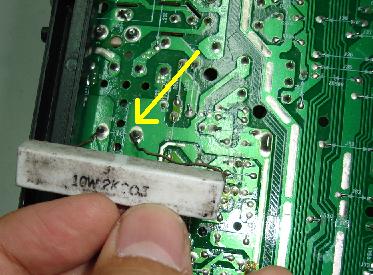
    [IMG]

    Use a resistor to discharge the capacitor leads

    Third method and also my favorite method is to place the leads of a high wattage resistor on the leads of the capacitors you want to discharge. You can use either a 1.8 k or a 2.2 kilo ohm 5 to 10 watt resistor to discharge the high voltage capacitor in a switch mode power supplies. It is very simple to use and very effective .It takes only a couple of seconds to fully discharge the capacitor.
    Using only one hand, you can do the job while the other hand you still can hold a solder gun or secure the equipment casing.

    I strongly recommend to those who are using the screw driver to discharge a capacitor in power supply to consider the second and third method as these is the safest methods. It not only protects the circuit, it also protects you. If you had discharge the capacitor and you are still not sure or no confidence whether the charge already gone, you can always use a meter to confirm it.
  16. AlbertLionheart TechSpot Chancellor Posts: 2,711

    The bigger the sticker telling you not to open the thing the more tempting it is to prove you are smart enough to ignore it. Doh!
  17. Ignoring electrical safety sometimes has tragic consequences and not knowing the details makes it difficult to pinpoint exactly what happened in this case. The main factors are current, duration and pathway.

    It is important for everyone to know that as little as 60 milliamps can kill if the current flows from the point of contact through the heart muscle on its way to ground. Large shocks tend to propel us away from the electrical source, which sometimes prevents electrocution. Small shocks typically don’t do this and we don’t let go of electrical source before a lethal shock is delivered. Sustained electrical shock even at lower currents can cause ventricular fibrillation leading to death.

    Electrical paths from arm-to-arm, or arm-to-foot are the most likely to traverse the heart and cause electrocution.

    There are many other factors such as, whether the current is AC or DC, the conductivity of the skin, whether we are perspiring, if the conductor somehow manages to puncture the skin, etc. that can come into play.

    Capacitors must always be treated with respect because the stored energy they hold can be lethal. Computer power supply capacitors normally bleed off fairly quickly, but should always be properly tested or better yet discharged by holding a screw driver by its insulated handle and then touching the metal part across the both contacts at the same time. Wearing eye protection is a good idea.

    Doing any kind of electrical work when you are alone is never a good idea.

    I hope readers find this information useful.
  18. avoidz TechSpot Enthusiast Posts: 308   +30

    Hard to say what really happened. Maybe he was a curious teenager who opened up a PSU to have a look inside or to clean it. Usually it's safe to unplug and handle a power supply unit and transplant it to another PC. I just replace them when they get too dusty.
  19. cliffordcooley TechSpot Paladin Posts: 2,279   +290

    Here is an interesting concept.

    Why does the electrical resistance of the human body varies according to the Composition of the Blood?
    An answer that was marked as the best answer. I personally don't know anything about human physiology.
    Electricity will always travel the path of least resistance. So the interesting concept here would be, was the path of least resistance using blood as a highway straight through his heart? Where the conditions in his body perfect for even the slightest of jolts to cause major continuity?