also @ TechSpot: LG Display announces 5.0-inch, 1080p AH-IPS display for smartphones

Intel and Micron begin mass-producing 20nm NAND chips

By

On December 6, 2011, 4:00 PM EST

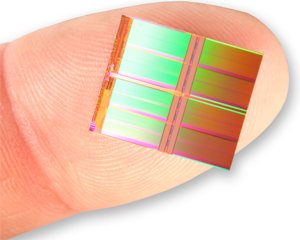
Intel and Micron have announced the development of the world's first 128Gbit (16GB) multilevel-cell NAND flash memory chip made using a 20nm manufacturing process technology that incorporates high-K metal gate transistors. Scheduled for mass production in the first half of 2012, the new NAND will enable up to a terabit (128GB) of data storage in a finger-tip size package using eight die, and it meets the high-speed ONFI 3.0 specification to achieve speeds of 333 megatransfers per second (MT/s).

Intel and Micron said that the key to their success with their 20nm process technology is a new planar cell structure, which enables more aggressive cell scaling than conventional architectures, while maintaining performance and reliability on par with previous generation NAND chips.

The joint venture also announced it is moving a 20nm 64Gb NAND flash product into mass production this month. The new 20nm 64Gbit (8GB) chip measures just 118mm2 and enables a 30% to 40% reduction in board space (depending on package type) compared to their existing 25nm 64Gbit (8GB) NAND device.

Designed for use in tablets, smartphones and high-capacity solid-state drives, the smaller 20nm NAND memory will enable manufacturers to either cram more capacity into their gadgets or use the extra space for other end-product improvements such as a bigger battery, larger screen or adding new hardware features. It should also help reduce NAND costs over time as yields reach optimal levels.

Related Stories

, , , , , ,

Related Products from Product Finder

Intel SSD 510 120GB MLC SATA600

The Intel SSD 510 drops Intel's traditional 7mm design that uses a shim to reach the 9.5mm thickness of a standard 2.5" drive. The drives casing now measures 3.92 x 2.74 x 0.37" (99.8 x 69.63 x 9.5mm) and weighs 0.18lbs (81.6 grams). It boasts read and write speeds of 450MB/s and 210MB/s. Naturally, the SATA 6Gb/s interface is essential to achieving these staggering read speeds.

10 Reviews

Intel SSD 2.5 inch X25-M G2 80GB MLC SATA300

Read expert reviews, pros/cons and product information about Intel SSD 2.5 inch X25-M G2 80GB MLC SATA300. There are 14 reviews available so far.

7 Reviews

Intel 2.5 inch 320 Series SATA300

Read expert reviews, pros/cons and product information about Intel 2.5 inch 320 Series SATA300. There are 49 reviews available so far.

18 Reviews

User Comments (5)

Post a comment
hahahanoobs
on December 6, 2011
4:04 PM

Intel can't stop, won't stop. I envy them tremendously.

Reply

Burty117
on December 6, 2011
4:10 PM

hahahanoobs said:

Intel can't stop, won't stop. I envy them tremendously.

+1

Reply

Guest
on December 6, 2011
4:46 PM

I always thought that 128Gbit is 16Gbyte, does this new technology use 16-bit bytes perhaps?

Reply

Jos
on December 6, 2011
5:11 PM

@Guest: Fixed, it's 16GB

Reply

DanUK
on December 7, 2011
11:08 AM

Incredible! Give it a few years and I can't wait to see how much they'll be able to fit into the same space.

Reply

Browse more commented news

Post a new comment

Guest user

To post as an anonymous
user click here
.

Members

If you are a TechSpot member,
please login first.


By signing up you gain complete access to the TechSpot community. Join thousands of computer and technology enthusiasts that contribute and share knowledge in our forum. Post messages, get a private inbox, upload your own photo gallery and more.

Subscribe to TechSpot

Get free exclusive content, learn about new features and tech breaking news.