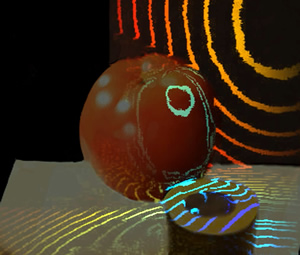
In everyday life, we take for granted how instantaneous light seems. In reality though, the photons which make up the light we see travel around 186,280 miles per second. Researchers at MIT have developed a digital camera capable of capturing data so quickly that we can actually watch light itself unfold in slow motion. Researchers claim the camera captures roughly one trillion frames per second worth of visual data, yet it still has its limits.
The camera is part high-technology and part technique. The equipment itself consists of a "streak" camera, some cleverly used mirrors and a titanium sapphire laser that generates extremely brief (ie. one femtosecond) pulses of light.
The streak camera utilizes an array of 500 sensors which capture light at an astonishing rate of one-trillion times per second. The camera was originally designed to collect information regarding wavelengths of light, a common way to determine the material composition of an object. Different molecules absorb unique wavelengths of light and reflect others. This reflected light is what we call color. Rather handily, scientists can identify molecules by analyzing their spectral density and this camera allows them to do just that.
The system relies on a recent technology called a streak camera, deployed in a totally unexpected way. The aperture of the streak camera is a narrow slit. Particles of light --- photons --- enter the camera through the slit and pass through an electric field that deflects them in a direction perpendicular to the slit. Because the electric field is changing very rapidly, it deflects late-arriving photons more than it does early-arriving ones.
The image produced by the camera is thus two-dimensional, but only one of the dimensions --- the one corresponding to the direction of the slit --- is spatial. The other dimension, corresponding to the degree of deflection, is time. The image thus represents the time of arrival of photons passing through a one-dimensional slice of space.
Because of how the camera requires multiple shots of the same exact scene, objects must remain completely still. The camera does not capture an entire scene all at once but rather, it collects one-dimensional strips of data which can be used to determine the departure and arrival of photons in the scene. This data is algorithmically compiled together to recreate a two-dimensional video with astonishing results. Unfortunately, the compilation of this data can take hours of post-processing and the process itself is impractical for use at home, making this unlikely to replace your digital video camera any time soon.
Despite of the obvious drawbacks as a consumer product, researchers claim such equipment and techniques – in the future – could allow for studio-quality lighting in virtually any environment and any light source or medical imaging. For now though, the device is useful to scientists as they are better able to study the propagation of photons on scales of speed compatible with human perception.