Home › News › Security
Google's Street View cars collect locations of Wi-Fi devices
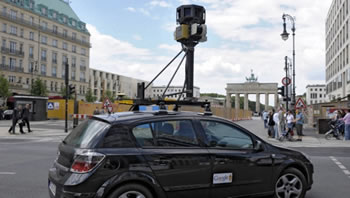
Google is back in the hot seat today following a CNET report that suggests the search giant's Street View cars collected the locations of countless Wi-Fi devices. Along with mapping Wi-Fi access points (the intended purpose), the vehicles also charted the street addresses and unique identifiers of wireless Internet devices such as laptops and smartphones -- a practice that has been confirmed by the CNIL (France's data privacy commission).
What's worse, the search giant reportedly releases that information online, and you can't opt out of it. Harvested MAC addresses and their last known coordinates are published on the company's public geolocation database for all to access. Although this isn't inherently dangerous (it's effectively just a snapshot of where your device last was, so it's not like someone can stalk you with the information), it still raises valid privacy concerns.
For instance, someone could use the data to show you were at a specific place during a specific time, and that's something you might not want to share with the world. The Internet exploded earlier this year when it was discovered that Apple's iOS devices recorded a year's worth of location data that could be mapped to show your previous whereabouts. The company later released a software update that minimized users' biggest complaints.
And of course, isn't the first time Google's Street View cars have been caught gathering more information than intended. The company faced worldwide investigations, raids and even a $143,000 fine from France after it was discovered that the company "accidentally" collected private information from Wi-Fi networks, including emails, fragments of visited websites and passwords. The US FTC dropped its Wi-Fi sniffing investigation last October.
Google has remained incredibly quiet about the latest controversy, declining CNET's requests for comment. The site asked Google more than a dozen questions on the subect over the span of several months and the search company hasn't answered many, if any of them. "It would be helpful to have some clarity about why and how (a hardware address) got in there so people can act accordingly," said security researcher Ashkan Soltani.
User Comments (9)
Post a comment|
mario on July 25, 2011 3:30 PM |
Everyone remember Google doesn't make money by selling you stuff they make money by selling you. |
|
Benny26 on July 25, 2011 4:49 PM |
"What's worse, the search giant reportedly releases that information online, and you can't opt out of it." Oh dear...Google should have its tin hat at the ready on this one. |
|
aj_the_kidd on July 25, 2011 6:47 PM |
Remember the days when we all "knew" companies were shady but didn't have any proof and were mainly just ignorant to it, I kinda miss those days. That being said this act didn't seem inherently shady, just stupid and I'm guessing a bit of a surprise. Seems like their WiFi detection software worked a little too well |
|
gwailo247 on July 25, 2011 7:32 PM |
mario said: Was Google this evil before Android or just after?
Everyone remember Google doesn't make money by selling you stuff they make money by selling you. |
|
Archean on July 26, 2011 1:29 AM |
aj_the_kidd said: It is 'designed' to work this way, so I am sure the intention was there, it smells just like the NOW case, only thing is no one will be doing any investigation to get to the bottom of it.
Remember the days when we all "knew" companies were shady but didn't have any proof and were mainly just ignorant to it, I kinda miss those days. That being said this act didn't seem inherently shady, just stupid and I'm guessing a bit of a surprise. Seems like their WiFi detection software worked a little too well |
|
aj_the_kidd on July 26, 2011 2:03 AM |
Archean said: I dont know, ive written programs which were designed and intended in one way, with a great deal of testing and then in the real world have it execute differently with real data. Whatever the case is with google be it bad design or designing with bad intentions, nothing is going to come out of this, nothing major anyway.
aj_the_kidd said: It is 'designed' to work this way, so I am sure the intention was there, it smells just like the NOW case, only thing is no one will be doing any investigation to get to the bottom of it. Remember the days when we all "knew" companies were shady but didn't have any proof and were mainly just ignorant to it, I kinda miss those days. That being said this act didn't seem inherently shady, just stupid and I'm guessing a bit of a surprise. Seems like their WiFi detection software worked a little too well |
|
Guest on July 26, 2011 7:25 AM |
Are we sure that Google's Street View cars are not run by Lulzsec? |
|
Guest on July 26, 2011 8:04 AM |
Really? This is news? I figured that was public knowledge long ago! I mean, your android phone PROMPTS YOU TO TURN ON WIFI to enhance its locating ability when you go into google maps. Also, it's just like the wardrivers of the past, driving around town with a laptop and GPS, picking up signals and cataloging their locations. I really had to check the date on this story to make sure I wasn't reading old news. |
|
Guest on July 26, 2011 10:25 AM |
This is not news. Google and Skyhook Wireless do this. This is Wifi location services using GPS coordinates paired with unique MAC address snooping. This is not new. We've had this service for years. Google needs to periodically update their Wifi/GPS database. The best way to do that is with their Street cars that travel through streets. Most likely you use this service right now with the iPhone/iPad Google maps app. |
Most Popular
| Trending | Featured |
-
HTML 5 Gaming Showcase: Old Classics and Modern Games You Can Play for Free
-
Samsung's Massive 5.3-inch Smartphone: Galaxy Note Review
-
Microsoft claims Google foils IE's privacy policies as well
-
Apple settles class action lawsuit, will pay $15 to iPhone 4 owners
-
Microsoft details Windows 8 and SkyDrive integration, Metro-style app
