also @ TechSpot: Huawei Ascend P6 smartphone is the thinnest in the world at 6.18mm

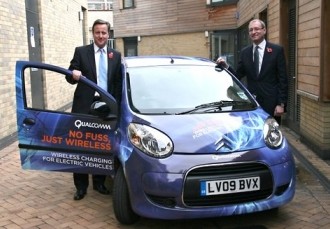
Qualcomm teams up with Renault to trial wireless electric car charging

By Lee Kaelin

On July 25, 2012, 4:30 PM

Qualcomm announced a new partnership yesterday with French carmaker Renault to begin field trials of its revolutionary wireless electric vehicle charging (WEVC) technology, which if successful could lead to a wider adoption of all-electric vehicles along with various potential uses in other markets. Despite its appeal among environmentally-minded individuals, drawbacks such as a lack of widespread charging stations has stifled growth. WEVC could change that.

In some respects it echoes the joint effort between Samsung and Qualcomm to create a wireless charging standard, but on a much grander scale, the latest venture highlights Qualcomm's continued push into wireless charging technologies following its purchase of leading wireless car charging firm HaloIPT last November.

Qualcomm's technology utilizes a concept involving inductive power transfer with two coils tuned to create a magnetic field to "move" the power from one location to another. For a vehicle to be wirelessly charged, it requires a charging mat embedded in the ground and a receiver installed on the underside of the vehicle. When the vehicle is parked above the "mat," it's charged. By having a wireless charger at work and another on your driveway, it would be possible to keep the battery packs continuously topped up.

"The system will magnetically optimize the connection, so it doesn't matter if you are slightly askew while charging or terrible at parking your car like me," said Andrew Gilbert, executive vice president of European innovation development at Qualcomm, speaking to the NY Times. "This makes the system easy to use and easy to fit."

"Delta Motorsport has developed an advanced passenger EV that is a good platform to demonstrate our Qualcomm Halo Wireless EV Charging in pre-commercial deployments. Delta brings high-performance automotive engineering design to the London WEVC trial and the Delta E-4 Coupe displays technology at the cutting edge of EV innovation," said Qualcomm Europe vice president of business development and marketing Anthony Thomson.

The company will start its trial in London later this year to evaluate the commercial viability of WEVC.

, , , , ,

User Comments: 39

Got something to say? Post a comment
  1. No it's a Citron, hence the Citron badge on the front of the car.

  2. What is rubbish is your ignorant comments. There is indeed a mechanism invented and patented by Curtis Birnbach working jointly with Kappenman, who not long ago authored a IEEE paper on the subject.

    Can you not understand what zoltan keeps telling you? A mechanism that could cause meltdown just because the grid failed does not exist, it is plain english, he is not talking about some machine you tree hugger!

    For pity's sake READ the other posts instead of just vomiting your one line of nonsense!

  3. Can you not understand what zoltan keeps telling you? A mechanism that could cause meltdown just because the grid failed does not exist, it is plain english, he is not talking about some machine you tree hugger!

    For pity's sake READ the other posts instead of just vomiting your one line of nonsense!

    Absolutely! (but perhaps not in those exact words)

  4. Both he and you happen to be mistaken. But, of course you will never believe that. A meltdown is entirely possible with grid failure.

  5. Both he and you happen to be mistaken. But, of course you will never believe that. A meltdown is entirely possible with grid failure.

    If so, why do you persistently refuse to describe the mechanism by which it could happen? It is pointless to reiterate the same old statement without any backup!

    Perhaps we could just take turns to say "Is!" "Isn't!" "Is!" "Isn't!" "Is!" "Isn't!" etc.

  6. Yes Mark, it would help all the scientists out here if you explained your assertion instead of merely repeating it ad nauseam?

  7. Guys, Marky is obviously trolling - typing provocative crap that he can't back up, and waiting for everyone's blood pressure to max out! He doesn't believe the fairy-tales either! Ignore the ***** ;-)

  8. "Unfortunately, the world's nuclear power plants, as they are currently designed, are critically dependent upon maintaining connection to a functioning electrical grid, for all but relatively short periods of electrical blackouts, in order to keep their reactor cores continuously cooled so as to avoid catastrophic reactor core meltdowns and spent fuel rod storage pond fires.

    If an extreme GMD were to cause widespread grid collapse (which it most certainly will), in as little as one or two hours after each nuclear reactor facility's backup generators either fail to start, or run out of fuel, the reactor cores will start to melt down. After a few days without electricity to run the cooling system pumps, the water bath covering the spent fuel rods stored in “spent fuel ponds” will boil away, allowing the stored fuel rods to melt down and burn [2]. Since the Nuclear Regulatory Commission (NRC) currently mandates that only one week's supply of backup generator fuel needs to be stored at each reactor site, it is likely that after we witness the spectacular night-time celestial light show from the next extreme GMD we will have about one week in which to prepare ourselves for Armageddon.

    To do nothing is to behave like ostriches with our heads in the sand, blindly believing that “everything will be okay,” as our world inexorably drifts towards the next naturally recurring, 100% inevitable, super solar storm and resultant extreme GMD. The result of which in short order will end the industrialized world as we know it, incurring almost incalculable suffering, death, and environmental destruction on a scale not seen since the extinction of the dinosaurs some 65 million years ago."

    Extract from Dire Warnings on the Aesop Institute website. Article is by Matthew Stein, title: 400 Chernobyls

  9. And more later in the same article:

    "Most ofus tend to believe that a nuclear reactor is something that can be shut down in short order, like some massive piece of machinery that can be turned off by simply flipping a switch, or by performing a series of operations in a prescribed manner over a relatively short time, such as a few hours or perhaps a day or two. In spite of my MIT education (BSME, MIT, 1978), until recently I too was under the spell of this comforting delusion, which is far from the truth. You see, the trillions of chain reactions going on inside a nuclear reactor's core continuously produce such incredible amounts of energy that a single nuclear power plant can generate more electricity than is required to power a good sized city. Unfortunately, these reactions do not simply “cease fire” at the flip of a switch. In general, it takes 5 to 7 days to slow down a reactor core's nuclear chain reactions to the point where the core may be removed from the reactor.

    After removal, the fuel rods are quite “hot”, both from the perspective of temperature and radioactivity. For the next 3 to 5 years these fuel rods must be immersed under roughly 20 feet of continuously cooled water, both to shield the surrounding area from radioactivity, as well as to prevent catastrophic melt-down from occurring. According to Gundersen, after slowing down the chain reactions inside the reactor cores at Fukushima for a full eight months, the fuel rods would start melting down again if coolant flow was suspended for just 38 hours.

    Gundersen explained that, essentially all modern nuclear reactors are designed with banks of "fuel rods", which contain highly radioactive materials, combined with banks of "control rods", which mesh between the fuel rods like the interwoven fingers of your right and left hands. It is the degree of interweave that moderates and controls the rate of nuclear chain reactions. He further explained that in the event of a significant loss of reactor control, reactors are designed for a "fail-safe" process to occur, where the control rods automatically fall into the fully meshed position with respect to the fuel rods, resulting in maximal slowing of the core's nuclear reactions and beginning the process of shutting down the reactor.

    Typically, this action rapidly reduces the power produced by these chain reactions by a factor of 20:1 (to 5.0 per cent of full power), but that still leaves thousands of horsepower worth of waste heat that must be removed if the reactor core is not to rapidly overheat and fail catastrophically. After a day of leaving the control rods in the fully interwoven position, this reaction slows to 1.0 per cent, and after a week it will be about 0.1 per cent of full power. Once the reactions in the fuel rods slow to the point where the rods may be removed from the reactor, the spent fuel rods must be cooled inside containment ponds for 3?5 more years before the nuclear reactions decay to a point where the rods can be moved to specially designed air-cooled storage banks.

    As mentioned previously, nuclear power plants are only required to store enough backupfuel reserves on-site to keep their backup diesel generators running for a period of one week. The NRC has always operated from the assumption that extended grid “blackouts” would not last for periods of more than a few days. The government has promised that, in the event of a major catastrophe such as a Hurricane Katrina, diesel trucks will show up like clockwork at all troubled nuclear facilities until local grid-supplied electrical power services have been re-established. Unfortunately, governments and regulators have not considered the possibility that the next extreme GMD which Mother Nature unleashes upon Earth will quite likely disrupt grid services over much of the industrial world for a period of years, not just days. The chances that the world's nuclear reactors will receive weekly deliveries of diesel fuel under such chaotic circumstances are practically zero. In a world suffering from loss of fuel and electric power, if any such deliveries were attempted those fuel tankers would be prime targets for armed hijackers."

  10. Gundersen explained that, essentially all modern nuclear reactors are designed with banks of "fuel rods", which contain highly radioactive materials, combined with banks of "control rods", which mesh between the fuel rods like the interwoven fingers of your right and left hands. It is the degree of interweave that moderates and controls the rate of nuclear chain reactions. He further explained that in the event of a significant loss of reactor control, reactors are designed for a "fail-safe" process to occur, where the control rods automatically fall into the fully meshed position with respect to the fuel rods, resulting in maximal slowing of the core's nuclear reactions and beginning the process of shutting down the reactor.

    That's part of the mechanism explaining how you're wrong - still nothing to SUPPORT what you've been endlessly reiterating?

  11. I'm inclined to agree with guest a couple of days ago -

    Guys, Marky is obviously trolling - typing provocative crap that he can't back up, and waiting for everyone's blood pressure to max out! He doesn't believe the fairy-tales either! Ignore the ***** ;-)

    This guy obviously just wants to cut and paste articles without reading them, we're meant to go "Ooh, isn't he profound!" so if you actually read it and say why it's wrong, he's confused and annoyed, and just pastes some more!

    I'm adding him to ignore list (he's obviously a grade A wind-up specialist), unwatching the thread (which has been forgotten anyway!), suggest you all do same!

  12. Since Arnie Gunderson has called Aesop Institute to confirm what appears on our website, small bits of which I have quoted, I suggest you go to his website at Fairewinds.org and learn how dangerous he sees these unrecognized problems to be. Arnie has decades of experience in the nuclear industry and has become a whistleblower once he realized some of the little recognized hazards. ENENews has his most recent interview with Dr. Helen Caldicott regarding the continuing hazards at Fukushima.

  13. @Mark Goldes:- Why not shut up if you can't be bothered to read the other's posts?

    You haven't even responded to the OP!!

  14. Mark Goldes:- Why not shut up if you can't be bothered to read the other's posts?

    You haven't even responded to the OP!!

    Very true! I'm following the advice of Zoltan above, I'm bored with Mark the Ctrl+V enthusiast!

Recently commented stories

Add New Comment

TechSpot Members
Login or sign up for free,
it takes about 30 seconds.
You may also...
Get complete access to the TechSpot community. Join thousands of technology enthusiasts that contribute and share knowledge in our forum. Get a private inbox, upload your own photo gallery and more.
TechSpot on:

Subscribe to TechSpot

Get free exclusive content, learn about new features and breaking tech news.