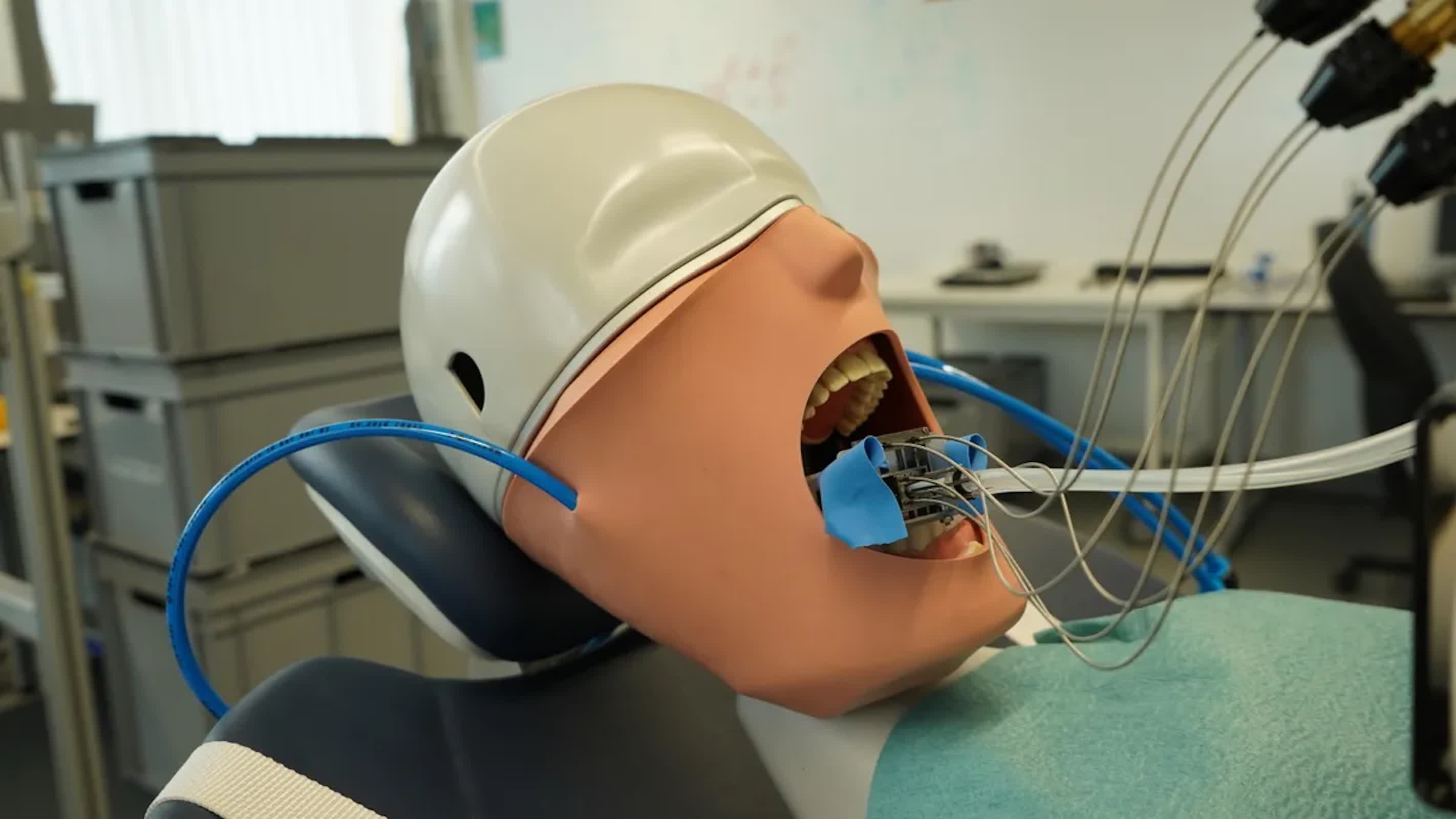
First look: Researchers at the University of Basel are developing a small robotic device to automate parts of the crown-preparation process. The system, called the Miniature Intraoral Robot (MIR), is designed to sit in a patient's mouth and assist with drilling when a tooth is being prepared for a crown. Instead of relying entirely on handheld tools, the robot takes over part of the process, aiming for more precise, repeatable tooth preparation and a shorter overall treatment.
Getting a crown usually takes several visits. A dentist first prepares the tooth, then fits a temporary crown, and later replaces it with a permanent one. The MIR is meant to reduce the number of appointments patients need. In theory, a dentist could scan the patient's mouth and order a permanent crown during the same appointment in which the tooth is treated.
The device is divided into parts that sit inside the mouth and parts that remain outside. The part that operates inside the mouth is small enough to fit comfortably in place, while larger elements like the motor and control systems stay outside. They're linked by cables and a drive shaft that carry motion to the drill, much like how a car's drivetrain carries power from the engine to the wheels.
To keep everything stable, the robot is attached to a custom dental splint that fits over the patient's teeth. That splint keeps the robot aligned with the tooth it's working on. If the patient moves their head, the robot moves with it, helping maintain accuracy during the procedure.
So far, the MIR has only been tested in the lab on synthetic resin tooth models and ceramic materials with enamel-like hardness, not in real patients. The early tests assessed how precisely the robot can drill and how much force it exerts, with the aim of keeping the cutting confined to the planned tooth surface.
The research team is still refining the technology. One of the next steps is adding sensors and a camera so the robot can track its position in real time. That would allow it to maintain accuracy throughout a procedure and recover its position if something interrupts the process, such as a power loss.
The project sits within a growing field of medical robotics that targets tasks needing very high precision, such as dental work and microsurgery.
The MIR is still in development and not ready for use on patients. If it eventually clears testing and clinical trials, the system could streamline crown preparation, potentially reducing follow-up visits and shifting some of the drilling work from the dentist to the robot.