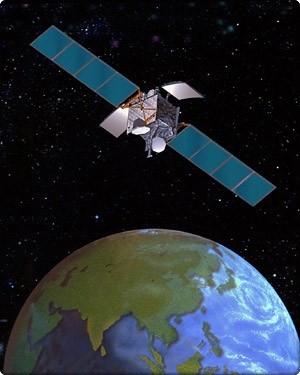
Unwilling to comply with the entertainment industry's utopian vision of the Internet, a team of hackers plans to launch its own communication satellites into space. Detailed at the Chaos Communication Congress in Berlin, the Hackerspace Global Grid (HGG) wants to send at least one satellite into low orbit to communication with various ground stations, creating an independent network.
"The first goal is an uncensorable Internet in space. Let's take the Internet out of the control of terrestrial entities," said activist Nick Farr. The team expects have three prototype ground stations deployed in the first half of 2012, with future devices to be produced and sold on a non-profit model. It's estimated that each ground station will cost about €100 (equal to approximately $130 or £84).
"It's kind of a reverse GPS," explained Armin Bauer, an HGG participant. "GPS uses satellites to calculate where we are, and this tells us where the satellites are. We would use GPS coordinates but also improve on them by using fixed sites in precisely-known locations." Although the ground stations sound relatively cheap and simple to build, getting a satellite into space isn't so straightforward.
For starters, HGG's satellites would have to hitch a ride into space on a pricey rocket – balloon-based solutions are affordable but imprecise. However, even with a whole array of satellites strategically placed in orbit, they wouldn't always be visible to tracking devices. In other words, links between ground stations and the satellites would be spotty, according to Professor Alan Woodward.
Woodward says current examples of low orbit amateur satellites orbit every 90 minutes. "That's not to say they can't be used for communications but obviously only for the relatively brief periods that they are in your view. It's difficult to see how such satellites could be used as a viable communications grid other than in bursts, even if there were a significant number in your constellation."
HGG's venture is an offshoot of a larger aerospace endeavor with an ambitious 23-year goal of putting an amateur astronaut on the moon. Given the magnitude of that undertaking, it's natural that smaller projects are unfolding along the way. In addition to ground stations, HGG is developing new space-resilient electronics along with vessels to escort said electronics out of the atmosphere.
Along with the controversial Stop Online Piracy Act in the US, many other nations are clamping down on the Web. In the last week alone we've seen reports about SOPA-like legislation passing in Spain, while the Republic of Belarus has made it illegal for its citizens to access foreign sites – especially for commercial purposes. Violations are a misdemeanor punishable by up to a $125 fine.