
Forward-looking: Researchers at Japan's RIKEN Center for Quantum Computing have developed a new amplifier capable of detecting the faint signals emitted by qubits with almost no added noise, marking a major step toward larger and more reliable quantum computers. Their design centers on a device known as a Josephson traveling-wave parametric amplifier (JTWPA), which amplifies extremely weak microwave signals from superconducting qubits while keeping added noise close to the theoretical minimum allowed by quantum physics.
It is a crucial component in superconducting quantum architectures, where even minimal noise can overwhelm a qubit's delicate state. In conventional designs, energy losses in dielectric materials have been a primary source of excess noise, adding more than a photon's worth during amplification and blurring qubit measurement results.
To address this, the RIKEN group, led by Sandbo Chang and Yasunobu Nakamura, redesigned the JTWPA's core geometry. Their approach eliminates lossy dielectric materials and replaces the standard waveguide with a spiraled "fishbone" structure. This tapered configuration allows the signal to propagate as a traveling wave while significantly reducing unwanted losses.
Simulations indicated that the new structure could suppress much of the noise that has long constrained the technology, and the team's experiments confirmed those predictions. The prototype achieved a measured noise level of 0.68 quanta – only slightly above the quantum limit of 0.5 quanta imposed by the laws of physics for any phase-preserving amplifier.
The breakthrough, reported in Physical Review Applied, positions the JTWPA as a leading candidate for large-scale integration in 100-qubit systems and beyond.
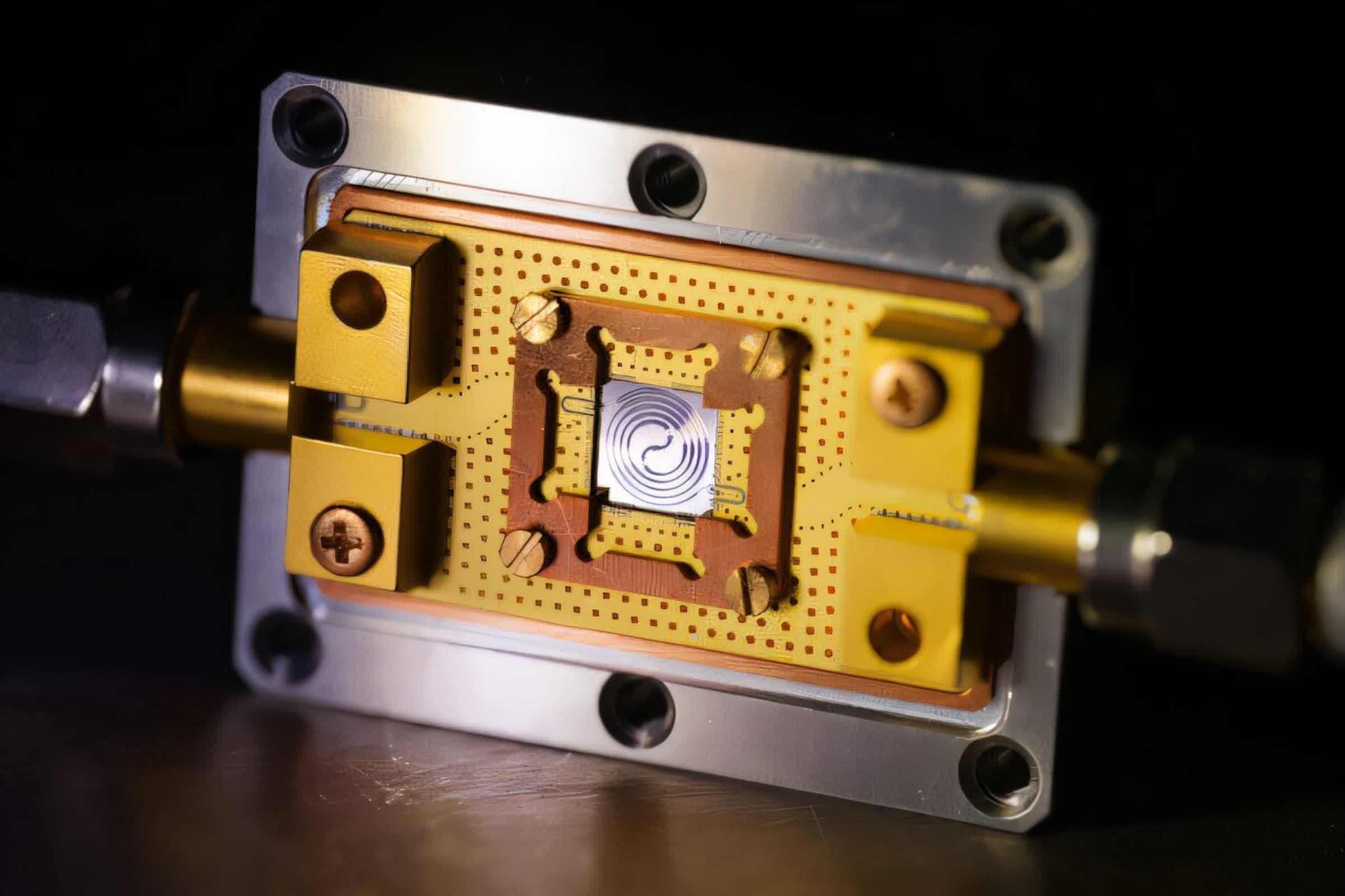
Beyond pushing the boundaries of precision, the work offers a practical advantage. The researchers deliberately avoided exotic materials and complex fabrication steps. According to Nakamura, the design remains compatible with standard superconducting qubit manufacturing workflows, meaning most laboratories that already produce such devices can replicate the results using existing tools.
In a field where quantum gains often hinge on nanoscopic refinements, cleaner amplification can have ripple effects across the entire computational stack. Amplifiers that approach the quantum noise floor enable faster, more reliable readouts of multiple qubits simultaneously – a key requirement for scaling quantum processors.
With the fishbone waveguide now demonstrating that such fidelity is achievable, attention shifts from theoretical optimization to production-level deployment. If superconducting quantum computers ultimately transition from controlled research platforms to practical systems, it may be because engineers learned to detect the faintest signals with unprecedented clarity.