
AI Data Bubble: After bringing the first true HAMR drives to market, Seagate is now further advancing its next-gen magnetic storage platform. The new "Mozaic 4+" drives are already here, with massive data hoarding capacities and a specific focus on AI workloads for enterprise customers.
Seagate introduced the Mozaic 3+ platform in 2024, turning the heat-assisted magnetic recording (HAMR) dream into a real product for customers in need of massive storage capacities. The HDD maker is now introducing the next-generation Mozaic 4+ drives, which offer capacities up to 44TB.
The US corporation originally known as Shugart Technology is partnering with two unnamed cloud providers working at hyperscale levels. Seagate said that the Mozaic 4+ drives have been qualified and are now in production, shipping in volume to its first clients. Broader availability for other hyperscalers – as well as lesser customers – should arrive sooner rather than later.
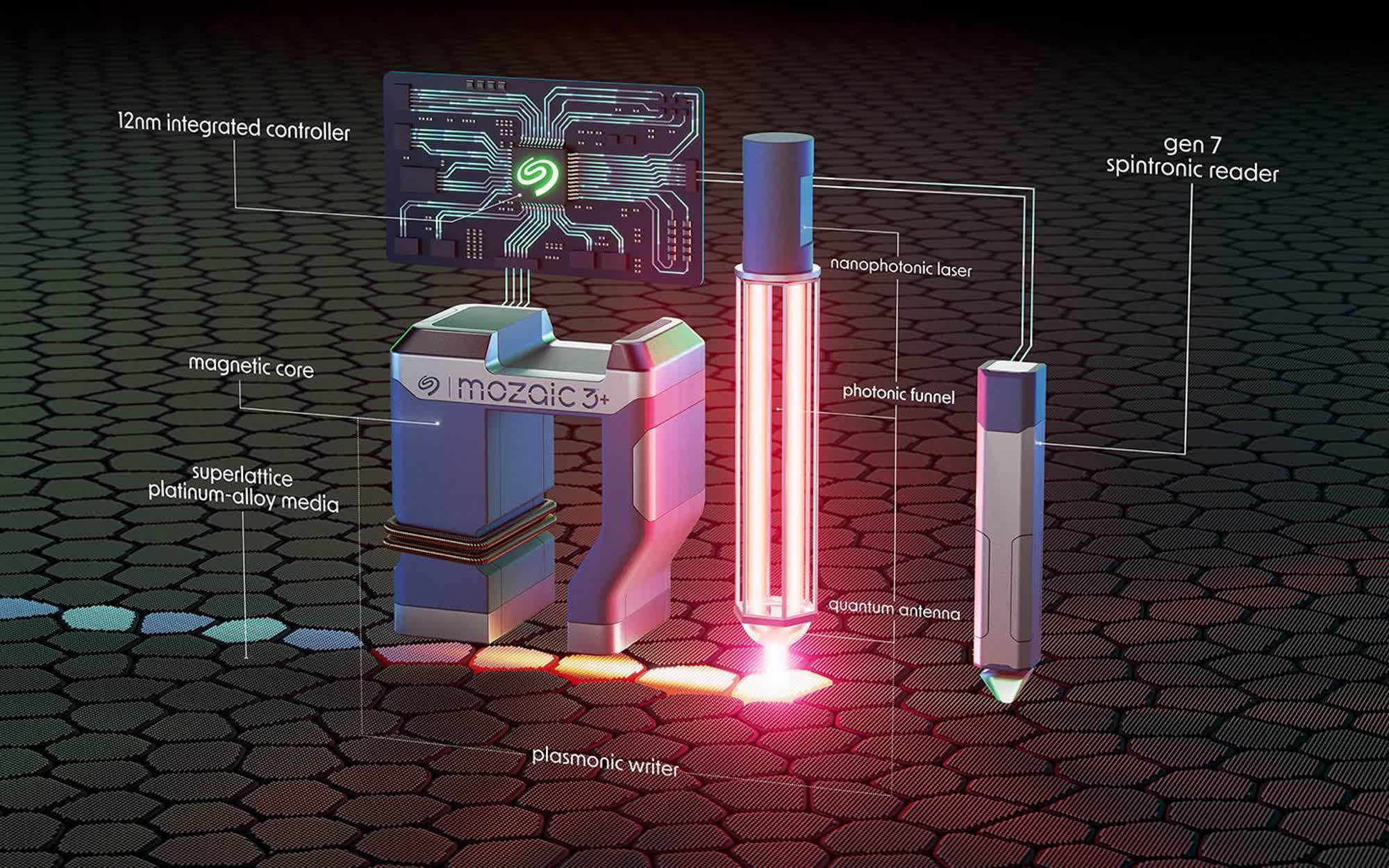
Mozaic 4+ drives are an incremental evolution of the Mozaic 3+ platform, with further improvements in efficiency, reliability, and storage capacity. Seagate explained that when deployed at one exabyte of capacity, the new hard disk drives should improve infrastructure efficiency by around 47% compared to a "standard" 30TB configuration. Seagate said Mozaic 4+ can reduce the footprint of a data center installation by 100 square feet, lowering the annual energy consumption by 0.8 million kilowatt-hours.
This kind of energy efficiency can have a significant impact when dealing with AI-scale operations, providing measurable economic savings. Mozaic 4+ has been specifically designed to benefit hyperscale players and AI data centers, which are, of course, the only meaningful goal almost all technology corporations are focused on right now.
Data is once again an extremely valuable asset, Seagate CEO Dave Mosley said, because extremely large data volumes are now required to train and operate chatbots, military systems, and other complex LLM ventures. High-capacity hard disk drives such as Seagate's HAMR units are an essential element in these new data-hungry efforts.
HAMR technology uses a laser diode embedded in the drive's read/write heads to quickly heat a small spot on the recording platter. This highly localized, sub-nanosecond heating process increases the data density for storing additional digital bits. Western Digital is also working on its own HAMR drives, although the company still describes the technology as a future endeavor.
While WD tries to tackle the "complex and challenging" HAMR technology, Seagate is accelerating the Mozaic + roadmap. The storage company is working to push data density to up to 10TB per platter, and is already envisioning hard disk drives that can hold up to 100 terabytes per drive. Enterprise-class reliability should match today's products. Meanwhile, consumers are struggling to find new HDDs to buy because AI corporations have managed to purchase the whole supply chain.