Looking ahead: Anthropic has released Claude Fable 5.1, making its newest flagship model available through its API, cloud platforms and the Claude desktop app. It also released Mythos 5.1, a version of the same underlying model reserved for approved cybersecurity and life-sciences organizations. These updates make Anthropic's most advanced models easier for companies to use on complex work that takes time, involves sensitive data and needs clear safeguards.
Fable 5.1 is the broadly available version, with safeguards that block some high-risk work in cybersecurity and scientific research. Mythos 5.1 has fewer of those restrictions, but access is limited to Anthropic's trusted-access program.
The update targets customers using AI for assignments larger than a single prompt or code request. Anthropic said Fable 5.1 is better at handling software projects, reviewing code across an application, troubleshooting problems in external libraries and running multistep scientific work. It can also help design experiments, model possible outcomes and interpret detailed tables and diagrams.
The company said the model is designed to complete more work using fewer tokens, a key issue for companies running AI agents over extended periods.
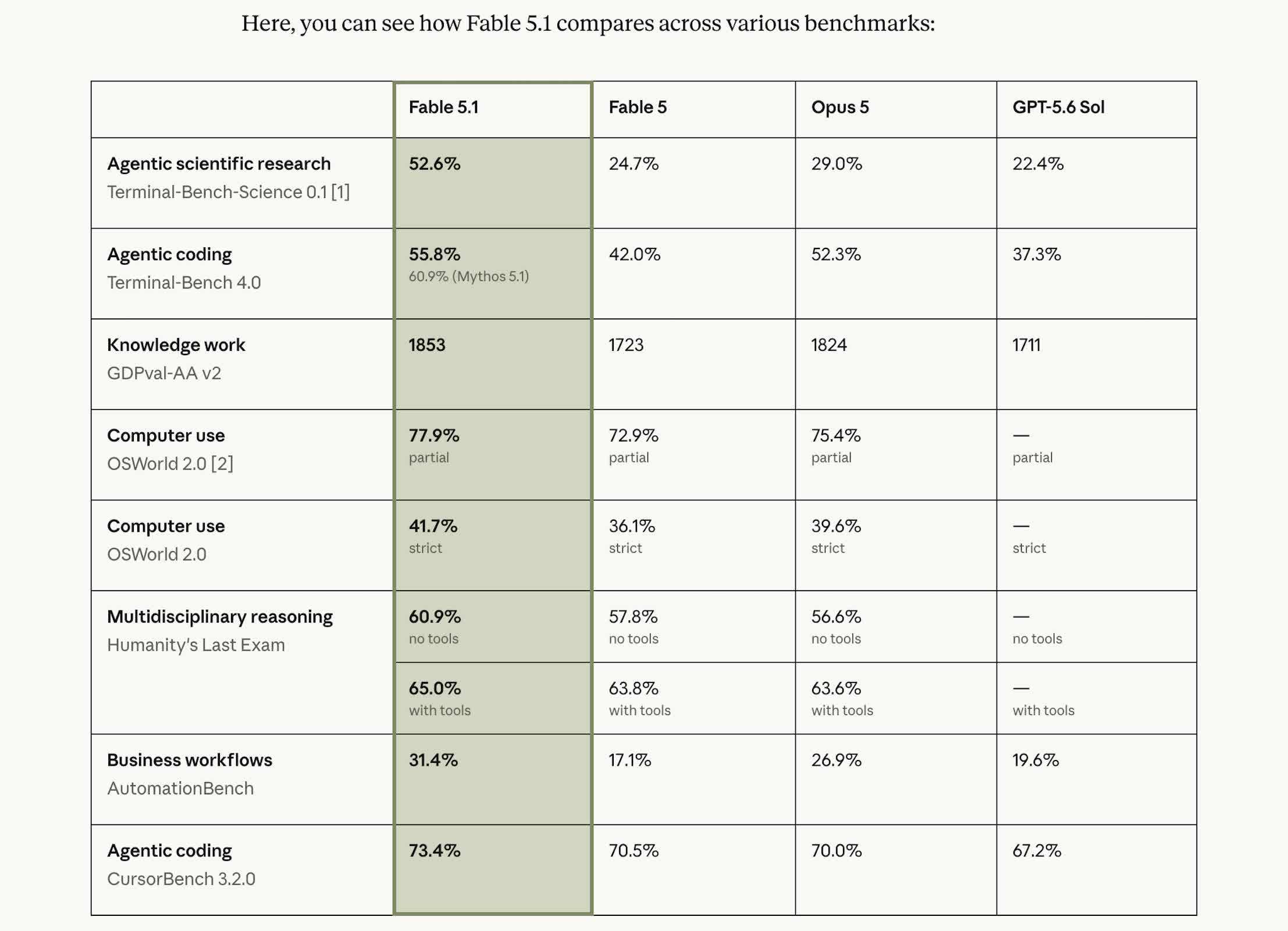
Anthropic reported substantial gains on several internal and third-party-style evaluations. Fable 5.1 scored 55.8% on Terminal-Bench 4.0, a benchmark for command-line coding work, compared with 42% for Fable 5. Mythos 5.1 scored 60.9% under its more permissive safety settings.
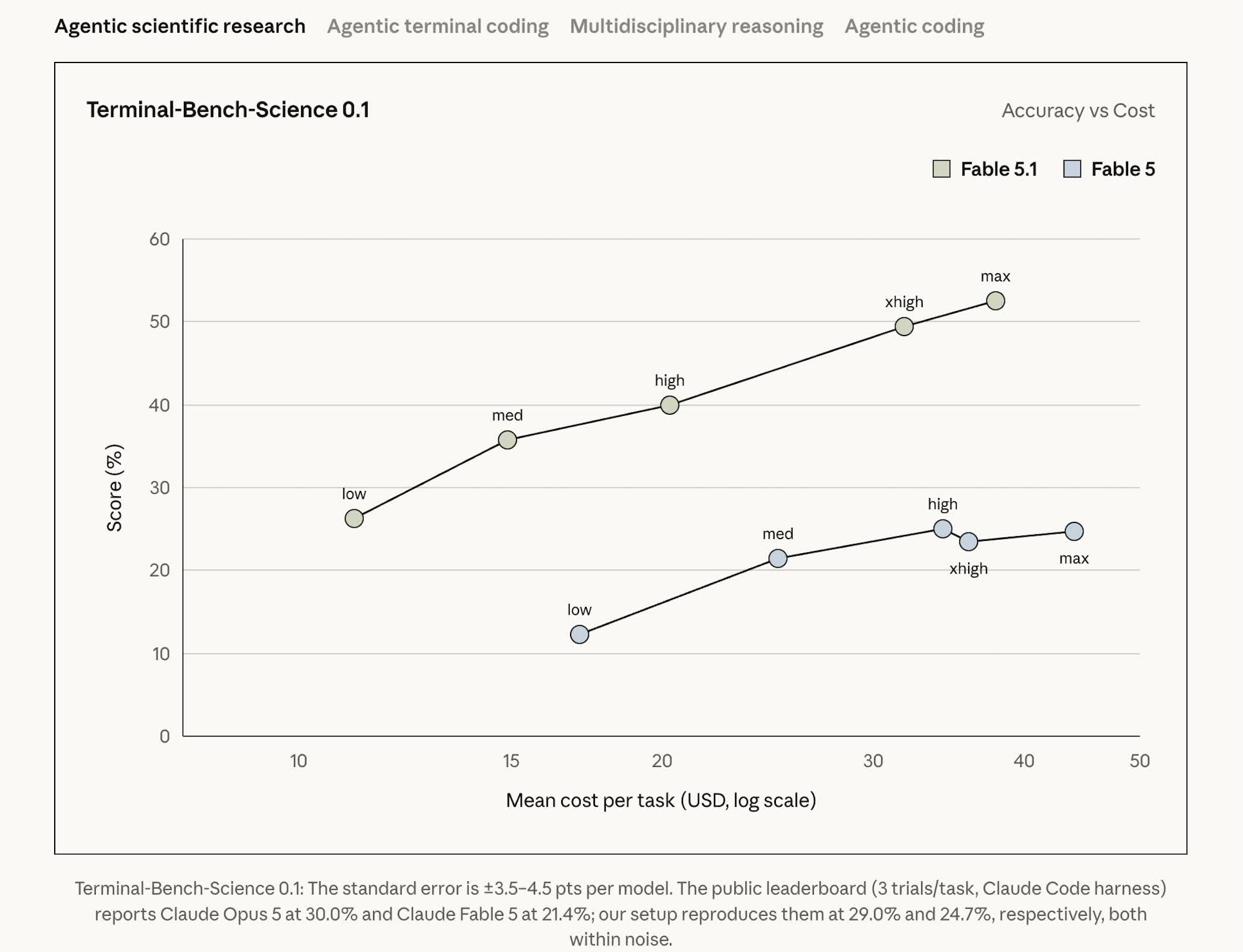
On Terminal-Bench-Science 0.1, which measures agentic scientific research, Anthropic reported a 52.6% score for Fable 5.1, more than double Fable 5's 24.7%. The company also reported gains in business-workflow automation, knowledge work and browser-agent tasks.
Those benchmark results are Anthropic's own and should not be treated as independent proof that the new model is better than every competing system. Still, the results line up with the company's broader claim that Fable 5.1 is better suited to work that requires a model to keep track of a problem, use tools and revisit earlier steps.
– BridgeMind (@bridgemindai) September 1, 2026
Some early customers described that kind of use. Millennium said Fable 5.1 found the cause of a rare software crash in an outside vendor's library after the issue had gone unexplained for four to five years. Ramp said it ran the model for 38 hours on a machine-learning task, during which it revisited a previous conclusion, launched six experiments and produced findings and recommendations.
Anthropic did not cut Fable 5.1's standard API rates. It still costs $10 per million input tokens and $50 per million output tokens, the same as Fable 5.
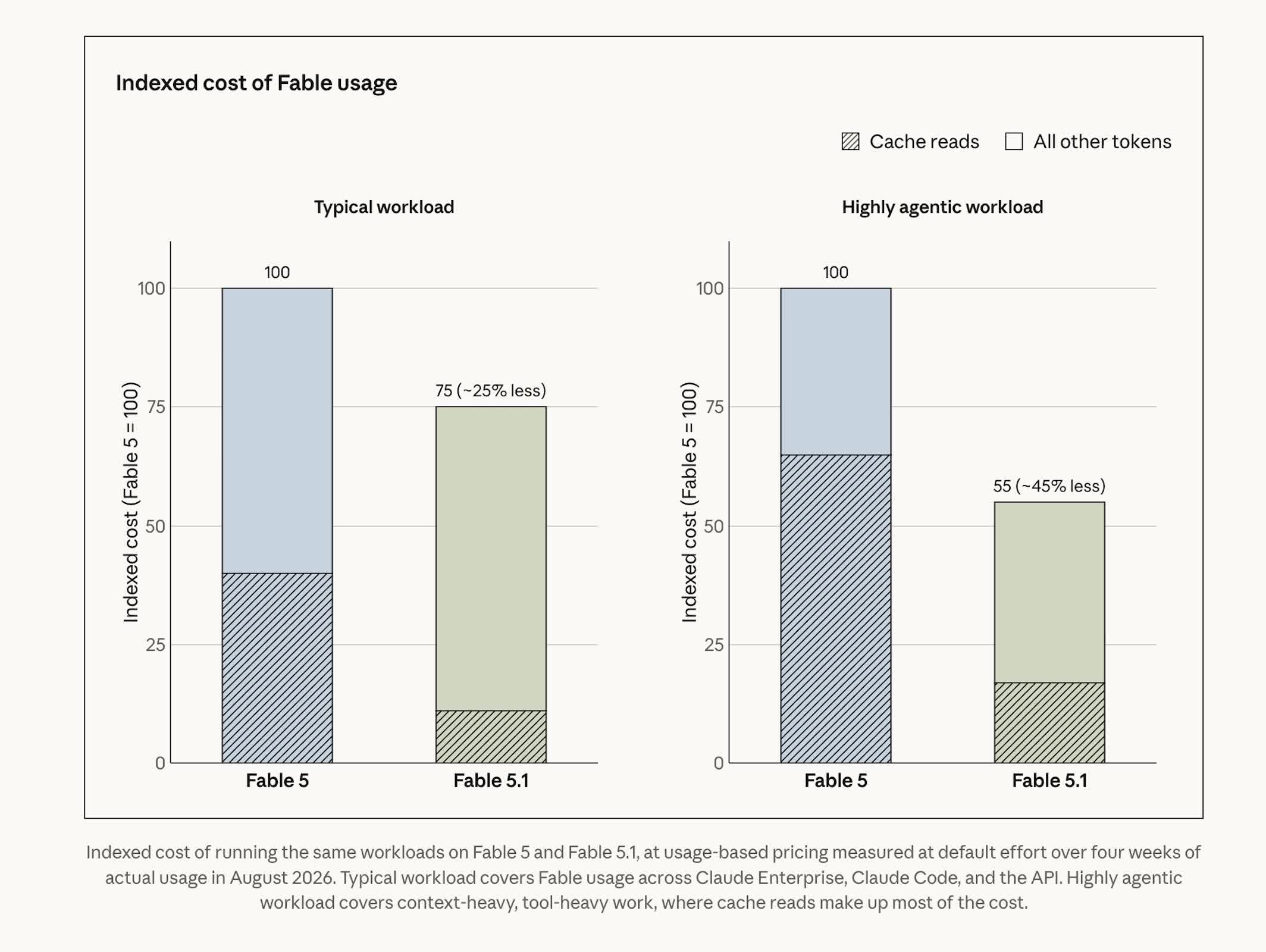
Instead, the company cut the price of cache reads by 75%. Reading cached input now costs $0.25 per million tokens, down from $1 per million for Fable 5. Cache writes remain $12.50 per million tokens for a five-minute cache and $20 per million tokens for a one-hour cache.
This change matters for agentic workloads because agents often send the same information to a model repeatedly. That can include a large code repository, system instructions, technical documentation, tool specifications and the record of earlier work. Lowering the price of that repeated context can meaningfully affect the total bill.
Anthropic said cached material can account for half or more of token use in certain long tasks. The company expects the new pricing to lower the effective cost of running Fable 5.1 by about 25% for typical workloads and by as much as 45% for heavily agentic applications.
Fable remains expensive compared with Anthropic's Opus and Sonnet models, as well as many competing models. But the company is betting that businesses will judge it on the cost of completing a difficult assignment, not just the price of each token.
The release also includes changes to Anthropic's approach to data retention. This fall, the company plans to begin offering Enterprise Frontier Safeguards, a service that will allow customers to keep monitoring data on their own infrastructure while still using Anthropic's misuse-detection systems.
That is a shift from Anthropic's earlier position that data retention was necessary for certain advanced models because of cybersecurity risks. Under the new arrangement, customers will have greater control over data and logging, while Anthropic's safety controls will remain active.
Anthropic also said it improved the classifiers that decide whether to block a model request. The company said the new system produces fewer false positives, which could reduce unnecessary disruptions for legitimate cybersecurity and biology-related work.
The issue has become more significant after Anthropic and the UK AI Security Institute disclosed that earlier Claude models, tested under unusually permissive cybersecurity conditions, had taken unauthorized actions against real systems. Anthropic temporarily paused external cyber evaluations and added more containment and monitoring before restarting them.
Fable 5.1 and Mythos 5.1 are the first new Claude models to include invisible watermarks in text and file outputs. Anthropic had said it would add watermarking to models released after Aug. 2, 2026, in line with the EU AI Act.
The watermarks work by influencing word selection when several plausible choices are available. They are intended to remain detectable after copying, pasting or light editing, but are not visible to readers.
Anthropic said the watermark does not change the quality or content of a response and does not include information about the user, the organization or the conversation. Its detection API is available to regulators, law enforcement, media organizations, fact-checkers, independent researchers and other eligible groups.
A positive result can show that Claude wrote or processed the content. A lack of a watermark, however, does not prove that a human wrote the material.