A little background
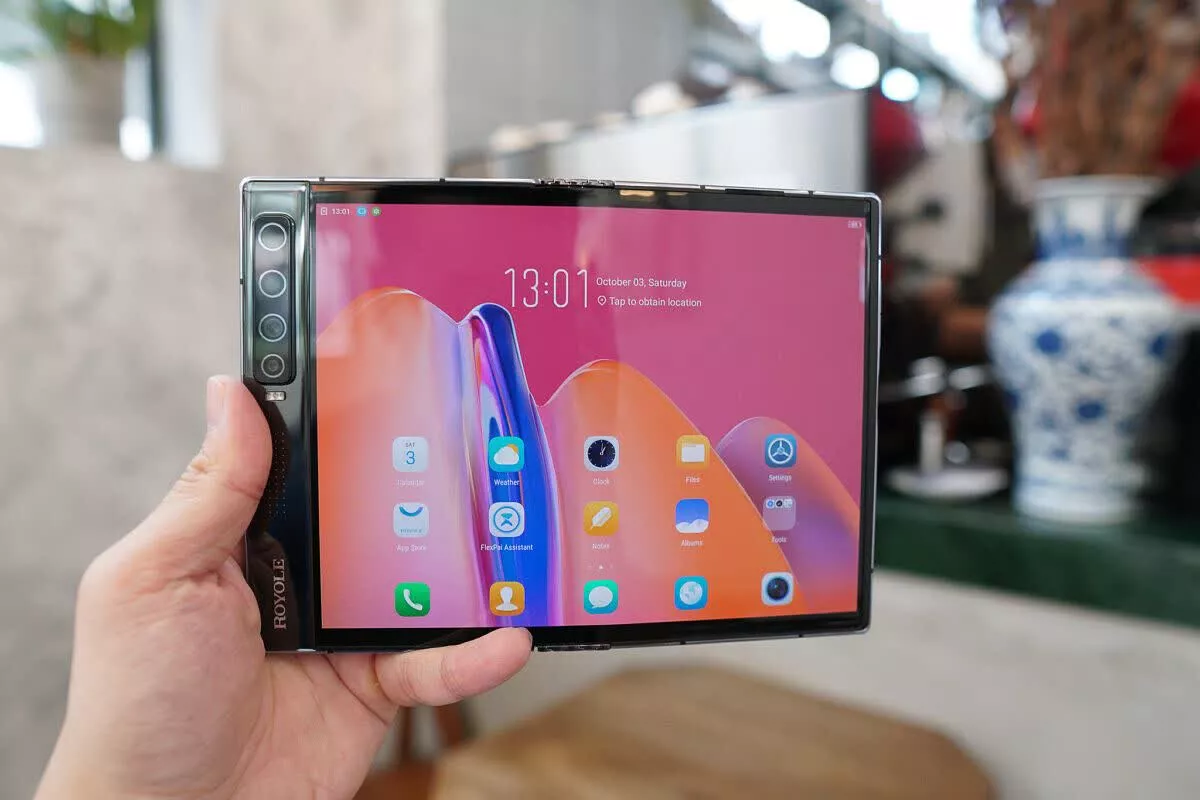
Ask most people to name the first folding-screen device and they will say Galaxy Fold. The real answer is a phone almost nobody outside China ever held: the Royole FlexPai, unveiled in Beijing on October 31, 2018, sold in a flash sale the following day, and shipped to buyers that December.
Royole was not a phone company. It was a Silicon Valley and Shenzhen display manufacturer that had been building ultra-thin flexible AMOLED panels since 2012, and the FlexPai existed largely to prove those panels could ship in a real product before Samsung Display or BOE beat it there.
The first consumer gadget with a foldable display wasn't made by Samsung
The spec sheet was serious enough: a 7.8-inch AMOLED at 1,920 x 1,440 in a 4:3 ratio, folding down to roughly 4 inches of usable screen, a Snapdragon 855, 6GB or 8GB of RAM, dual 16MP and 20MP cameras, and a hinge Royole rated for 200,000 folds. Pricing ran from 8,999 to 12,999 yuan, about $1,300 to $1,870 at the time.
It was also, by every account, rough. The FlexPai folded outward rather than inward, so the display was permanently exposed. It closed unevenly, leaving a visible wedge and a pronounced crease. Royole's Android 9 skin called "Water OS" frequently failed to reflow the UI when the device changed shape. Reviewers treated it as a proof of concept that had been rushed to market to win a race, which is exactly what it was.
Other early foldables...
Samsung's Galaxy Fold was announced in February 2019 and was supposed to arrive that April, but review units died within days after debris entered the hinge and testers peeled off what looked like a screen protector.
The relaunch finally happened on September 2019, in South Korea. Huawei's Mate X, revealed at MWC 2019 alongside a similar outward-folding design, slipped repeatedly and went on sale only in China on November 2019.
The ZTE Axon M was the trickiest distractor for our trivia. It shipped in October 2017, a full year before the FlexPai, and it folds. But it uses two separate rigid LCD panels joined by a mechanical hinge, with a thick seam down the middle, which makes it a dual-screen phone rather than a foldable-display one.
Flexible OLED reached consumers even earlier, in the curved Samsung Galaxy Round and LG G Flex of 2013, but those panels bent once at the factory and never moved again. A screen that folds and unfolds in the user's hands started with the FlexPai.