Cutting corners: A new survey offers a detailed look at how GenAI is transforming the daily work of software developers. The results reveal a clear divide: seasoned engineers are more likely to rely heavily on AI-generated code, take on the task of correcting it, and still view it as a net time-saver. In contrast, junior developers appear more cautious, adopting AI tools at a slower pace and reporting fewer gains in efficiency.
A new survey from cloud platform Fastly shows that an increasing number of experienced developers are not only generating substantial amounts of code with AI tools but are also deploying that code to production at significantly higher rates than less experienced engineers.
In the poll of 791 professional developers, nearly one-third of senior engineers, defined as those with 10+ years of experience, reported that over half of the code they ship is AI generated. That figure is more than double the rate among junior developers with two years of experience or less, only 13% of whom reported the same.
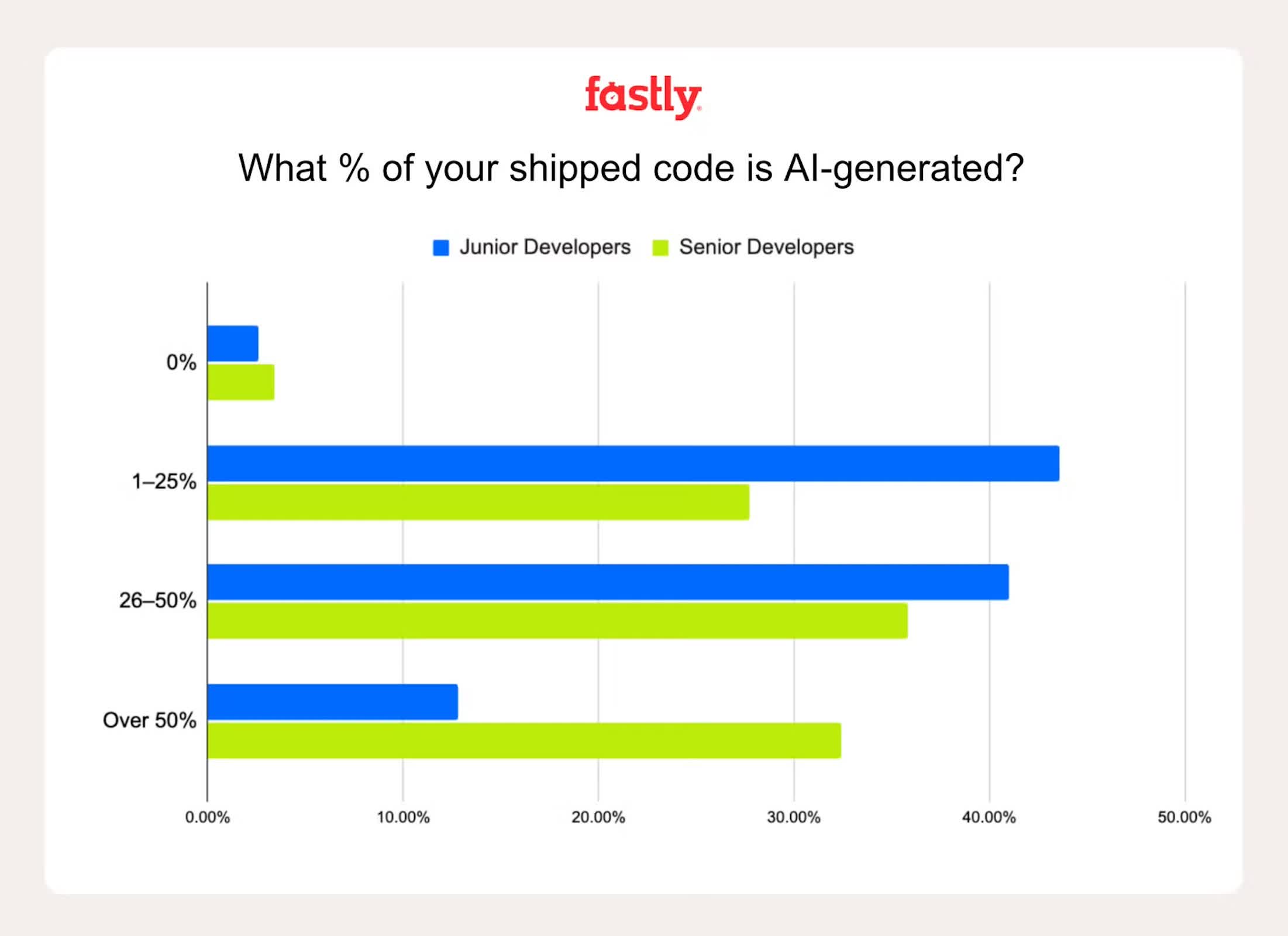
These findings point to both a higher rate of AI usage among senior engineers and greater trust in machine-generated code once it reaches production.
This trend contrasts somewhat with industry concerns about vibe coding, a term used to describe a new "style" of software development where engineers provide only prompts to a chatbot, then use the AI's answer to iteratively refine the application. In this approach, the AI is essentially directed like a junior developer. A common challenge with vibe coding is that AI-generated code may appear correct on the surface but can contain serious flaws or vulnerabilities.
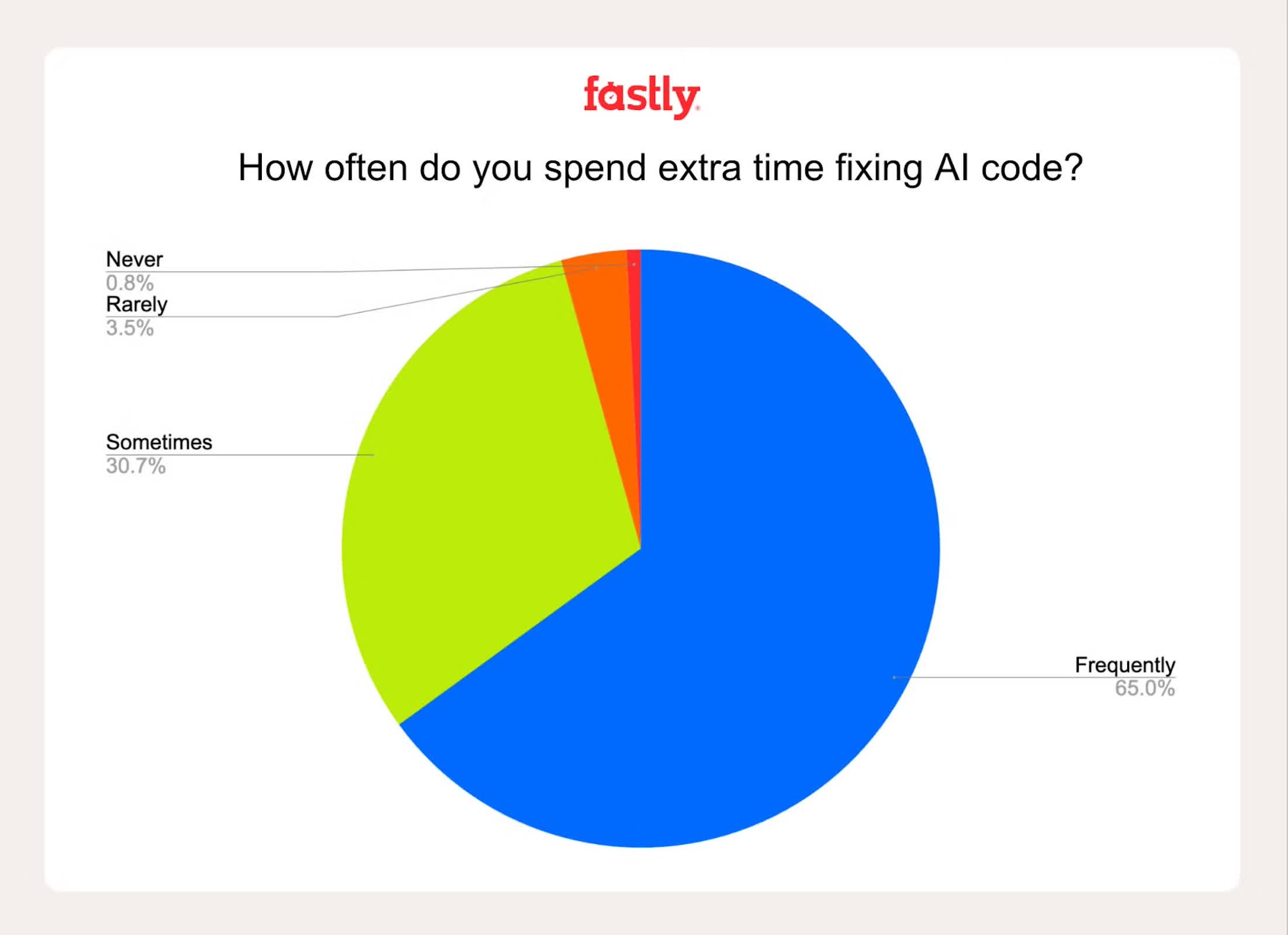
The survey also highlights a gap between perceived speed and the reality of editing. 28% of developers said they often spent so much time fixing or rewriting AI-supplied code that any potential benefits were largely erased. Another 14% said they rarely needed to make significant changes.
Still, more than half of all participants reported that AI tools, including GitHub Copilot, Google Gemini, and Anthropic Claude, helped them work faster. Senior engineers expressed stronger enthusiasm, with 59% saying AI sped up their work, compared to 49% of junior developers.
Seniors were also twice as likely to report substantial time savings, even though they said they spent more effort fixing AI's mistakes.
One senior developer wrote in the survey that "AI will bench-test code and find errors much faster than a human, repairing them seamlessly. This has been the case many times." A junior respondent pointed to the frustrations: "It's always hard when AI assumes what I'm doing and that's not the case, so I have to go back and redo it myself."
The contrast between juniors and seniors may have less to do with enthusiasm than with expertise. While just over half of junior developers described AI assistance as making them moderately faster, only 39% of seniors said the same. Instead, a quarter of senior respondents said AI made them "a lot" faster, about double the proportion of juniors.
Fastly offered one likely explanation: experienced developers tend to be better at detecting subtle flaws in code. That experience enables them to identify when AI-generated output appears correct but behaves incorrectly, making them more efficient at correcting mistakes without losing momentum.
The survey also underscores a common paradox of AI tools. Many developers say the technology helps them feel faster, but outside research suggests otherwise. Fastly's survey findings come on the heels of a randomized controlled trial from earlier this summer, which found that experienced open-source developers actually took 19% longer to complete tasks when using code assistants. According to Fastly, the discrepancy may stem from psychology: rapid autocomplete creates an early sense of progress, but the need for extensive revisions later erases some of those gains.
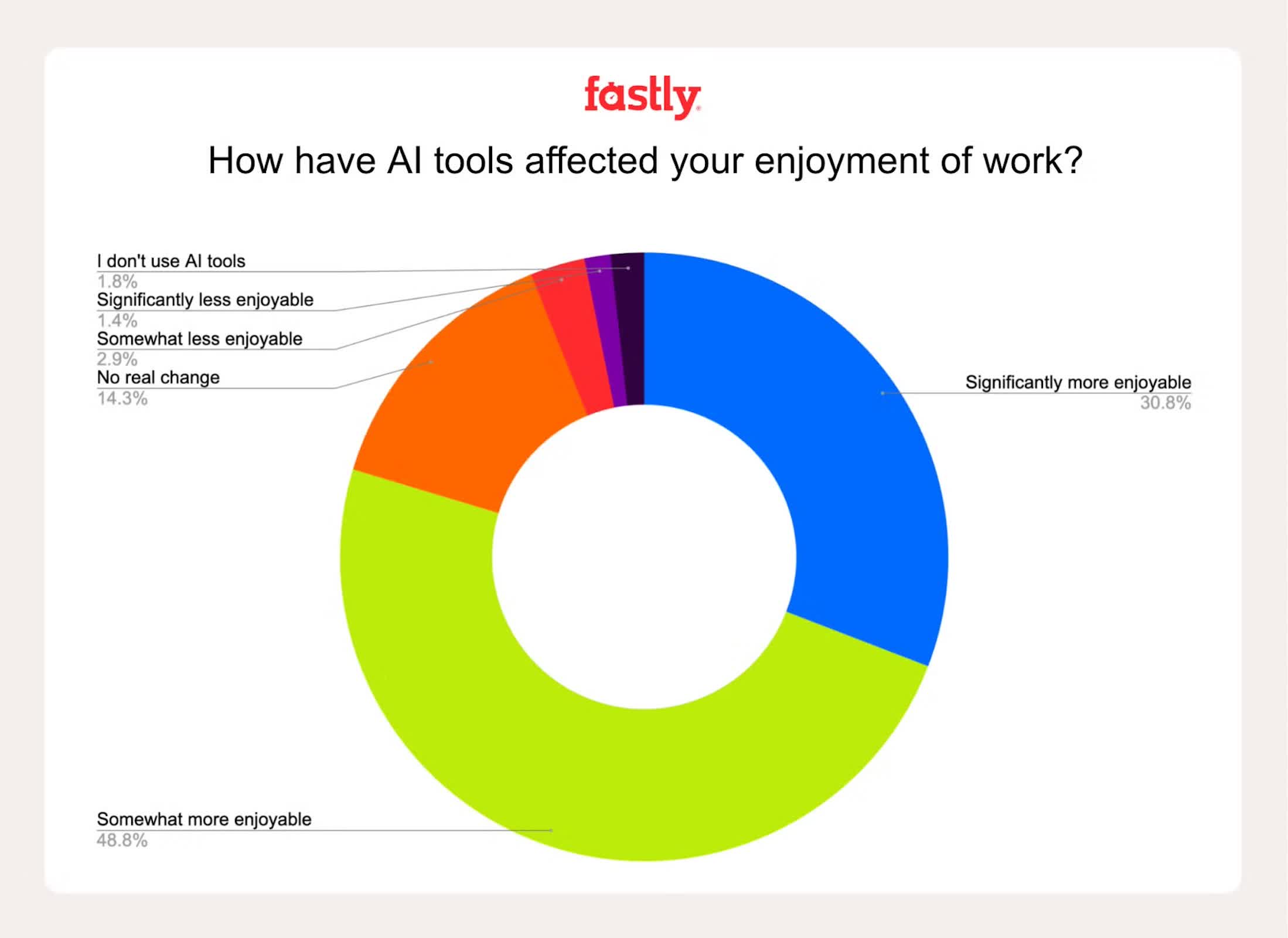
While efficiency gains remain uneven, the impact of AI on job satisfaction is much clearer. Roughly 80% of developers across all experience levels said coding felt more enjoyable when working with AI.
One survey participant described this trade-off: "GitHub Copilot greatly helps my workflow by suggesting code snippets and even entire functions. However, it once generated a complex algorithm that seemed correct but contained a subtle bug, leading to several hours of debugging."
While efficiency gains remain uneven, the impact of AI on job satisfaction is much clearer. Roughly 80% of developers across all experience levels said coding felt more enjoyable when working with AI. For some, the appeal lies in removing repetitive tasks. For others, it's the novelty of generating usable code on demand. In an industry plagued by burnout and backlogs, this morale boost may prove valuable even if productivity gains remain elusive.
Sustainability emerged as another central theme. The survey found that developers are increasingly aware of AI's environmental costs, including its significant carbon footprint. Two-thirds of respondents acknowledged these energy demands, and most reported incorporating green coding practices into their work. Adoption of these practices rose with experience, from just over half of junior developers to nearly 80% of mid- and senior-level engineers.
32% of senior developers report that half their code comes from AI, double the rate of juniors


