Highly anticipated: In the emerging field of additive manufacturing, one startup believes the next revolution in energy storage won't come from chemistry but from geometry. Material Hybrid Manufacturing, founded in 2023 by engineer Gabe Elias, a veteran of both Mercedes-AMG Petronas and Rivian, has developed a way to 3D print complete battery systems directly onto or within surfaces. Its approach could eliminate the rigid rectangular and cylindrical cells that currently define how devices, vehicles, and drones are designed.
Material won a $1.25 million contract from the US Air Force to validate the 3D-printing technology earlier this year. The 18-month project aims to demonstrate how printed, conformable batteries could transform design freedom for defense and aerospace hardware.
The company joins a fast-growing global race to commercialize printed battery technologies alongside competitors such as Sakuú in Silicon Valley and Blackstone Technology in Germany. Each is betting that customizable battery geometries will define the next generation of energy storage, especially for compact systems where form dictates function.
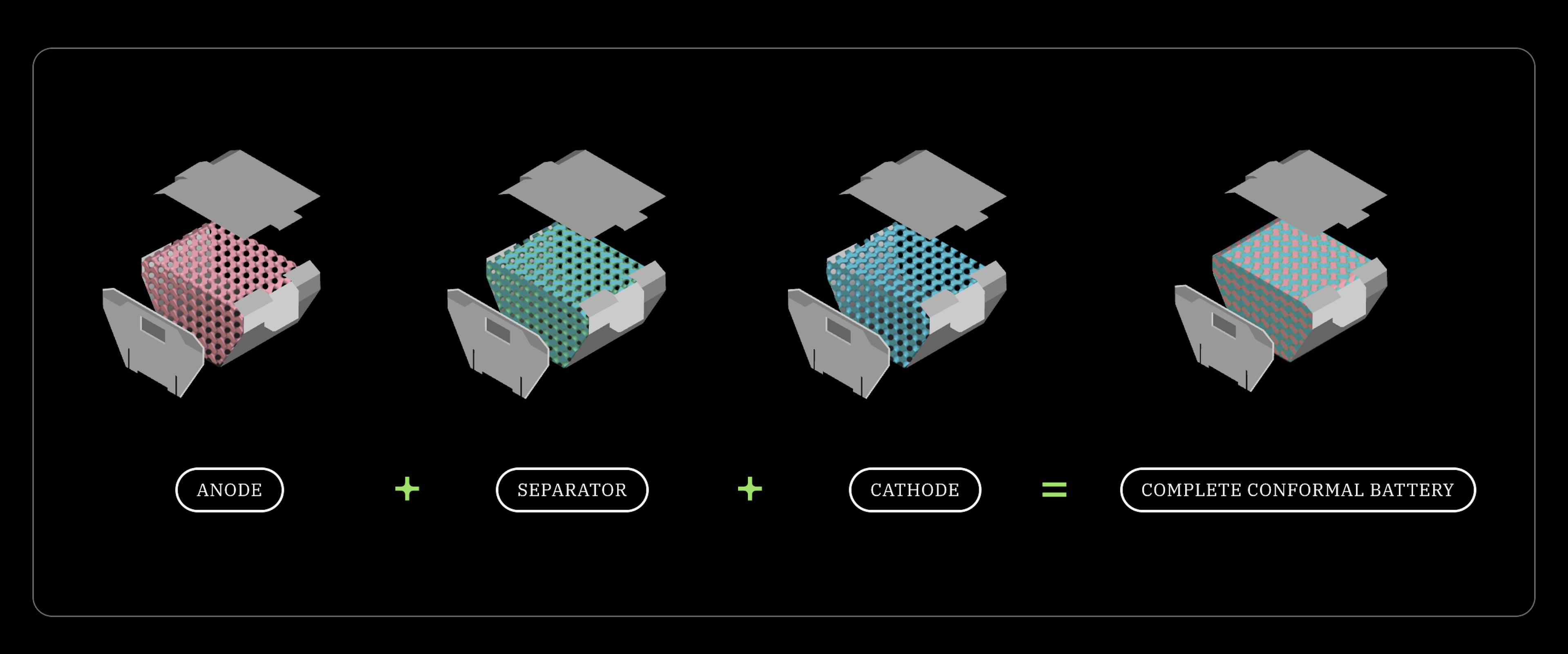
Material's proprietary platform, called Hybrid3D, can print every layer of a functional battery – anode, cathode, separator, and casing – in situ, without molds or tooling. The system integrates principles from direct-ink printing and fused deposition modeling to deposit active materials in successive layers only 100 to 150 micrometers thick. After printing, a liquid electrolyte is infused to complete the cell, although the company is pursuing solid-state variants for future product iterations.
Unlike conventional manufacturing, which requires metal housings, bus bars, and extensive wiring, the printed approach embeds batteries seamlessly into existing surfaces. In a drone, that could mean distributing energy along the wings or arms. In a wearable, it could curve around the frame of a pair of smart glasses rather than sitting as a fixed module.
Elias tells IEEE Spectrum that the Hybrid3D process can conform to virtually any shape while maintaining chemical flexibility – printing with NMC 811, NMC 111, LFP, or lithium-titanate oxide chemistries by simply swapping input materials and adjusting software parameters.
Material's founders first envisioned their printed batteries for automotive use, imagining custom-shaped packs in electric passenger cars. That idea stalled after they realized electric vehicles already have ample room for battery integration: a Rivian pickup, for instance, accommodates more than 7,700 cylindrical cells within its 135-kilowatt-hour pack.
But smaller systems, such as compact drones, defense gear, and next-generation consumer devices, face far tighter packaging limits. "Things are shrinking, so we're shrinking around it," Elias said. "Electronics are becoming embedded, consolidated, optimized, and batteries are the only part of that equation that's being left behind."
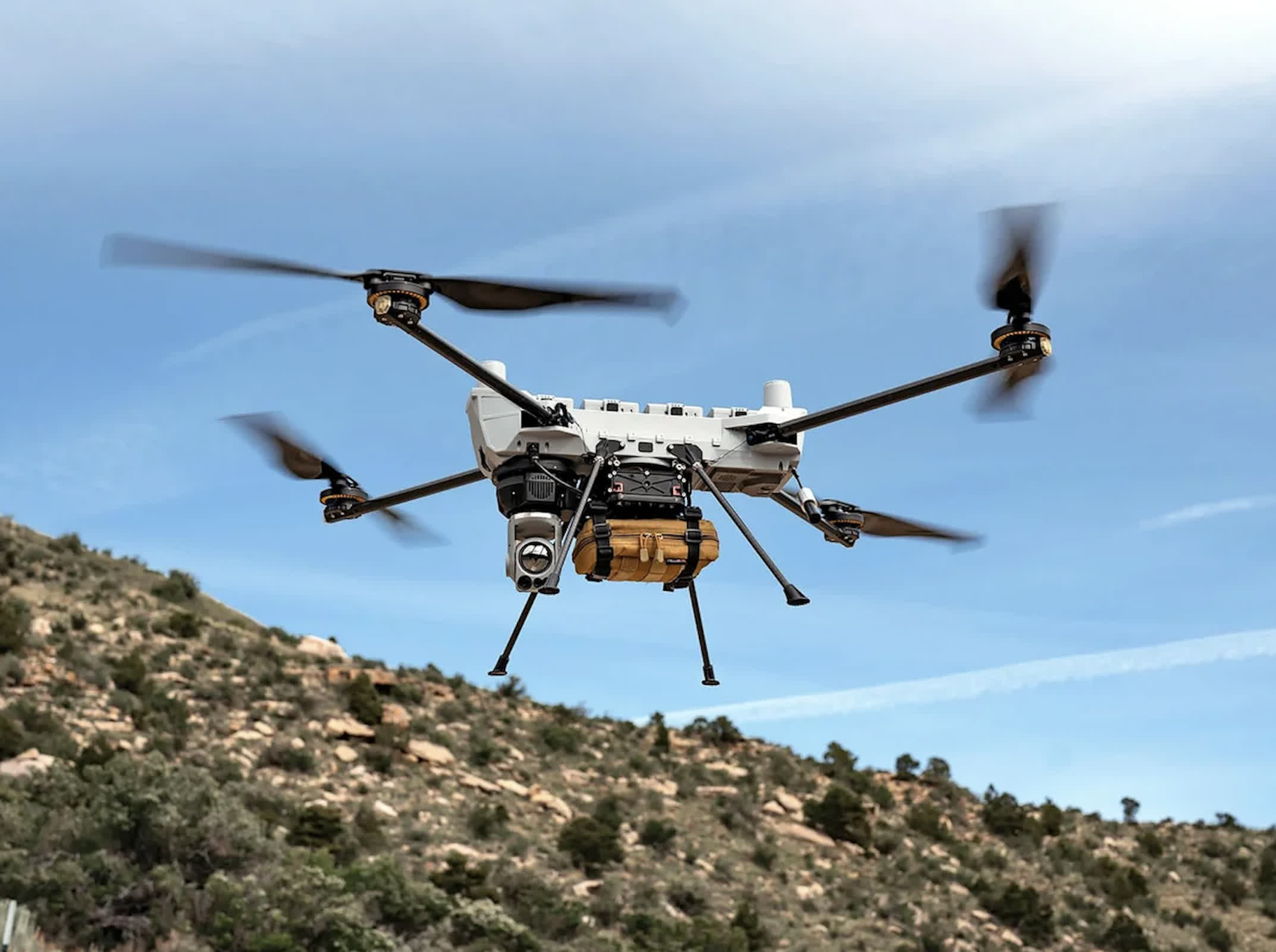
To turn concept into proof, Material partnered with Performance Drone Works (PDW) to retrofit one of PDW's unmanned aerial vehicles with a 3D-printed battery pack. Using the same volume as an existing pack holding 48 cylindrical cells, Material's design achieved a 50 percent increase in energy density and used 35 percent more of the available internal space.
According to the team, that efficiency could translate into drones that fly twice as far or carry heavier payloads while flying the same distance. Expanded versions of the technology could embed energy directly into airframes or motor housings, removing the need for discrete battery modules altogether.
The military implications are obvious: lighter, more ergonomic packs for soldiers or helmets with integrated power supplies to support advanced optics and communications.
At Mercedes-AMG, Elias once explored wrapping battery cells around an F1 driver's seat to improve aerodynamics and balance, but abandoned the effort due to the added mechanical complexity. Those frustrations ultimately inspired Material's additive approach: a battery that can become an intrinsic layer of a structure, much like carbon fiber in composite construction.

Founders Miles Dotson, Gabe Elias, and Christopher Reyes
Elias sees this as the logical continuation of "cell-to-pack" integration – turning energy storage into a structural subsystem rather than an independent component. Material's first commercial-scale printer uses a 550-by-350-millimeter bed, with larger formats already in development to print larger assemblies.
The implications for production are substantial. Printed batteries could move directly from a CAD model to a physical device, eliminating the expensive retooling and factory line setups that dominate today's cell manufacturing.
Elias points out that legacy consumer electronics firms are also exploring conformable batteries. Apple, for example, has invested heavily in L-shaped and custom batteries for iPhones using conventional processes. He argues that printed methods could achieve similar forms at far lower cost and higher scalability – vital if wearables such as smart glasses ever hope to balance style with function.
Material's roadmap includes refining material flow characteristics to ensure consistent layer thickness and stable yields, which is no small challenge when each layer must maintain precision on the scale of the width of a human hair.
Yet the potential economics are compelling. If successful, 3D-printed batteries could compete across price tiers from single cells to multi-kilowatt-hour packs, which today range from $400 to $3,000 per kilowatt-hour.
By consolidating components and simplifying assembly, printed systems could command stronger margins in complex applications such as aerospace and defense, where flexibility, weight, and structural integration outweigh sheer unit cost.
3D-printed batteries aim to reshape energy storage in small devices


