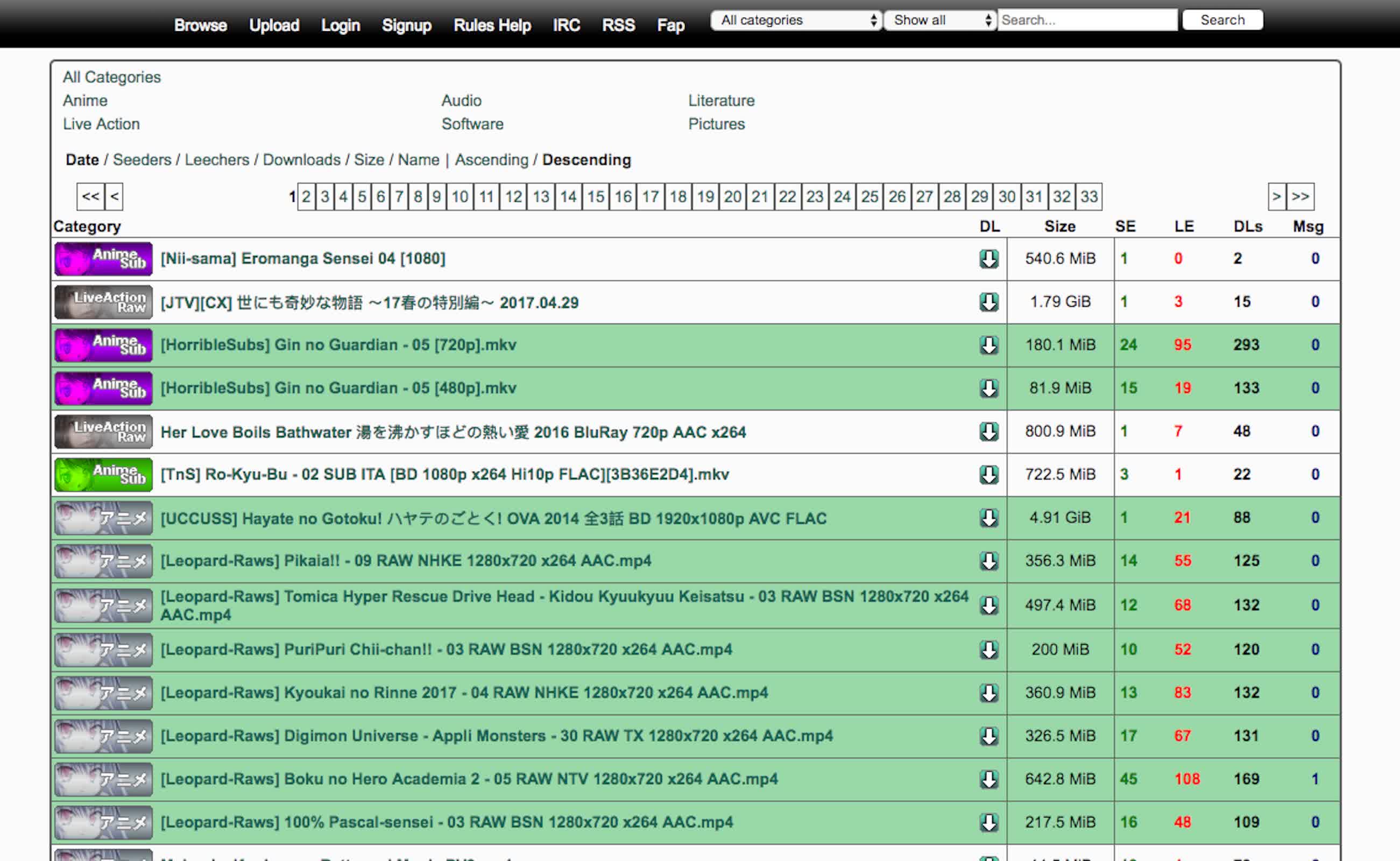
What just happened? Kyoto Prefectural Police have arrested a man accused of uploading copyrighted TV programs to the torrent site Nyaa, following an investigation that began several years ago. The case has drawn attention because the investigation does not appear to have relied on the usual method of joining BitTorrent swarms and identifying users who are sharing files. Instead, CODA, a Japanese anti-piracy organization, said it examined how information moves between torrent index sites and trackers.

Police arrested Masakazu Ono, 56, of Sagamihara in Kanagawa Prefecture. He is accused of acting as an initial seeder, meaning he was allegedly the first person to make complete files available for others to download. One of the files tied to the case was reportedly Midnight Taxi, a 2026 drama produced by NHK and WOWOW.
Authorities said Ono had uploaded nearly 1,000 NHK recordings during the investigation.
CODA began looking into Nyaa uploaders in 2021 through its Cross-Border Enforcement Project. The group worked with the Japan Hacker Association, known as JHA, before Kyoto police joined the case in 2024. Three alleged secondary uploaders connected to "reach sites" were charged in 2025. Those sites appear to be link aggregators that direct users to torrent files.
The details of how investigators identified Ono have not been made public. CODA said it "analyzed how data moves through torrent sites, such as index sites and tracker sites." That leaves open several possibilities.
Torrent index sites and trackers serve different roles. An index site is the public-facing page where users find torrent files. A tracker works in the background. BitTorrent software connects to it to find other users involved with the same file.
Trackers can show which users are active in a torrent at a given time. They may indicate whether a user has a complete copy of a file or is still downloading it. If investigators followed newly posted torrents over a long period, they may have been able to identify an IP address that repeatedly appeared as the first source with a complete copy.
That would fit the length of the investigation. A single upload may not provide much evidence, but a pattern across hundreds of files could help connect an account or network address to the original source of the material.
JHA's involvement is also significant. Its founder, Takayuki Sugiura, is known for decrypting the Winny peer-to-peer protocol in 2004 to identify original uploaders. Nyaa and Winny are different systems, but both involve tracing the source of files that spread across decentralized networks.
There are other ways investigators could have connected activity to Ono. He may have used Nyaa without a VPN while logged into an account. Data from website cookies or content-delivery-network logs could also have been matched with Nyaa activity and tracker records. CODA has not said whether any of those methods were used.
The more common approach in piracy investigations is to run a tracker honeypot or enter a torrent swarm and record the IP addresses of people sharing a file. That may not have been the approach in this case. Nyaa uses a small group of established trackers, and CODA's description points more toward analysis of the site's infrastructure than direct participation in a swarm.
Japanese law also limits broad monitoring of internet traffic. Methods such as deep packet inspection or large-scale traffic-volume monitoring would likely face legal concerns before authorities had identified a suspect.
A years-long investigation just unmasked a major torrent pirate, the how remains unclear


