AI images are getting harder to spot, but physics still gives them away if you know where to look

Daniel Sims

Posts: 2,466   +74
Staff
Through the looking glass: AI image generators have grown sophisticated enough to largely eliminate early tells like malformed hands or feet. However, image forensics experts recently began focusing on laws of physics that large language models do not (yet) understand, such as those governing light and perspective.
A study published in the journal Science explains that while modern image generators are rapidly improving, the models behind them remain fundamentally ignorant of how light and geometry work in the real world. Measuring simple details like reflections or shadows can still give away a fake photo – that gap, experts argue, is now one of the most reliable ways to distinguish authentic photographs from AI fakes.

Spotting a fabricated image used to be straightforward. Early generators mangled anatomical details, rendered text as gibberish, and missed the grain and compression artifacts native to real photography. Those flaws have largely been engineered away in the latest tools, making AI-generated imagery convincing enough to fool casual viewers, which means they are increasingly likely to spread unchecked across social media.
Part of what makes these images effective is a kind of manufactured drama. They tend to look the way humans expect reality to look: vivid, cinematic, and stylized in ways shaped by decades of movies and media.

Hany Farid, a UC Berkeley professor widely considered one of the founders of digital forensics, has been exploiting a subtler weakness. He has (so far) successfully fought AI fakes by comparing small details to how they should appear in reality. AI image generators, he argues, have yet to learn a foundational lesson from any introductory art class: the vanishing point.

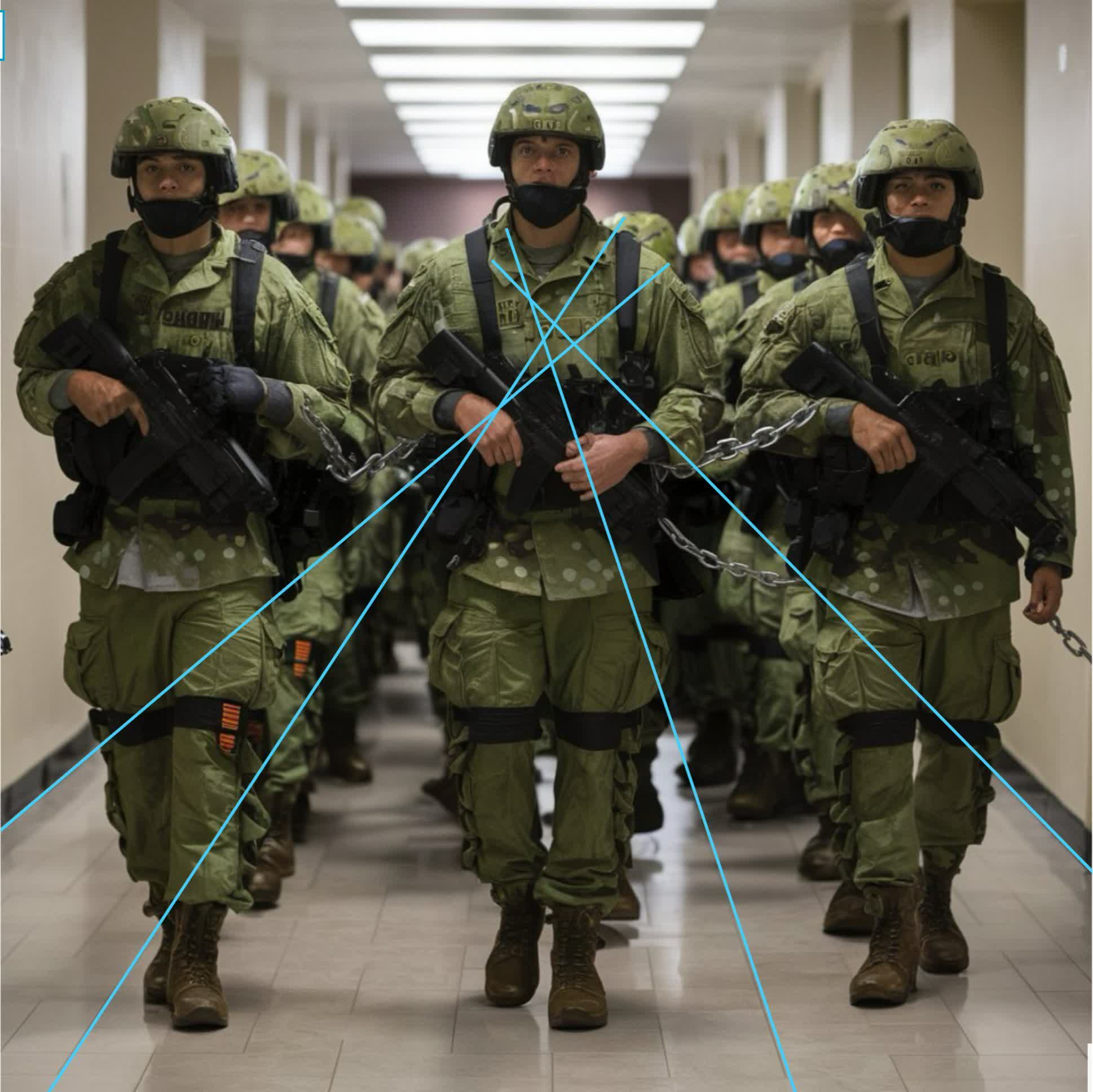
For example, although the above AI-generated image of soldiers marching down a hallway contains obvious flaws such as garbled text and chains leading nowhere, the floor tiles reveal a subtler mistake. In the real world, parallel lines, such as floor tiles or floorboards, should meet at a vanishing point. Drawing lines on a photo to find the vanishing point is a good way to verify its authenticity.
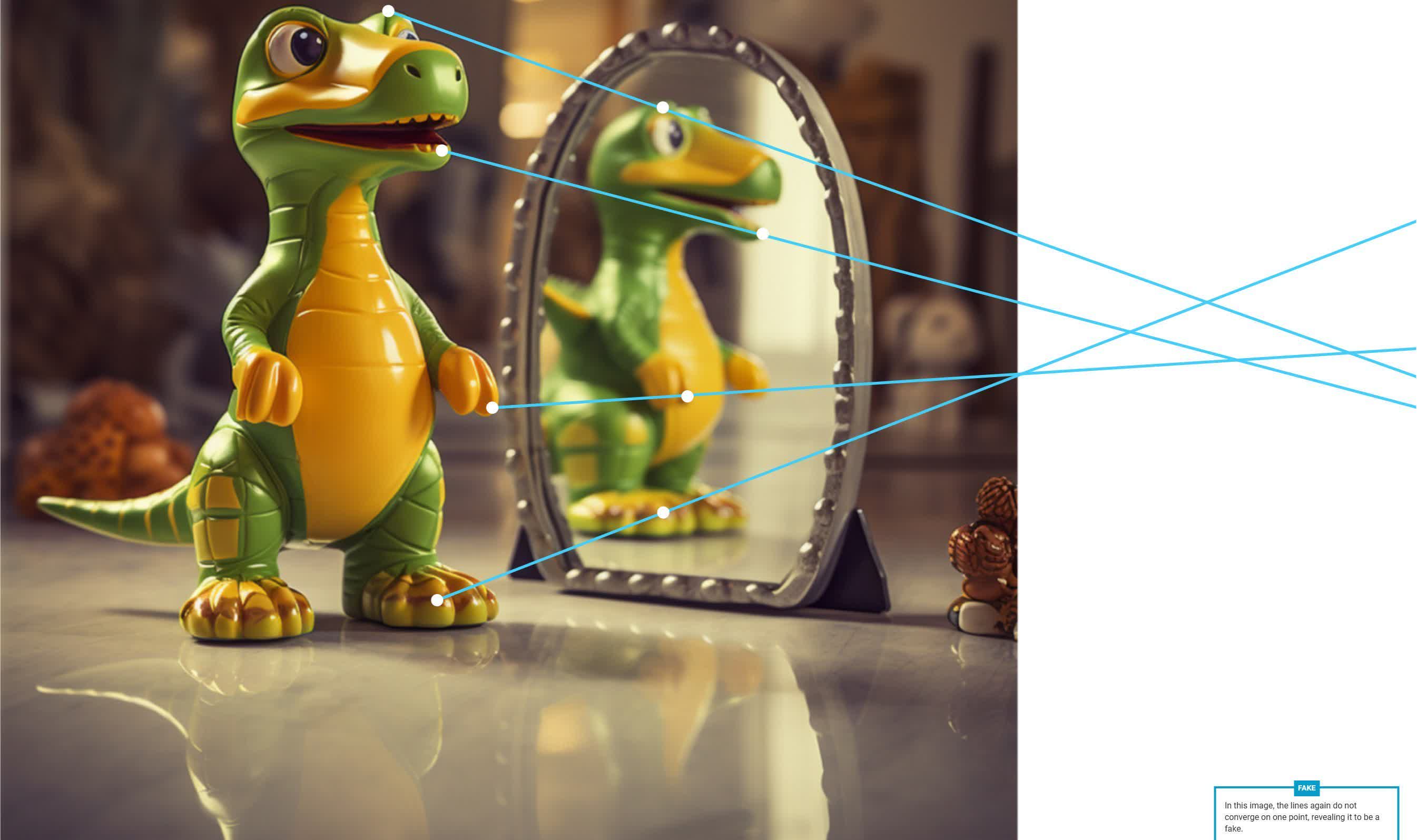
Reflections offer another opportunity to administer the same test. Although AI image generators can now create reflections convincing enough for the human eye, any straight measuring tool can break the illusion, since lines connecting points to their matching points in reflections should run parallel and meet at a vanishing point.

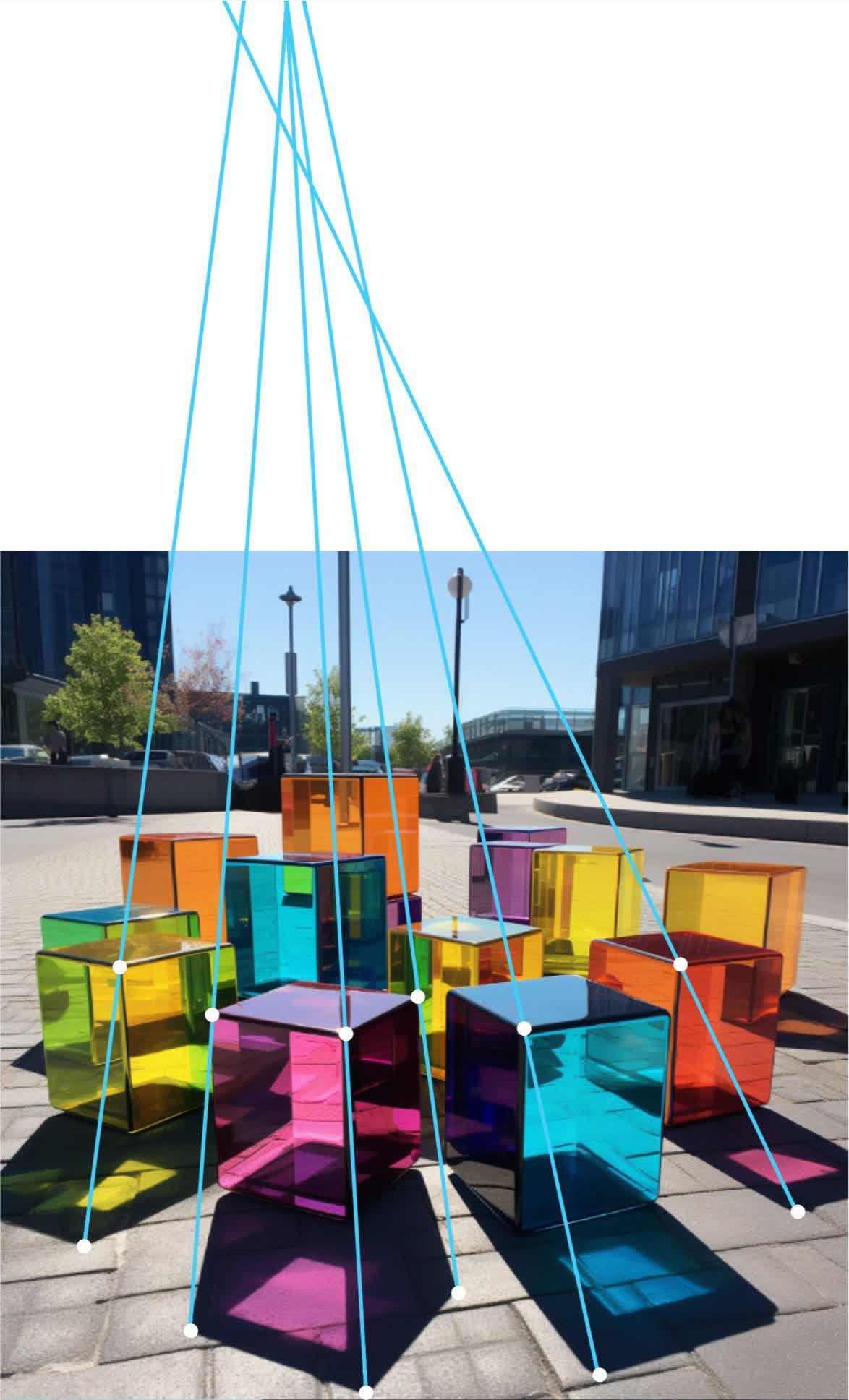
Shadows created by sunlight follow the same rules. The Sun is so far away from the Earth that its rays are effectively parallel when they reach us, so lines connecting points on objects to the same points on their shadows should also intersect at a vanishing point.
Whether LLMs will overcome these errors, or when, remains unclear. While other AI flaws are quickly disappearing, measuring perspective lines requires more time and effort than casual viewers are willing to spend. Understanding such physical laws might also be beyond the capabilities of current generative AI models.

Researchers also warn skeptical users against using AI-based detection tools. While some can be more reliable than untrained human eyes, they can struggle with input that differs significantly from their training data.

A separate study adds an unexpected wrinkle: verifying a real photo may actually be harder than catching a fake one. The longer a viewer examines an image and fails to find anything wrong, the more likely it is to be genuine – meaning that sometimes, the absence of errors is itself the evidence.

Permalink to story:

 
Soon the only entity able to distinguish a real image from a fake one will be another AI… and soon after, even they won’t.

We’re only in this tech’s infancy and it can already fool 99% of us… I’d give it a few years at most to be able to fool everyone.

The good part is when you get scammed to send nudes, you can say its just AI
 
Digital photos will lose credibility. Traditional film photos will gain credibility. Old photo books prior to the digital age will become a standard.

What a weird take. How would film photos be duplicated/distributed at scale without them being converted to digital first? What's to stop someone projecting a fake digital image onto film? If only old books can be trusted, does that mean we can no longer make new ones and we just stop recording history?
 
Doesn't really matter if images are real anymore because the the messaging is usually a lie.
After all, why let a silly thing like reality or human rights interfere with your ambitions?
 
Digital photos will lose credibility. Traditional film photos will gain credibility. Old photo books prior to the digital age will become a standard.
Time is a flat circle or something... That said, you can easily print digital photos onto film.
 
On the modern internet, it's easiest to live by this motto.

Everything online is fake.

Then, choose your poison. I choose to believe the news articles I read from the few sites I visit are accurate. I occasionally dig to verify. Otherwise, I take everything else as fiction.
That's how it was in the beginning. It wasn't until brain dead normies got on with smart phones and social media did people start taking stuff on the internet at face value.
 
That's how it was in the beginning. It wasn't until brain dead normies got on with smart phones and social media did people start taking stuff on the internet at face value.
No… it was never “that way”. People have always believed that which they either want to or fear to believe… have since social media was merely word of mouth.

I remember when the internet was new in the mid-90s and I made a website called Cribbage Inc. I claimed that we were the most powerful and influential cribbage organization in the western hemisphere… 2 different media outlets contacted me for interviews assuming I was telling the truth… ABC Melbourne and CBC St. John both interviewed me… boy were they surprised to find out I was just a university kid who made it all up…
 
What a weird take. How would film photos be duplicated/distributed at scale without them being converted to digital first? What's to stop someone projecting a fake digital image onto film? If only old books can be trusted, does that mean we can no longer make new ones and we just stop recording history?
Digital photos will lose credibility. Traditional film photos will gain credibility. Old photo books prior to the digital age will become a standard.
But what if AI generates undetectable Deep Fake images of film photos?
 
The AI'ers are getting more flagrant. Just started watching a "2026 Rose Parade". ALL AI.
I think as time goes on humans that are paying attention will get even better at spotting this nonsense.
Google/YouTube and others should not be paying for this click bait.
 
The AI'ers are getting more flagrant. Just started watching a "2026 Rose Parade". ALL AI.
I think as time goes on humans that are paying attention will get even better at spotting this nonsense.
Google/YouTube and others should not be paying for this click bait.
Except the AI improves - and humans don’t… so in a few years, what makes you think we’ll get better at detecting it?
 
YouTube apparently used AI to detect AI and ended up demonetizing dozens of stop motion channels claiming they had "no value". Two channels got their privileges back after enough people called YouTube out, but the others are still derailed because YouTube consistently refuses to ever learn the right lessons or care enough to protect their users from their all or nothing policies. This is also why so many people end up being victimized by attack campaigns when someone doesn't like a criticism, often even when they themselves pleaded for it.
 
Except the AI improves - and humans don’t… so in a few years, what makes you think we’ll get better at detecting it?
Not only do humans not improve, invariably large sections of them get worse. The very advent of AI should logically have made people at least a little more skeptical of misinformation but the opposite happened and they're more gullible than ever. And I'm not even talking about the people that just automatically call everything AI whether that even makes sense or not.
 
That's how it was in the beginning. It wasn't until brain dead normies got on with smart phones and social media did people start taking stuff on the internet at face value.
Except that's just as lazy as believing everything you see. Zero tolerance equals zero intelligence. If you don't
"Don't believe everything you see on the internet"

Perennial advice that blooms eternal.
And yet the generation that said it the most is the one that fell for everything they saw the instant the internet became dumbed down enough for them to use it.
 
Just more proof that we live in a simulation. Once AI improves to the level our simulation hardware runs on, we'll be able to run simulations of life itself on our own, for the ultimate inception/microcosm.

Kidding (kinda). I am still up in the air about human life as simulation, but if anything, AI and a greater understanding (and application) of quantum mechanics will certainly break the bubble if that is what it is.
 
Back