
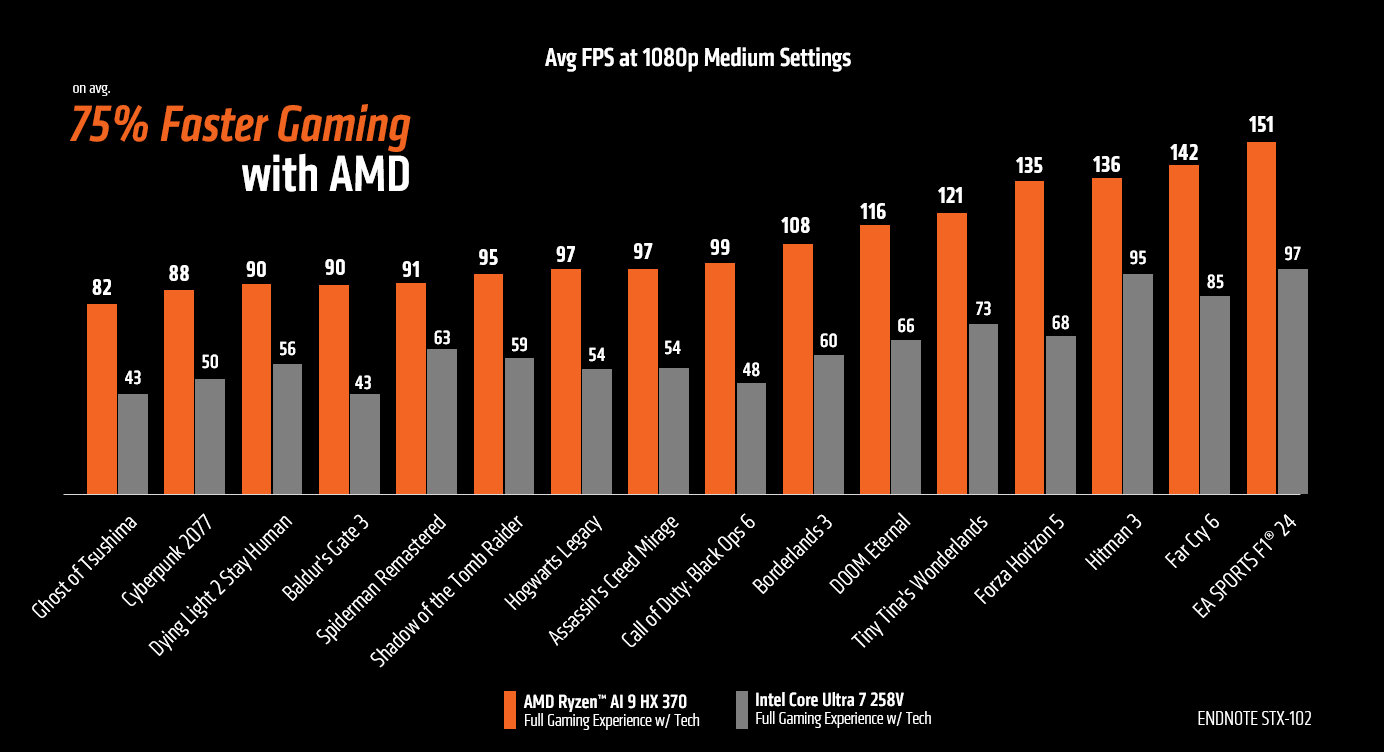
What just happened? AMD is making bold claims regarding the gaming performance capabilities of its new Ryzen AI 300 series mobile processors. The chip giant recently dropped a blog post showing off some impressive performance numbers, boasting that its flagship Ryzen AI 9 HX 370 CPU with integrated Radeon 890M graphics is on average 75% faster than Intel's rival Core Ultra 7 258V packing Arc 140V graphics.
To back these claims, AMD rolled out benchmark results for over 15 popular game titles run at 1080p medium settings. The titles tested include Cyberpunk 2077, Assassin's Creed Mirage, Call of Duty: Black Ops 6, and Hogwarts Legacy. Across the board, AMD's Ryzen AI chip consistently outgunned the competing Intel processor.
In the latest Call of Duty installment, the HX 370 averaged a smooth 99 fps compared to just 48 fps on the 258V – a staggering 51 fps lead for Team Red. Similar domination was observed in racing titles like Forza Horizon 5 and F1 24, with with performance leads exceeding 50 fps.
However, there's a catch: AMD is leveraging the full breadth of its upscaling and frame generation tech like FSR 3, HYPR-RX, and AFMF 2 to achieve these results. Together, these software tricks apply technologies such as intelligent upscaling, anti-lag, and motion-focused dynamic resolution scaling to significantly boost performance.
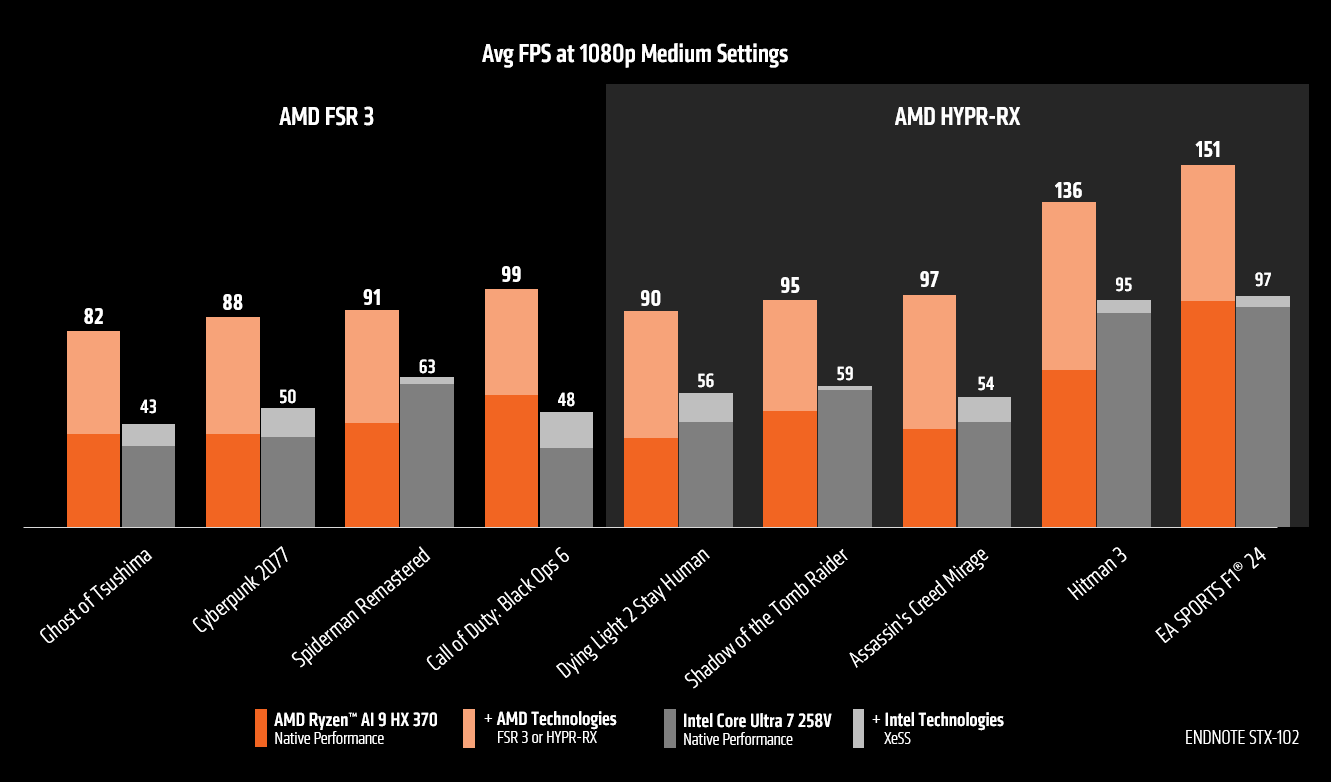
On Intel's side, the benchmarks utilize XeSS where available and FSR for titles without XeSS support. However, XeSS currently lacks frame generation capabilities, putting it at an inherent disadvantage.
That said, AMD also included native performance to give a more apples-to-apples comparison. In this raw state, the Ryzen AI 9 HX 370 and Core Ultra 7 258V traded blows, with each chip taking a lead in certain titles.
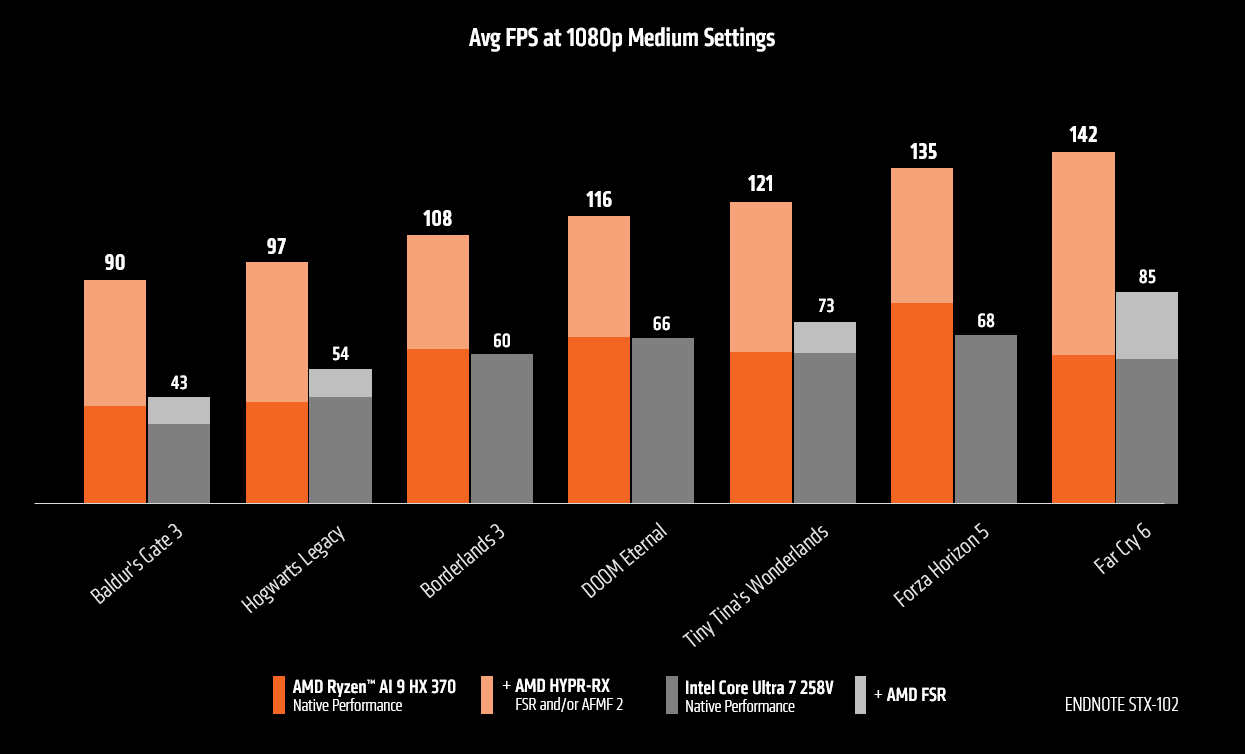
The key takeaway is that when running unassisted, the gaming capabilities of these latest AMD and Intel mobile chips are much more evenly matched than AMD's 75% lead implies.
There's no doubt that the future of mobile gaming lies in performance-boosting technologies like upscaling, frame generation, and dynamic resolution scaling. Together, these technologies are poised to become increasingly important tools for high-fidelity gaming on low-power hardware. They already are must-haves for ray-traced 4K PC gaming.
On that front, AMD appears to have a decisive lead over Intel. FidelityFX Super Resolution and frame generation are supported in hundreds of games, while Intel's XeSS is still rolling out with just over 130 titles supported so far.
AMD claims Ryzen AI 9 HX 370 is 75% faster than Intel's Core Ultra 7 258V in gaming


