Bottom line: Despite new US sanctions and restrictions aimed at stopping the spread of commercial spyware, analysts say the industry remains largely unchecked. As more investors get involved and companies adapt, the scope and secrecy of spyware operations continue to grow.

American investors are pouring more money into companies that develop commercial spyware, according to a new report. Their growing involvement is helping the surveillance industry expand worldwide and raising new questions about privacy and security risks.
A new analysis from the Atlantic Council documents a surge in US-based involvement over the past year. Researchers tracked 20 new American investors entering the market in 2024, boosting the total to 31 – a figure that now matches the investor count for the entire European Union, including Switzerland. Italy alone has emerged as the EU's top participant with 12 spyware investors, while Israel counts 26 backers within its borders.
To compile the report, the research team surveyed 561 entities operating across 46 countries from 1992 to 2024. The results reveal that 34 new spyware investors were identified in 2024, bringing the cumulative global tally to 128, up from 94 the previous year. The study relies heavily on a structured dataset that tracks market actors through public records, financial disclosures, and regulatory filings.
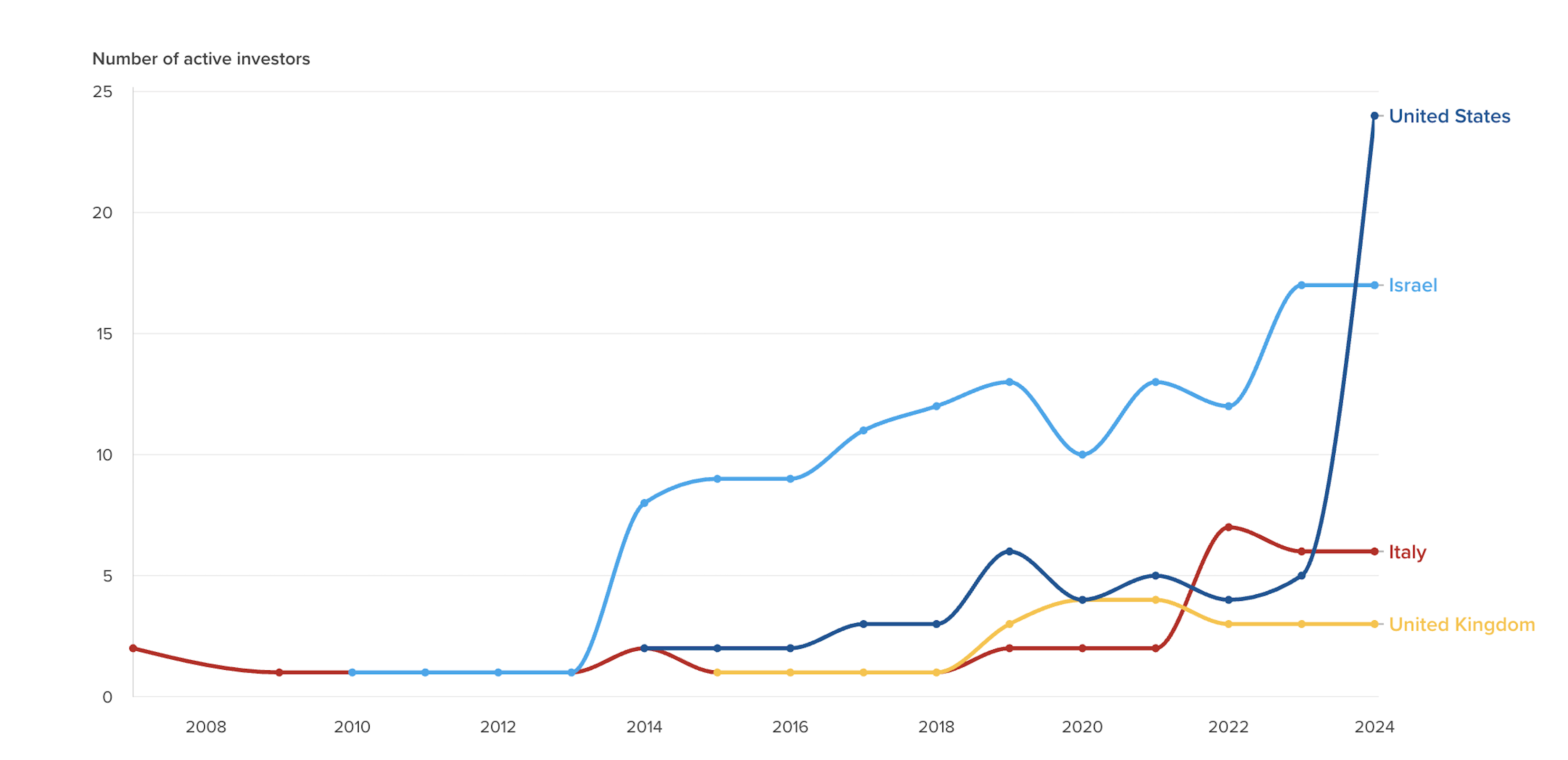
Major American backing comes from some of Wall Street's most prominent financial players, including hedge funds D.E. Shaw & Co. and Millennium Management, the trading firm Jane Street, and Ameriprise Financial. Atlantic Council researchers found all four firms had invested in the Israeli firm Cognyte, whose interception technology has allegedly facilitated human rights abuses in countries including Azerbaijan and Indonesia, according to foreign government reports and investigative findings.
In another development, Florida-based AE Industrial Partners, a major private equity group focused on defense and national security, completed its late-2024 acquisition of Israeli spyware maker Paragon Solutions. The company surfaced in recent headlines after its contract with US Immigration and Customs Enforcement – first disclosed by WIRED – was reinstated abruptly following a lengthy suspension. The deal has attracted criticism from privacy and civil rights advocates, who argue that renewed government deployments of spyware exacerbate constitutional and civil liberties risks amid wider expansion of ICE's enforcement powers.
The fallout from Paragon's operations is rippling across Europe as well. WhatsApp reported that Italian journalists and non-governmental organizations were targeted by Paragon's products, leading to scrutiny from an Italian parliamentary committee. The committee concluded the software had only been used to monitor human rights defenders – a determination challenged by outside researchers.
Experts at the University of Toronto's Citizen Lab later used forensic techniques to confirm at least one Italian journalist was targeted by Paragon's iOS spyware and identified likely clients in Australia, Canada, Denmark, Cyprus, Singapore, and Israel. Paragon rebutted the Italian committee's findings, arguing that authorities declined technical verification that could have clarified misuse claims.
While American and Israeli investments draw the most international attention, the report also highlights a sprawling network of resellers and brokers that facilitate deals between vendors, suppliers, and buyers. New entrants into the surveillance market include Bindecy (Israel), SIO (Italy), and a range of front companies associated with notorious products, such as the NSO Group's Pegasus spyware. Additional suppliers highlighted by the report are based in the United Kingdom and the United Arab Emirates.
The Atlantic Council's reviewers describe these resellers as a "notably under-researched set of actors" who help forge links between international buyers and sellers. This network creates an "expanded and opaque" global supply chain that hinders transparency and complicates regulatory accountability. The authors warn that, to date, resellers and brokers have primarily operated outside the scope of regulatory response or lawmaker attention.
This year, the spyware market expanded its footprint to include three new national jurisdictions – Japan, Malaysia, and Panama – with Japan's involvement drawing particular attention. Despite Tokyo's commitment to international norms restricting the sale and misuse of spyware – including its participation in the Joint Statement on Efforts to Counter the Proliferation and Misuse of Commercial Spyware – the country now appears on industry maps.
American funding catapults spyware industry beyond Israel's lead


