Arm faces shareholder backlash over CEO Rene Haas' "excessive" $800 million pay package

midian182

Posts: 12,003   +183
Staff member
WTF?! Does an $800 million compensation package seem excessive? Yes, obviously, which is why Arm is facing a potential shareholder revolt over a proposal to hand that amount to CEO Rene Haas. Much like Elon Musk's $1 trillion pay package, targets must be met for Haas to receive the full amount.
Proxy advisers ISS and Glass Lewis are urging investors to reject the plan at the September 9 annual meeting, according to Seeking Alpha. ISS says value creation plans remain rare in Britain, can produce enormous rewards, and have unproven benefits. Glass Lewis also called the award excessive.

Arm's regulatory filing says the one-time award comprises 425,000 performance share units divided into three tranches. Haas receives 25% if Arm's market cap hits $1 trillion by March 31, 2029, another 25% if it reaches $1.5 trillion by March 31, 2030, and the remaining 50% if it hits $2 trillion by March 31, 2031. At the final target, the shares would be worth about $1,880 each, taking the total to roughly $800 million.

Arm will measure achievement using its average closing price over any 60-day period before the deadline. Missed interim awards can roll forward. Each tranche vests two years after its milestone, through April 1, 2033, provided Haas remains employed.

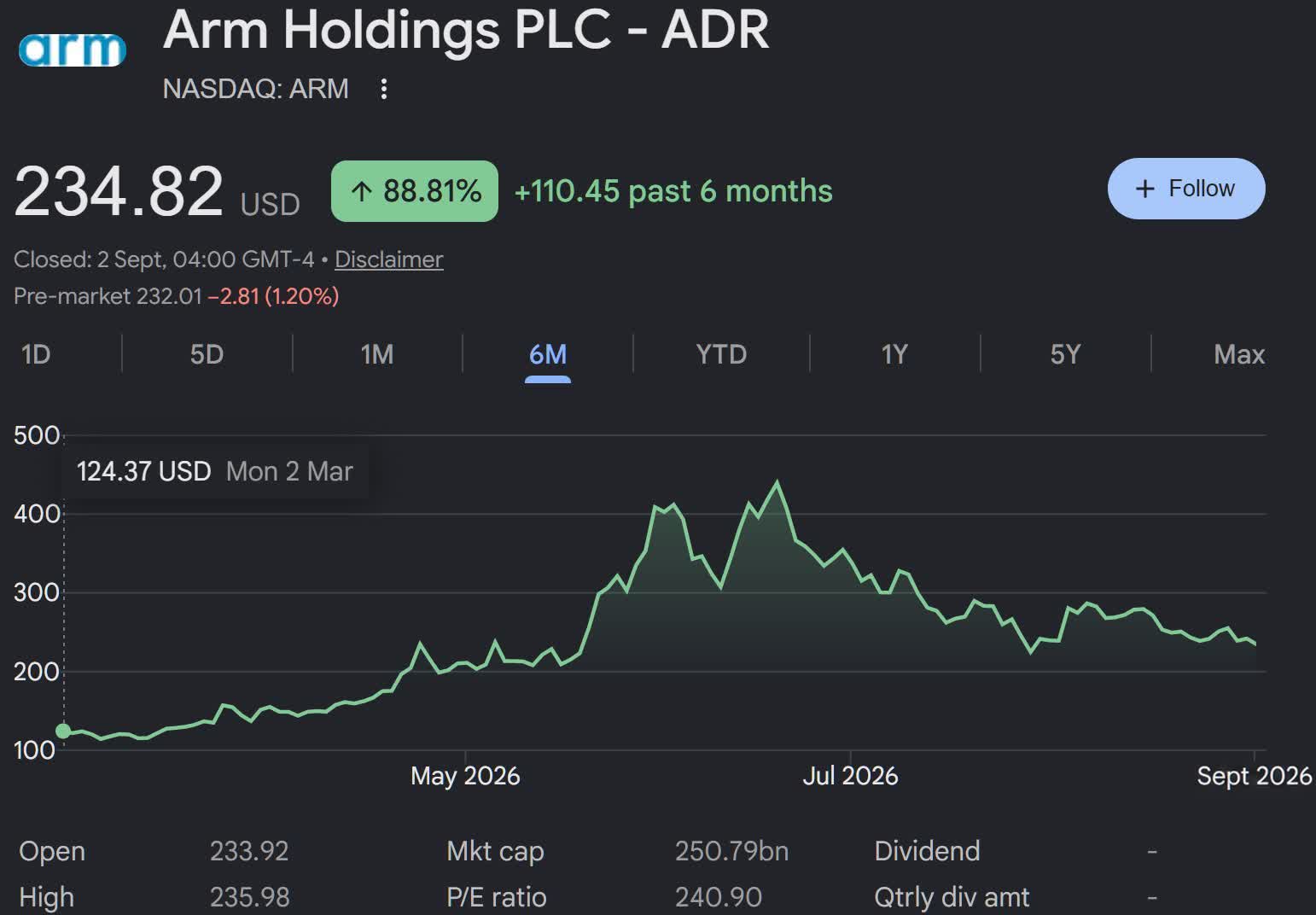
Arm is worth around $250 billion after its stock almost halved from a June peak. The first threshold requires a fourfold increase, and the final goal more than eightfold growth.
The company says US-style compensation is appropriate because it is listed on Nasdaq, Haas lives in California, and many rivals are American. The proposal also raises the maximum payout on his regular performance shares from 125% to 200%. He received $60.6 million in total remuneration during fiscal 2026.

It's unlikely that opposition to the package will have an effect. SoftBank owns 86.4% of Arm and can control most shareholder votes. ISS has also recommended voting against the re-election of Haas and chairman Masayoshi Son, citing insufficient board independence. Haas sits on SoftBank's board and became part-time CEO of SoftBank Group International in April, overlapping roles that Arm acknowledges could create the appearance of conflicts.
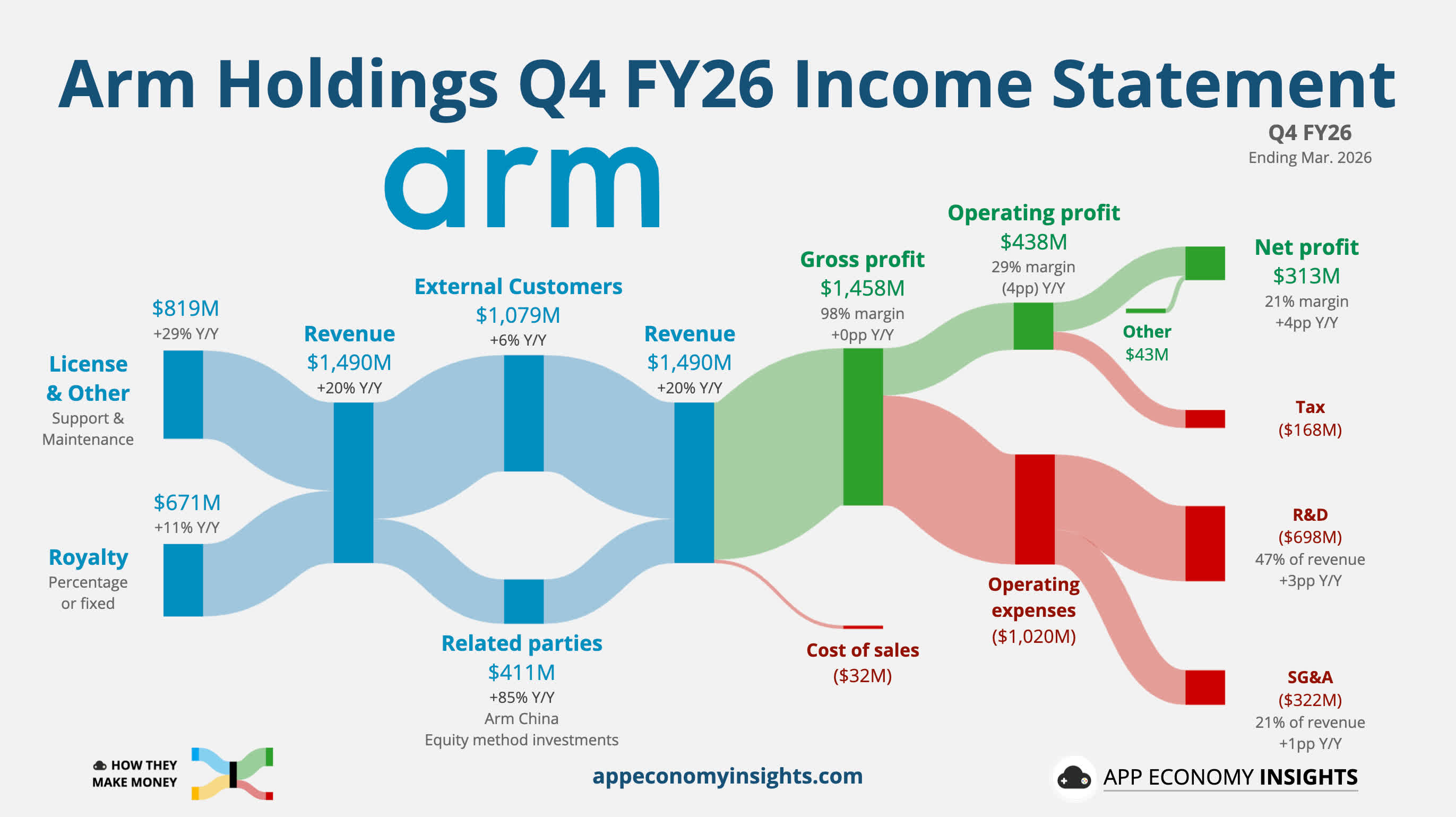
Credit: App Economy Insights

The size of the pay reflects Arm's transformation from licensing chip designs to selling its own AI-focused silicon. Haas expects the AGI CPU business to generate $15 billion in annual revenue within five years, contributing to a company-wide target of $25 billion.

Tesla shareholders approved Musk's similar plan for his $1 trillion package with about 75% support in November 2025. To collect every tranche over a decade, Tesla must reach an enormous $8.5 trillion market cap and hit some ambitious milestones, including 20 million vehicle deliveries, 10 million active Full Self-Driving subscriptions, one million commercial robotaxis, one million Optimus robots, and $400 billion in annual adjusted profit. Haas's potential payday almost looks modest by comparison.

Permalink to story:

 
Another classic Ragebait Rob article. Financial pleb sees big number and expects everyone to lose their minds.

Let's do the actual math:
($800M / $2T) * 100 = 0.04%.

He gets that money only if he increases Arm's value by over $1.7 trillion. Paying a guy 0.04% of the total company value to turn a $250B company into a $2T titan is a bargain for investors.

If you're crying about this, the author has intentionally pegged you as a headline-hypnotized midwit that doesn’t understand scale.
 
As an arm shareholder I think its time to invest more in arm shares then, He will be highly motivated.

EDIT: Sorry, Just noticed I am supposed to be angry about this, I didn't read the headline properly.
 
Another classic Ragebait Rob article. Financial pleb sees big number and expects everyone to lose their minds.

Let's do the actual math:
($800M / $2T) * 100 = 0.04%.

He gets that money only if he increases Arm's value by over $1.7 trillion. Paying a guy 0.04% of the total company value to turn a $250B company into a $2T titan is a bargain for investors.

If you're crying about this, the author has intentionally pegged you as a headline-hypnotized midwit that doesn’t understand scale.
My guess is, it's less about the proportion of money he will get, in relation to the amount of work required to get there, and more about if he should get it at all.

He WILL get that amount, if he succeeds. He shouldn't, because it would further the wealth gap. Investors will be happy, but the public won't be.

Which "public" do you mean, exactly? The ones who fundamentally refuse to self-educate so they can understand basic economic scale, preferring to cling to historically blind, economically illiterate ideas? The same delusional mentality that would rather see the entire tech ecosystem rot into stagnation just to satisfy an envy-driven obsession with the wealth gap?

Unfortunately, you can’t fix ideological stupidity. That camp is mentally weak and easily provoked. Fortunately, “the public” to which you refer isn’t monolithic.

Do we have economic imbalance? Yes. Do we need tougher regulation? Yes.

But, treating wealth like a static pie, where one person taking a bigger slice leaves less for everyone else, is the dimwit’s guide to the poorhouse. Wealth creation isn't a zero-sum game.

If Haas hits those targets, he isn't hoarding existing money; he is engineering $1.75 trillion in entirely new value that didn't exist before. Capping his reward out of resentment for the “wealth gap” is economic self-sabotage. It assumes that keeping a society artificially equal, at a lower standard of living, is better than allowing explosive technological and industrial growth.

If we disincentivize that kind of peak performance, the company stays stagnant, the technology doesn't advance, and the billions in tax revenue that could fund things like public infrastructure never materialize.

Preventing massive value creation just to stop an individual from getting wealthy helps absolutely no one—it just ensures everyone stays equally stagnant until natural economic retraction leaves everyone worse off.
 
Another classic Ragebait Rob article. Financial pleb sees big number and expects everyone to lose their minds.

Let's do the actual math:
($800M / $2T) * 100 = 0.04%.

He gets that money only if he increases Arm's value by over $1.7 trillion. Paying a guy 0.04% of the total company value to turn a $250B company into a $2T titan is a bargain for investors.

If you're crying about this, the author has intentionally pegged you as a headline-hypnotized midwit that doesn’t understand scale.
I agree but still it's an insane amount of money... for the work of a whole company. One person 800mil is not the way.
 
One person 800mil is not the way.
Hard disagree.

“Not the way” to what? Seems to me the benefit is nothing but prosperity for everyone involved with said growth. If we disincentivize that kind of peak performance, the company stays stagnant—how is that better?

Don’t ignore historical facts about how economic prosperity and upward mobility have massively improved in the last 30 years alone because of jealousy over some dude’s paycheck. Nobody is cheating anyone by getting a windfall that is a direct result of massive growth. Incentivizing and risk/reward is precisely what we should be doing. It’s how competition thrives and everyone in proximity prospers.

Again, wealth creation isn't a zero-sum game. Thinking about wealth like a static pie, where one person taking a bigger slice leaves less for everyone else, is economic illiteracy.

Capping his reward out of resentment for the “wealth gap” is economic self-sabotage. It assumes that keeping a society artificially equal, at a lower standard of living, is better than allowing explosive technological and industrial growth.

Thinking that this kind of pay for the proposed return is “not the way” ignores everything about how economic prosperity functions for the whole over a misguided narrow focus that can really only be summed up as jealousy. That helps absolutely no one—it just ensures everyone stays equally stagnant until natural economic retraction leaves everyone worse off.
 
Back