Astronomers may have discovered a new kind of object called a black hole star

Skye Jacobs

Posts: 2,239   +63
Staff
What we know so far: NASA's James Webb Space Telescope has identified a bright red object from the early universe that may be a black hole hidden inside an enormous shell of gas. The object is roughly the size of the solar system but produces more energy than any known star. Researchers say its unusual properties point to a black hole surrounded by an extended gas envelope – a proposed new type of object they call a "black hole star."
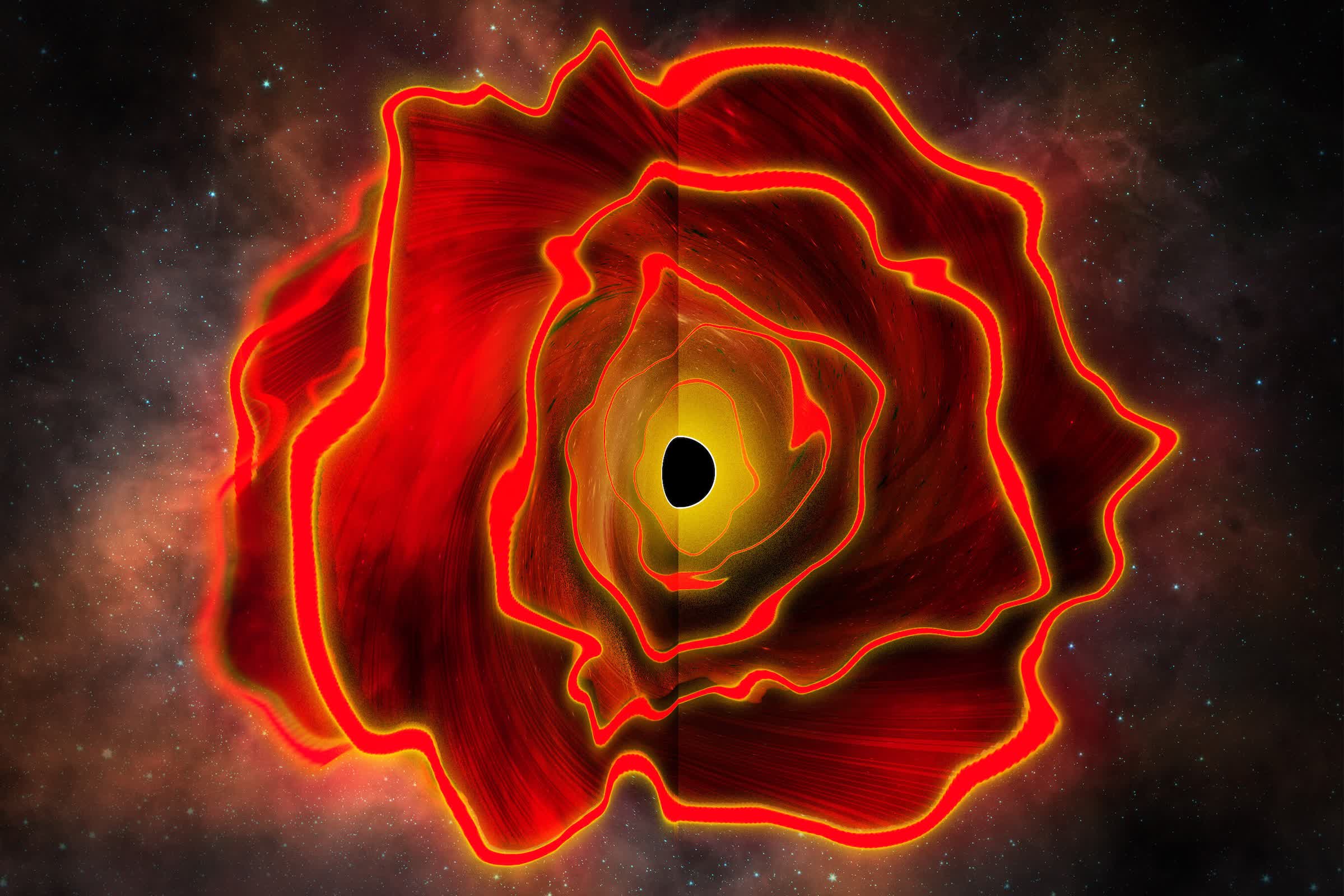
"Our picture of this object is evolving very rapidly," says lead author Rohan Naidu, a NASA Hubble Fellow and Pappalardo Fellow at MIT's Kavli Institute for Astrophysics and Space Research. "We think there is a central black hole that is 100,000 times as massive as the Sun. And around this black hole, there would be this very extended envelope of gas that looks like a star the size of the solar system. It's huge."

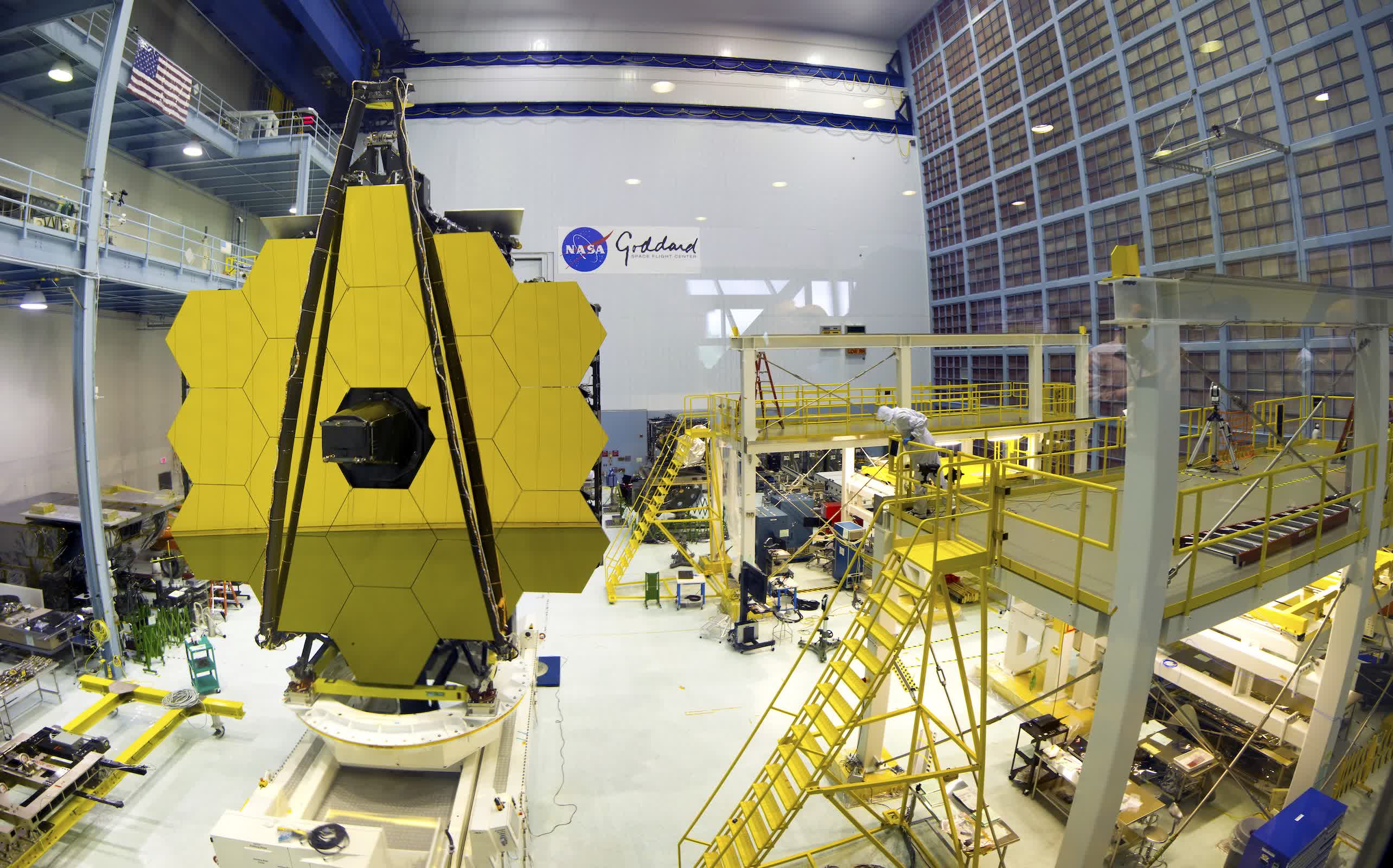
The finding, published in Nature, came from a survey called Mirage or Miracle, or MoM. The project uses the JWST to identify galaxies from just a few hundred million years after the Big Bang. The team was searching for distant galaxies when it detected the unusual red source.

At first glance, its red color could have suggested that dust was blocking and reddening its light. But its spectrum did not match that explanation. The researchers found a steep drop in the object's light at shorter wavelengths, a feature known as a Balmer break.

Balmer breaks are associated with dense gas absorbing photons in stellar atmospheres and can be observed in stars such as Vega. In this source, however, the break was much stronger than anything researchers have observed in ordinary stars.

Naidu said the object showed the strongest Balmer break the team has ever observed, making an ordinary star an unlikely explanation. The finding instead raised the possibility that researchers are seeing a vastly enlarged version of a stellar atmosphere, he added.
The light also showed little evidence of elements heavier than hydrogen and helium. That composition, combined with the source's unusual spectrum and extreme brightness, set it apart from typical stars and galaxies.

"It was truly singular in so many ways," Naidu says.

The object may also help explain a broader mystery emerging from JWST data: the many small, red sources seen in the early universe. Often called "little red dots," these objects appear in deep-space images but seem to have largely vanished by the present day.

"These little red dots seem to be everywhere in the early universe but essentially disappear by the present day," Naidu says. "What exactly these objects are has been one of the most debated topics of the JWST era."

The MoM survey was created partly to examine whether some apparently bright early galaxies are not galaxies at all.

Naidu said astronomers have been trying to explain why so many apparently bright galaxies appear so early in the universe's history. The team's work suggests that at least some may not be galaxies at all, but objects that merely resemble them in telescope data.

MIT's Robert Simcoe and Wendy Sun are co-authors of the study, along with collaborators from other institutions.

Permalink to story:

 
Black hole sun, won't you come
And wash away the rain?

My first thought was, I wonder if there are planets in orbit of it.
Since the "star" part of this object is the size of a solar system, I would expect any planets inside of it to be incredibly hot and likely devoid of any atmosphere. Not sure how we would see them, too, since typical detection methods require measuring the dimming of light as it passes between its star and us, and in this case the light from the "star" is between us and the planet. They're lit from the foreground, not background. Maybe we could detect them by looking for bright spots transiting? As the planets reflect light back through the light's source?
 
Half of JWST's discoveries these days boil down to "we don't actually know what this is, but it's really bright and really far away."
 
Not only do "black holes" not exist, they couldn't have ANY mass if they did. Math doesn't have mass, and it was Hilbert's error in 1916 that created the science-fictional black hole to begin with: working on Einstein's field equations, he divided by zero, returned an answer of "2", and assigned it to an R variable he mistook for a radius. There never has been any black holes, ever detected or observed, and certainly never photographed.

This article and every single one like it only shows a CGI rendition. Why can't we see the photo? Because there never was one. And a hole cannot have mass - it is the absence of mass and matter. It also can't have negative mass, which would mean negative energy, which also doesn't exist. Energy is the measure of a result of a collision, the transfer of momentum between two bodies of matter. E=mc², you know? Energy is the calculation of mass times an acceleration, in this case the speed of light linear times the speed of light's rotation at the tangent - a collision.

Black holes have been debunked for over a century, and yet here we are. Foolish.
 
Not only do "black holes" not exist, they couldn't have ANY mass if they did. Math doesn't have mass, and it was Hilbert's error in 1916 that created the science-fictional black hole to begin with: working on Einstein's field equations, he divided by zero, returned an answer of "2", and assigned it to an R variable he mistook for a radius. There never has been any black holes, ever detected or observed, and certainly never photographed.

This article and every single one like it only shows a CGI rendition. Why can't we see the photo? Because there never was one. And a hole cannot have mass - it is the absence of mass and matter. It also can't have negative mass, which would mean negative energy, which also doesn't exist. Energy is the measure of a result of a collision, the transfer of momentum between two bodies of matter. E=mc², you know? Energy is the calculation of mass times an acceleration, in this case the speed of light linear times the speed of light's rotation at the tangent - a collision.

Black holes have been debunked for over a century, and yet here we are. Foolish.

I recall there being several photographs of black holes over the years…low res and grainy but photographs nonetheless. Would you like to try again?

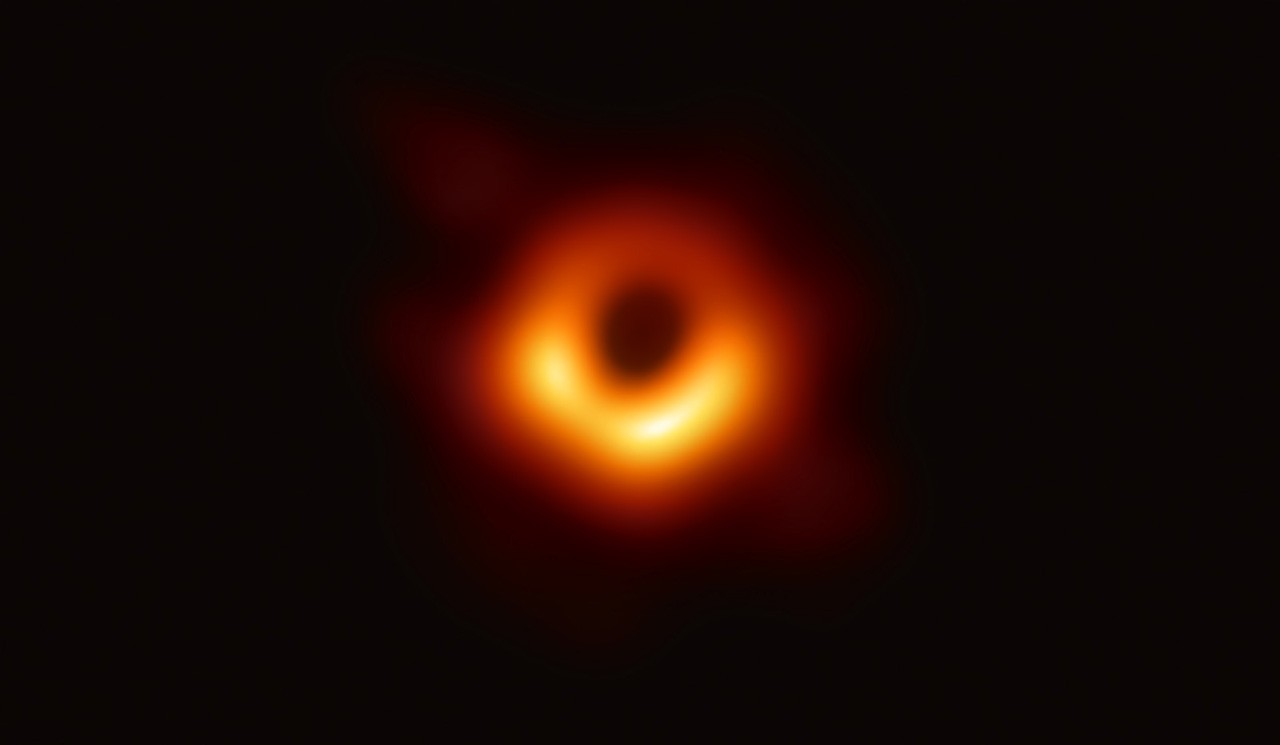
You’re probably just trolling but here you go

 
Not only do "black holes" not exist, they couldn't have ANY mass if they did. Math doesn't have mass, and it was Hilbert's error in 1916 that created the science-fictional black hole to begin with: working on Einstein's field equations, he divided by zero, returned an answer of "2", and assigned it to an R variable he mistook for a radius. There never has been any black holes, ever detected or observed, and certainly never photographed.

This article and every single one like it only shows a CGI rendition. Why can't we see the photo? Because there never was one. And a hole cannot have mass - it is the absence of mass and matter. It also can't have negative mass, which would mean negative energy, which also doesn't exist. Energy is the measure of a result of a collision, the transfer of momentum between two bodies of matter. E=mc², you know? Energy is the calculation of mass times an acceleration, in this case the speed of light linear times the speed of light's rotation at the tangent - a collision.

Black holes have been debunked for over a century, and yet here we are. Foolish.
General relativity predicts that if a collapsing object exceeds the Landau–Oppenheimer–Volkov limit of 2.5 solar masses, a black hole will form, Pauli's exclusion principle and neutron degeneracy pressure being unable to withstand the force of gravity. Then, Penrose proved mathematically that, if general relativity is correct, a singularity must form inside a black hole.

A black hole is not really a hole devoid of anything; it only looks that way because the gravity is so strong that light can't escape. It has a well-defined, if baffling, structure from GR. The chief mystery lies with the infinitely-dense future singularity, which some say will be replaced by a finite description once quantum gravity is established. Either way, black holes won't disappear and are a general feature of our universe.

Singularities don't end there: theory predicts that the universe began with one, albeit one with a different structure than the black-hole sort: inexplicably low entropy and zero Weyl tensor + infinite Ricci tensor vs. extremely high entropy and infinite Weyl and Ricci tensors.
 
Last edited:
Not only do "black holes" not exist, they couldn't have ANY mass if they did. Math doesn't have mass, and it was Hilbert's error in 1916 that created the science-fictional black hole to begin with: working on Einstein's field equations, he divided by zero, returned an answer of "2", and assigned it to an R variable he mistook for a radius. There never has been any black holes, ever detected or observed, and certainly never photographed.

This article and every single one like it only shows a CGI rendition. Why can't we see the photo? Because there never was one. And a hole cannot have mass - it is the absence of mass and matter. It also can't have negative mass, which would mean negative energy, which also doesn't exist. Energy is the measure of a result of a collision, the transfer of momentum between two bodies of matter. E=mc², you know? Energy is the calculation of mass times an acceleration, in this case the speed of light linear times the speed of light's rotation at the tangent - a collision.

Black holes have been debunked for over a century, and yet here we are. Foolish.
Back in my date bait had substance. It had nuance. And above all else, it was believable.
1787054920173.png
 
I recall there being several photographs of black holes over the years…low res and grainy but photographs nonetheless. Would you like to try again?

You’re probably just trolling but here you go

An orange and yellow blob is not a photograph of a black hole. It's not a photograph of anything, it's just an orange and yellow blob that took 14 seconds in Photoshop.
 
Back