Asus unveils NUC 15 Pro mini PC with Intel Core Ultra 200 CPUs and up to 96 GB of memory

DragonSlayer101

Posts: 987   +14
Staff
In a nutshell: Asus debuted the ROG NUC 2025 portable gaming PC and three other NUC products at CES 2025 last month. The company has now added to the lineup with the launch of the NUC 15 Pro mini PC featuring Arrow Lake-H and Raptor Lake-U/H processors.
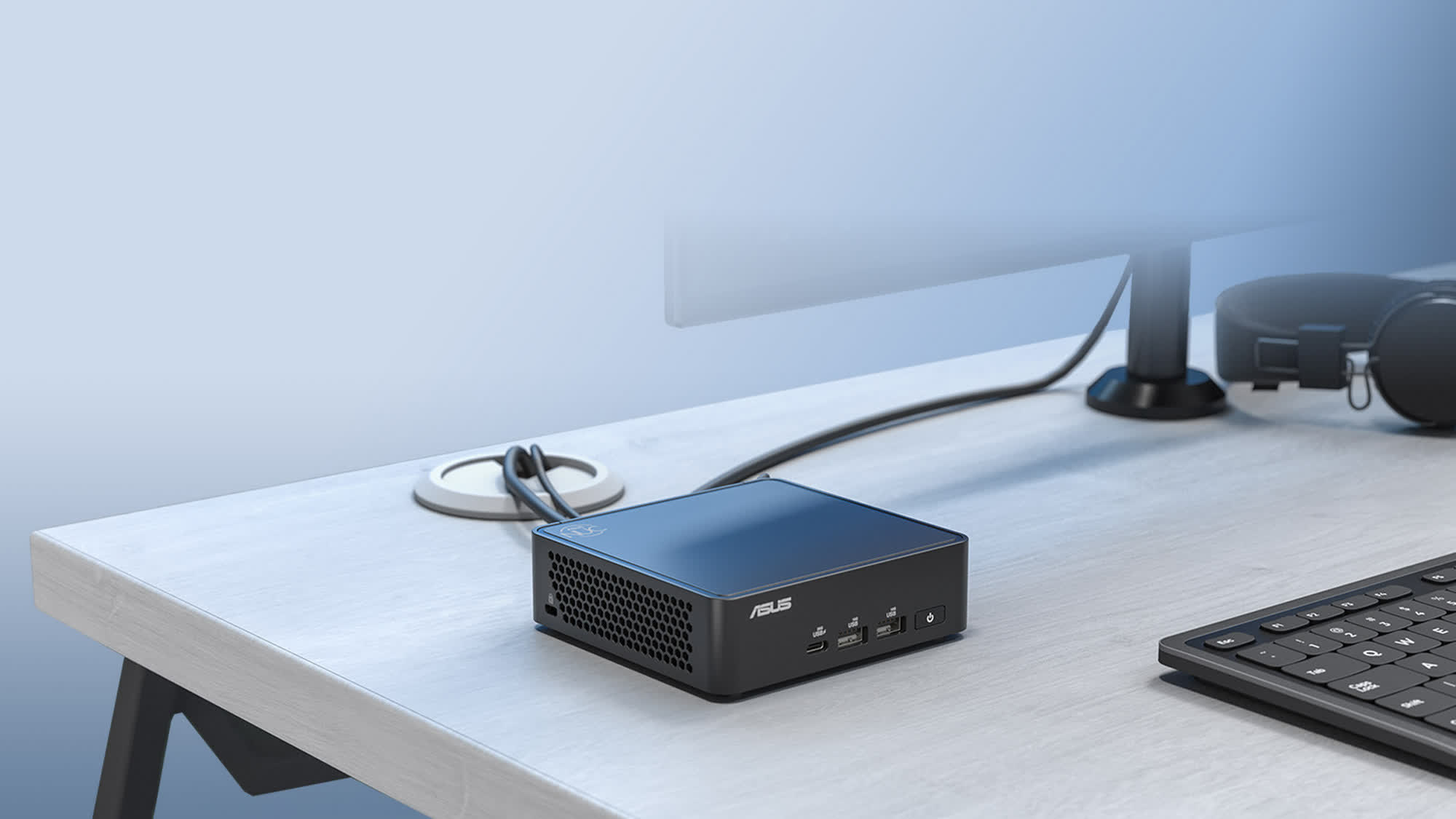
The top consumer model is powered by the Core Ultra 7 255H CPU, while the flagship enterprise model ships with the Core Ultra 7 265H. The processors used in the more affordable versions include the Core Ultra 5 235H, Core Ultra 225H, Core 7 240H, Core 5 210H, and Core 3 100U.

The new models do not include discrete graphics, but the Core Ultra variants feature an Intel Arc 140T iGPU, which should offer enough power for casual gaming. However, the Core 3, Core 5, and Core 7 variants only ship with integrated Intel Graphics. The Core Ultra models also receives up to 96 GB of DDR5-6400 memory, while the rest come with DDR5-5600 memory.

For storage, the NUC 15 Pro PCs include an M.2 2280 PCIe Gen4x4 slot with support for up to 2TB NVMe SSDs and an M.2 2242 PCIe Gen4x4 slot, supporting up to an additional 2TB SSD for a total of up to 4TB. The slots are also compatible with PCIe Gen 5 drives for easy upgrades.

The mini PCs offer fast wireless connectivity, featuring support for Wi-Fi 7 BE201 and Bluetooth 5.4 in the Core Ultra models. The Core 3, 5, and 7 variants support only up to Wi-Fi 7 BE202. According to Intel, the BE201 Wi-Fi chip supports the 320MHz channel width to deliver up to 5.8 Gbps, whereas the older BE202 chip only supports 160MHz and up to 2.4 Gbps.

Wired connectivity options include dual HDMI 2.1, dual Thunderbolt 4, triple USB Type-A 3.2 Gen 2, one USB Type-A 2.0, one USB-C 3.2 Gen2x2, and a 2.5G Ethernet port. There's also a Kensington lock on the side for increased security.

Asus did not announce anything about the availability and pricing of the NUC 15 Pro, and it has not yet published an official product page on the company's global website. We expect Asus to update its website and reveal the prices once the product is ready for launch.

Permalink to story:

 
It would be crazy to spend too much money on something that could overheat with just heavy processing utilities because of its small form factor.

On the other hand I spent $200.00 dollars on a much cheaper model for my parents for their daily use and even so I can tell it could overheat easily if they push the system to its limits.
 
I don't know why but I would. Just a preference for me.

(Maybe it's because I grew up with intel. Also the one AMD system we had stopped working for no reason at all)

Okay, that says it all right there. You don't know why? Because you are an unconditional fan of "Intel" products, maybe? There is a soft place in your heart for all things "Intel"??? Come on, man, let's get serious. Go with the best bang for the buck at the time you pull the trigger. That's wisdom. Unless you have lots of money, then do whatever you want.

What AMD system did you have that stopped working?
Do you know for a fact it was the CPU that stopped and not one of many other possible components that actually died and maybe NOT the AMD CPU?

Intel and AMD have both leap-frogged each other over the years in terms of who offers the best performance and who offers the best bang for buck. At least pick some kind of rational reason for your bias towards Intel.

 
Well, knowing AsSus like we do, this will likely be way overpriced & overhyped as usual...

Especially considering the number of other mfgr's making similar units with similar or better specs/features for less $$, so this one will probably be DOA, except the 5 or 6 diehard AsSus fans that I know of across the entire US :D
 
Okay, that says it all right there. You don't know why? Because you are an unconditional fan of "Intel" products, maybe? There is a soft place in your heart for all things "Intel"??? Come on, man, let's get serious. Go with the best bang for the buck at the time you pull the trigger. That's wisdom. Unless you have lots of money, then do whatever you want.

What AMD system did you have that stopped working?
Do you know for a fact it was the CPU that stopped and not one of many other possible components that actually died and maybe NOT the AMD CPU?

Intel and AMD have both leap-frogged each other over the years in terms of who offers the best performance and who offers the best bang for buck. At least pick some kind of rational reason for your bias towards Intel.
Yea, you are right, I am a die hard fan of intel. That system probably did die of the hard drive not the CPU, but then again, that was the ONLY system that did die that I can remember.

If I do ever buy a new system anyway, and AMD is light years away from intel, or just the Ryzen ...900X3D is the best value and way better than the Core Ultra ...85K, then that fan who was stupid enough to like Intel would die very easily. We all have our breaking point.

Also everyone can have their own preferences.

But for now, intel will be the choice for me.
 
It would be crazy to spend too much money on something that could overheat with just heavy processing utilities because of its small form factor.

On the other hand I spent $200.00 dollars on a much cheaper model for my parents for their daily use and even so I can tell it could overheat easily if they push the system to its limits.

These are mobile processors not desktop. If they don't overheat in a notebook then they aren't going to overheat here either since these have better ventilation than a laptop does.
 
I would rather take the one with AMD iGPU that can beat rtx4070

Oh you mean the imaginary one that doesn't exist? Maybe it can beat the mobile 4070 variant but ONLY when it is running in the low power mode (65W) but when you crank it up to the normal TGP of 115W it will blow the Ryzen AI 300 out of the water and it won't even come remotely close to desktop 4070 with a TGP of 200W

Those are NOT gaming APUs, those are mobile AI development APUs for laptops and the GPUs are mainly used for Compute applications (scientific) rather than gaming
 
Last edited:
These are mobile processors not desktop. If they don't overheat in a notebook then they aren't going to overheat here either since these have better ventilation than a laptop does.
Actually most laptops have better ventilation capabilities than these very compact "cube like" desktops as most laptops' components are usually separated with heatsinks and other plastic pieces in between throughout their 15" to 30 inches wide of its body frame while these cubes are barely 6 inches wide stacked up with other very hot components on top of each other.

Unless you have a Mac Mini like with high quality heat dispersion design, these cubes quality heavily depends on its ability to suppress that problem even with mobile processors.
 
Okay, that says it all right there. You don't know why? Because you are an unconditional fan of "Intel" products, maybe? There is a soft place in your heart for all things "Intel"??? Come on, man, let's get serious. Go with the best bang for the buck at the time you pull the trigger. That's wisdom. Unless you have lots of money, then do whatever you want.

What AMD system did you have that stopped working?
Do you know for a fact it was the CPU that stopped and not one of many other possible components that actually died and maybe NOT the AMD CPU?

Intel and AMD have both leap-frogged each other over the years in terms of who offers the best performance and who offers the best bang for buck. At least pick some kind of rational reason for your bias towards Intel.

First of all, calm down. People come to this community for help and to share helpful insights.

Secondly, why are you attacking the OP for having a preference for the CPU manufacturer that has a proven track record for over 30 years and that is also preferred by both business and consumers thanks to the reliability, availability and support of their products? AMD is definitely comparable NOW but they definitely weren't too long ago and they were also not as focused on serving the general public as much as niche demographics (I.e., gamers, CAD users, etc.). It's also pretty simple to determine which component is causing issues so I am not sure why you are questioning their troubleshooting capabilities with the little information that was provided. It is not rocket science.

Also, clearly you are an AMD fanboy and/or have a bone to pick with intel. Stop projecting and start advising in a helpful manner or, just zip it if you are adding zero value to the discussion.

Anyway, that's my 2 cents. And, to practice what I preach and to be helpful to HAZERD2, AMD processors are not better than intel processors across the board.

In fact, if you believe in facts over feelings that is, Intel CPUs fail far less than AMD CPUs.

Anyone can get a lemon at any time.

https://www.pcworld.com/article/241...g-less-often-than-amd-according-to-puget.html

https://www.pugetsystems.com/blog/2...-perspective-on-intel-cpu-instability-issues/
 
Actually most laptops have better ventilation capabilities than these very compact "cube like" desktops as most laptops' components are usually separated with heatsinks and other plastic pieces in between throughout their 15" to 30 inches wide of its body frame while these cubes are barely 6 inches wide stacked up with other very hot components on top of each other.

Unless you have a Mac Mini like with high quality heat dispersion design, these cubes quality heavily depends on its ability to suppress that problem even with mobile processors.
But the reason laptops have all those extra copper pieces is, more than likely, because of all the surrounding components that would be consuming ventilation air space that is not constrained in a "cube like" mini-PC. What sits directly above a laptop? Built-in keyboard. Guess what sits above the top of my mini-PC? Nothing. In fact, nothing consumes the ventilation space on the other 5 sides of my mini-PC unless I'm dumb enough to build up those blockages myself by not putting in a well ventilated area.

So, I don't think your making a good case for laptops having superior cooling systems just because they have copper heatsinks. I think they're much more constrained therefore they demand more intricate cooling designs. They're not superior, they're sufficient for the environment they are used in.

I bought a mini-PC, like 5 years ago now, that has an AMD Ryzen 5 4500U and it's still kicking and ticking to this day. So, yes, I would buy AMD again.

But that's only because I look at the generational technology available to me at my time of purchase, compare both sides, and then ask what the best value is. It's pretty simple for me really. AMD has been on a winning streak for a few years now.

So, they get my money until that changes substantially.
 
Back