AV1 codec now powers 30% of Netflix streaming as company looks forward to AV2

Daniel Sims

Posts: 2,464   +74
Staff
Recap: Support for the AV1 codec has grown considerably since its launch in 2018. Large and small platforms quickly adopted the format to minimize bandwidth consumption while preserving image quality. Netflix, a primary backer of AV1, plans to continue expanding the codec across its applications while also utilizing it and its upcoming successor for new ventures.
Netflix recently confirmed that the AV1 codec is responsible for nearly one-third of its streaming content. In a lengthy Medium post, the company explained how it helped foster the codec's creation and gradually adopted it across various devices.

The Alliance for Open Media (AOMedia), a consortium that includes Netflix, Amazon, Apple, Google, Microsoft, Mozilla, Nvidia, and other companies, launched AV1 in 2018 as a successor to Google's VP9 format. The codec compresses data more efficiently than the popular H.264 format and is royalty-free, unlike H.265/HEVC.
Decoding and encoding support for AV1 has rapidly spread to modern mobile devices, PC graphics chips, and other hardware over the past several years. During that time, users ranging from large companies to independent content creators have applauded its performance improvements.

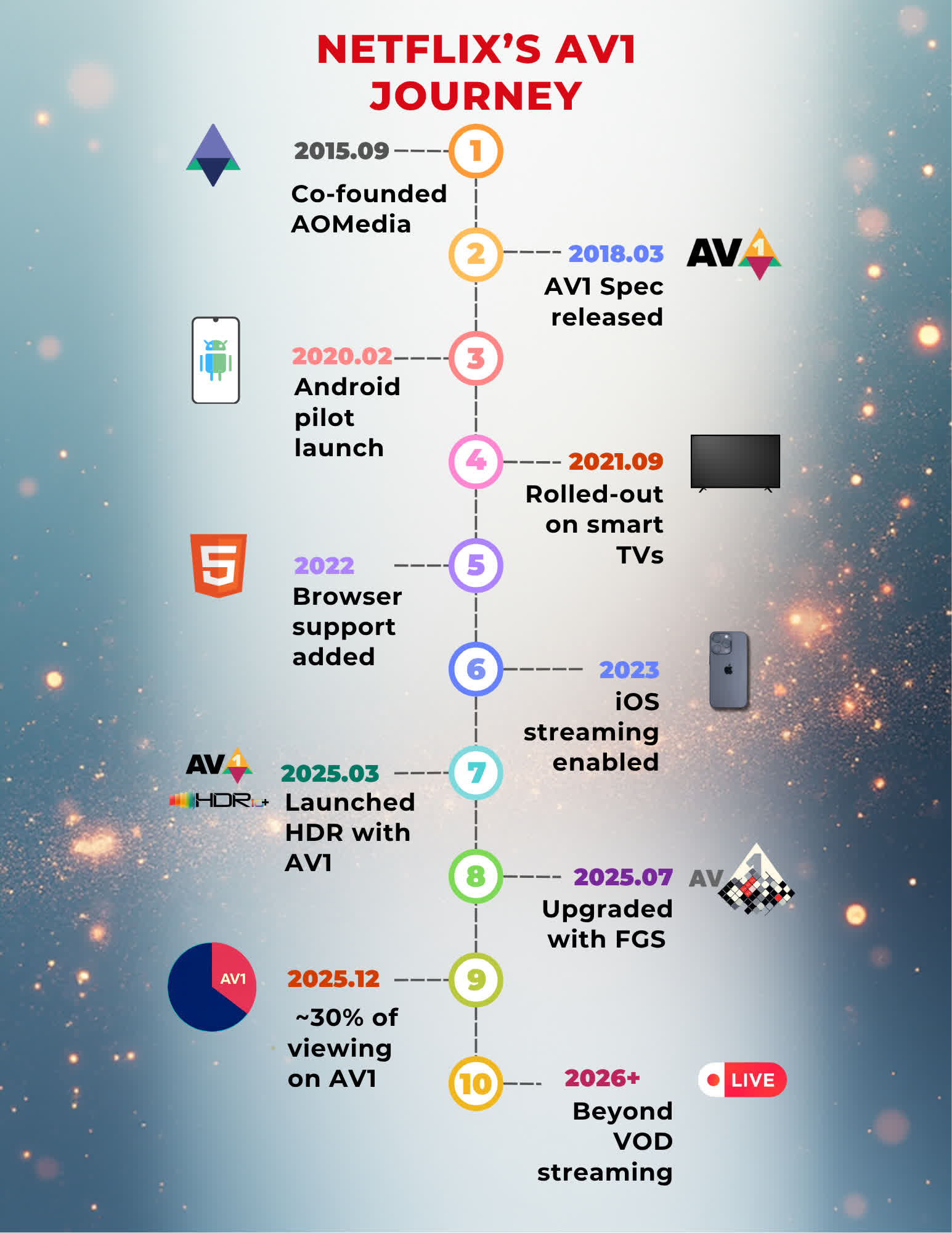
Netflix began adopting AV1 software decoding on Android devices in 2020 due to the platform's flexibility and the prominence of mobile devices among streaming audiences. Using the dav1d library, which developers had already optimized for mobile Arm chipsets, the company improved video playback quality for users on cellular networks.

However, bringing AV1 to smart TVs and other home devices required hardware-based decoding, which Netflix gradually certified in collaboration with SoC vendors. The company rolled out the codec on TVs in late 2021, added support for web browsers in 2022, and extended it to Apple's M3 and A17 Pro chips in 2023.
Earlier this year, Netflix rolled out AV1 HDR streaming using HDR10+. The format now covers 85 percent of the company's HDR catalog, and the company plans to transition all its HDR content to AV1 within the next few months.

Netflix explained how AV1 enables smarter film grain integration through Film Grain Synthesis, which strips grain from content before encoding and resynthesizes it in the decoder, lowering bandwidth usage while maintaining quality. The company also hopes the codec will enhance live streaming with customizable graphics overlays and improve cloud gaming performance.

AOMedia recently announced plans to launch AV2 before the end of this year. The new codec will deliver more efficient compression than AV1, supporting technologies such as augmented and virtual reality, split-screen streaming, and more.

The updated codec will come in handy when Netflix starts churning out new and old content from Warner Bros. The streaming titan recently agreed to purchase the production company for a historic $82.7 billion. The acquisition will give Netflix control over popular properties, including Game of Thrones, DC Comics, HBO, and multiple video game studios.

Permalink to story:

 
I just tried to convert an image to AVIF and realized it takes like 35 seconds on a high-end CPU lol. AV1 must be great for video, but I can't see it gaining traction for images.

JPEG will reign for the foreseeable future. Even its successor, JPEG XL, has struggled to gain traction.
 
That timeline is a sobering look at how long this all takes. It's better, it's free, and it's backed by an alliance of giants, but after 10 years in some ways we're still just getting started.
 
AV1 is a great codec. Most people don't understand that it is also a very nice denoiser. That's how it reduces detail at lower quality settings, by removing noise first. This means that unless you have a verified pipeline for grain synthesis, from encoder to client, AV1 should not be used to grainy film content. If your content has no grain? AV1 is king.

HEVC for grain, AV1 for everything else.

Also, when HEVC fails to hold detail, it breaks into blocks, but when AV1 fails to hold detail it looks like mushy plastic. Just an amusing observation.
 
Film Grain Synthesis always sounds like black magic to me. Remove grain, put it back later, and somehow it looks better while using less data. If only my laundry worked the same way.

I'm still not completely sold on the synthesis because of course they're going to talk it up, but step one is removing the existing grain, which is almost never a perfect process without it taking at least some detail with it. With step 2 being to add that grain back, I can't help but feel like the result mixes old noise with new noise. Softening the values of the grain is also a valid approach, but doesn't retain the true look. It's the approach I use if the true look was objectively hideous or poorly handled at any level. Always compromises, always trade-offs... tailor to your priorities.
 
I converted my whole PLEX server to AV1 and saved 200Gb. Can't wait for AV2.
How much space was everything taking up before you converted to AV1?

I'm sitting on about 4TB of shows/movies on my server all under codec H.264....wondering if it's worth taking the time to covert it to AV1.
 
I'm sitting on about 4TB of shows/movies on my server all under codec H.264....wondering if it's worth taking the time to covert it to AV1.

If you do, remember to test the first one against all the client devices you may want to watch it on. Support is not yet universal especially on older and lower-capability devices.
 
JPEG will reign for the foreseeable future. Even its successor, JPEG XL, has struggled to gain traction.
At least with JPEGs there's a good base line.
Bet we're stuck with GIFs for the foreseeable future as well and it's a terrible format, huge files and massive limitations and not too friendly on CPU usage either.
The only somewhat similar (but very different) thing I've seen gain traction is Lottie (which is a json file), which can even run on really low end hardware like an esp32 chip. Or animated pngs... but browser support is flaky making it a no-go.
 
AV1 is a great codec. Most people don't understand that it is also a very nice denoiser. That's how it reduces detail at lower quality settings, by removing noise first. This means that unless you have a verified pipeline for grain synthesis, from encoder to client, AV1 should not be used to grainy film content. If your content has no grain? AV1 is king.

HEVC for grain, AV1 for everything else.

Also, when HEVC fails to hold detail, it breaks into blocks, but when AV1 fails to hold detail it looks like mushy plastic. Just an amusing observation.
That's the problem with AV1's implementations: grain tends to be destroyed, creating a plastic-looking picture. SVT-AV1-PSY, the popular fork, can handle grain as well as older encoders but requires a great deal of tuning.

Film Grain Synthesis always sounds like black magic to me. Remove grain, put it back later, and somehow it looks better while using less data. If only my laundry worked the same way.
I'm still not completely sold on the synthesis because of course they're going to talk it up, but step one is removing the existing grain, which is almost never a perfect process without it taking at least some detail with it. With step 2 being to add that grain back, I can't help but feel like the result mixes old noise with new noise. Softening the values of the grain is also a valid approach, but doesn't retain the true look. It's the approach I use if the true look was objectively hideous or poorly handled at any level. Always compromises, always trade-offs... tailor to your priorities.
AV1's marketing was directed towards FGS, but it is not ideal in present implementations, both the denoising and synthesis parts. At any rate, in all video compression, grain is the most challenging thing to encode, being temporally random and breaking the frame-to-frame prediction of other, unchanging blocks. If only there were an academic breakthrough in coding noise, this age-old problem would be over.

I wonder how it compares to "jpeg2000"?
I haven't compared against JPEG 2000, but there were massive gains relative to JPEG and PNG, both of which XL aims to replace. It can also repackage older JPEGs losslessy, gaining a bit of compression from better entropy coding.

At least with JPEGs there's a good base line.
Bet we're stuck with GIFs for the foreseeable future as well and it's a terrible format, huge files and massive limitations and not too friendly on CPU usage either.
The only somewhat similar (but very different) thing I've seen gain traction is Lottie (which is a json file), which can even run on really low end hardware like an esp32 chip. Or animated pngs... but browser support is flaky making it a no-go.
Yes, GIF needs to go in the bin, but it's not happening any time soon. I've not seen Lottie. JPEG XL can handle animation, too, so it stands to be a potential successor.
 
How much space was everything taking up before you converted to AV1?

I'm sitting on about 4TB of shows/movies on my server all under codec H.264....wondering if it's worth taking the time to covert it to AV1.
Mine was well compressed already since they were H.265 and HEVC. I went from 10Tb to 9.5Tb. But since you are coming from H.264, you will see about a 30% reduction, I would think?
 
Re-encoding only makes sense if you're starting from a higher quality source than the final product. AV1 is a lossy codec, so if you re-encode something that was already lossy, you'll have losses on top of losses. does re-encoding reduce the file (beware, you can also multiply its size if the encoder is not well set)? Yes. Because much of the fine detail, high frequencies, structures were already eliminated in the first encoding, so the second encoding has an easier time reducing them, but it will also eliminate the remaining detail. You might end up with something that looks plasticky. You can take a 1080p file from 40Mbps down to 4Mbps (as a maximum, less on average if it's a variable bitrate) and still get 1080p with the best possible quality barely different from the source material, but it has to be a very controlled process, not something you can do with just a couple of clicks. Besides, it takes time.

I encode my own stuff, the things I want to save, at 720p, or even some (like some animated content) at 480p. I don't need more. And I do it in H.265 10-bit with variable bitrate, sometimes limiting the maximum bitrate. But the sources are 1080p or 4K, and of the best possible quality, sometimes from Blu-ray. And the encoding parameters are as effective as possible depending on the type of content. Does it take hours? Yes, it doesn't matter. But the results are the best possible.
 
Last edited:
AV1 is impressive for efficiency, but re-encoding an existing library is only worth it if you know your sources are high enough quality and your playback devices can handle it. The gains are real, especially coming from H.264, but you trade time and possibly some detail depending on how the first encode was done. For anyone with mixed devices, testing a couple of files first saves a lot of frustration.
It's not about the storage, really. It is about ability to transcode on fly. If I watch a video from my home server, I rather use as little bandwidth as possible, so if I watch on a tablet or mobile it is better to get it transcoded to AV1 and 1080p, no matter what is the source format. This save time and if I'm outside my place, bandwidth is important as well. AV1 is perfect for that.
 
Last edited:
A mixture of HEVC and H.265 so it was already well compressed.
I'm finding Plex to be very picky on HEVC/H.265 that I'm starting to abandon it. It seems Plex won't do HEVC .MKV files. It stutters, is slow and when choosing to Convert Automatically, my $5000 PC with a nVidia 4090 converting it, Plex gives an error at the TV that the server can't keep up. Stupid. I like the smaller size files, but not at the expense of reliability.

I've got 1000's of titles on Plex and cannot imaging converting them (Handbrake?) all to AV1. Plus, do Apple TV 4K boxes even work with AV1?
 
I wonder how it compares to "jpeg2000"?

In some ways similar, but jpegXL can offer lossless compression, lossless recompression is faster to encode, produces better results at a given compression level, and also supports depth maps and overlays. jpegXL is intended to be the successor to jpeg2000 which onoy really took off in medical and cinema industry due to wavelet compression

What we need to see is the frankly not-fit-for purpose, jpg standard abandoned by camera and phone makers and replaced by jpgXL which allows existing jpg to be converted without any additional loss and is backward compatible.
 
Back