
What just happened? Blue Origin's long-delayed New Glenn program has suffered a dramatic setback. A rocket being prepared for what would have been the vehicle's fourth flight exploded during a hotfire test at Cape Canaveral Space Force Station yesterday, destroying the vehicle in a massive fireball that lit up Florida's Space Coast.
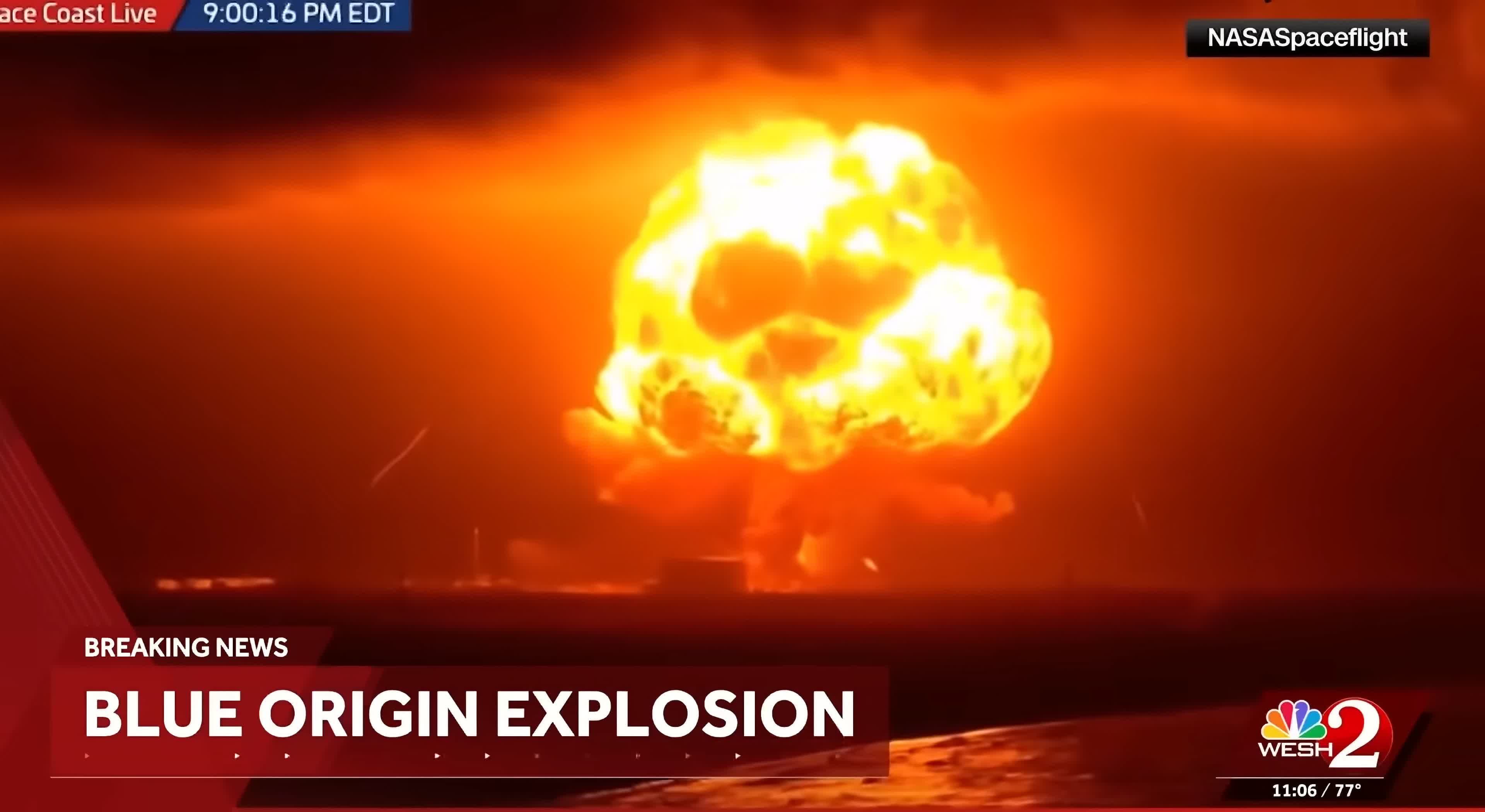
The test took place at Launch Complex 36 at about 9 pm ET. Static fire tests verify engines and ground systems while the rocket remains clamped to the pad – it's usually one of the final checks before launch. In this case, livestream footage showed the vehicle beginning to fire before flames spread around the base and New Glenn disappeared inside an explosion.
Blue Origin described the incident as an "anomaly," adding that everyone was safe.
"We experienced an anomaly during today's hotfire test. We will provide updates as we learn more."
Jeff Bezos later posted that all personnel were accounted for and safe, adding:
"It's too early to know the root cause but we're already working to find it. Very rough day, but we'll rebuild whatever needs rebuilding and get back to flying. It's worth it."
– Jeff Bezos (@JeffBezos) May 29, 2026
The Federal Aviation Administration (FAA) told TechCrunch it was aware of the explosion and said there was "no impact to air traffic."
The good news is that there were no reported injuries or fatalities, and the 48 Amazon Leo satellites New Glenn was expected to carry were not on board. The bad news is that Blue Origin has only one dedicated New Glenn launchpad, and footage after the blast suggested severe damage to surrounding equipment, which could mean a lengthy pause for the program.
The rocket had been preparing for an early June mission to place Amazon's Leo broadband satellites into low Earth orbit, part of the company's attempt to build a Starlink rival. New Glenn is also central to Blue Origin's wider ambitions, including national security launches and NASA work. The company was planning to attempt as many as 12 launches of New Glenn this year.
– Sawyer Merritt (@SawyerMerritt) May 29, 2026
The explosion comes at a difficult moment for Bezos' space firm. New Glenn reached orbit on its first flight in January 2025 after years of delays, though the booster was lost before it could land.
Its second flight, in November, was more encouraging. But April's third flight suffered a cryogenic upper-stage failure that left an AST SpaceMobile satellite in the wrong orbit. The FAA cleared the rocket to fly again only last week.
New Glenn is expected to support Artemis and Moon Base missions, and NASA awarded Blue Origin a $188 million lunar rover delivery contract just days before the explosion.
NASA Administrator Jared Isaacman said the agency would support the investigation.
"Spaceflight is unforgiving, and developing new heavy-lift launch capability is extraordinarily difficult."
– NASA Administrator Jared Isaacman (@NASAAdmin) May 29, 2026
SpaceX chief Elon Musk offered his own reaction: "Most unfortunate. Rockets are hard."
– Elon Musk (@elonmusk) May 29, 2026
Blue Origin's New Glenn rocket explodes in massive fireball during testing in Florida


