Discord's age-check crackdown is already pushing users elsewhere

Skye Jacobs

Posts: 1,913   +58
Staff
What just happened? Discord's global rollout of mandatory age verification is forcing millions of users to reconsider a chat service long treated as the backbone of online gaming and community building. Starting in March 2026, the company will reclassify every account as a "teen" profile unless users verify their age with facial recognition or a government-issued ID.
The decision, announced on February 9, signals a major shift in Discord's approach to moderation and compliance. The company says the system will apply universally, overriding prior account settings and community affiliations.

Once implemented, unverified accounts will lose access to age-restricted channels, blurred images will remain permanently obscured, and direct messages will be limited to existing friend lists.

What alarms users most is the requirement to share highly personal data with a platform that suffered a large-scale information breach just last year. That incident reportedly exposed records from Discord's earlier identity checks, affecting more than 70,000 users.

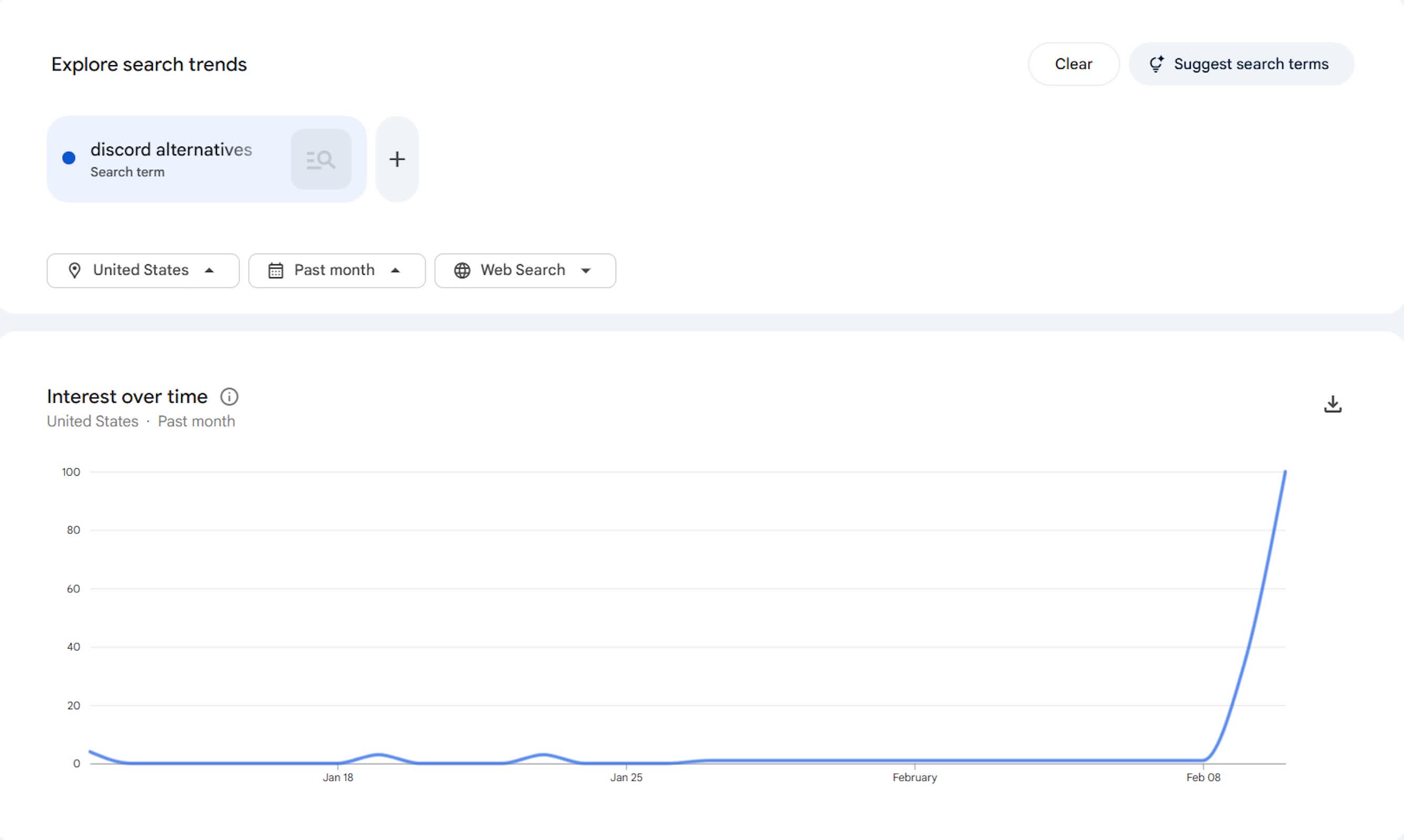
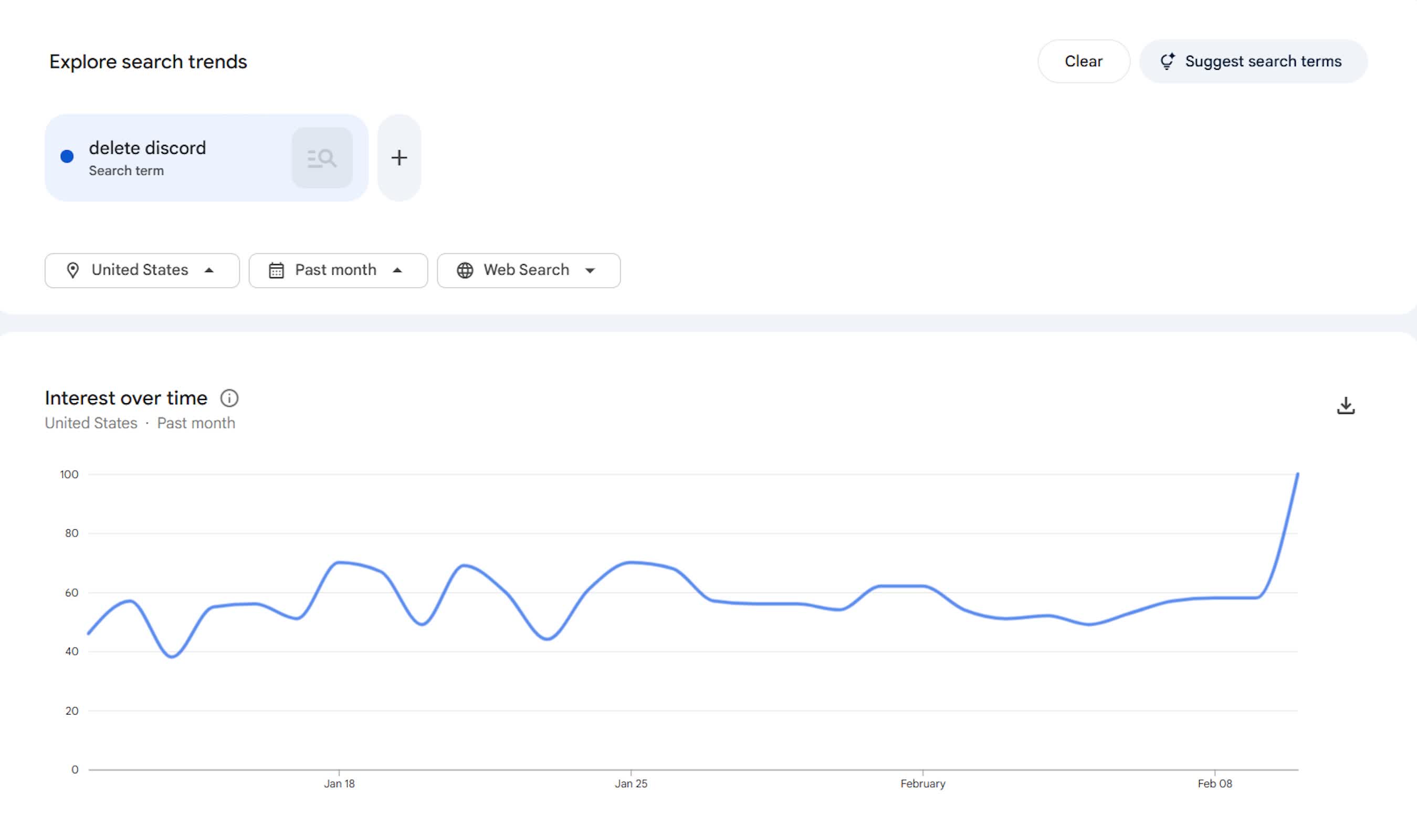
In the week following Discord's announcement, public sentiment turned sharply against the policy. Search interest in "Discord alternatives" surged by roughly 10,000% in the US, eclipsing typical volume from the past month. Queries for "Delete Discord" doubled in the same period, signaling that the company's privacy gamble could cost it more than goodwill.

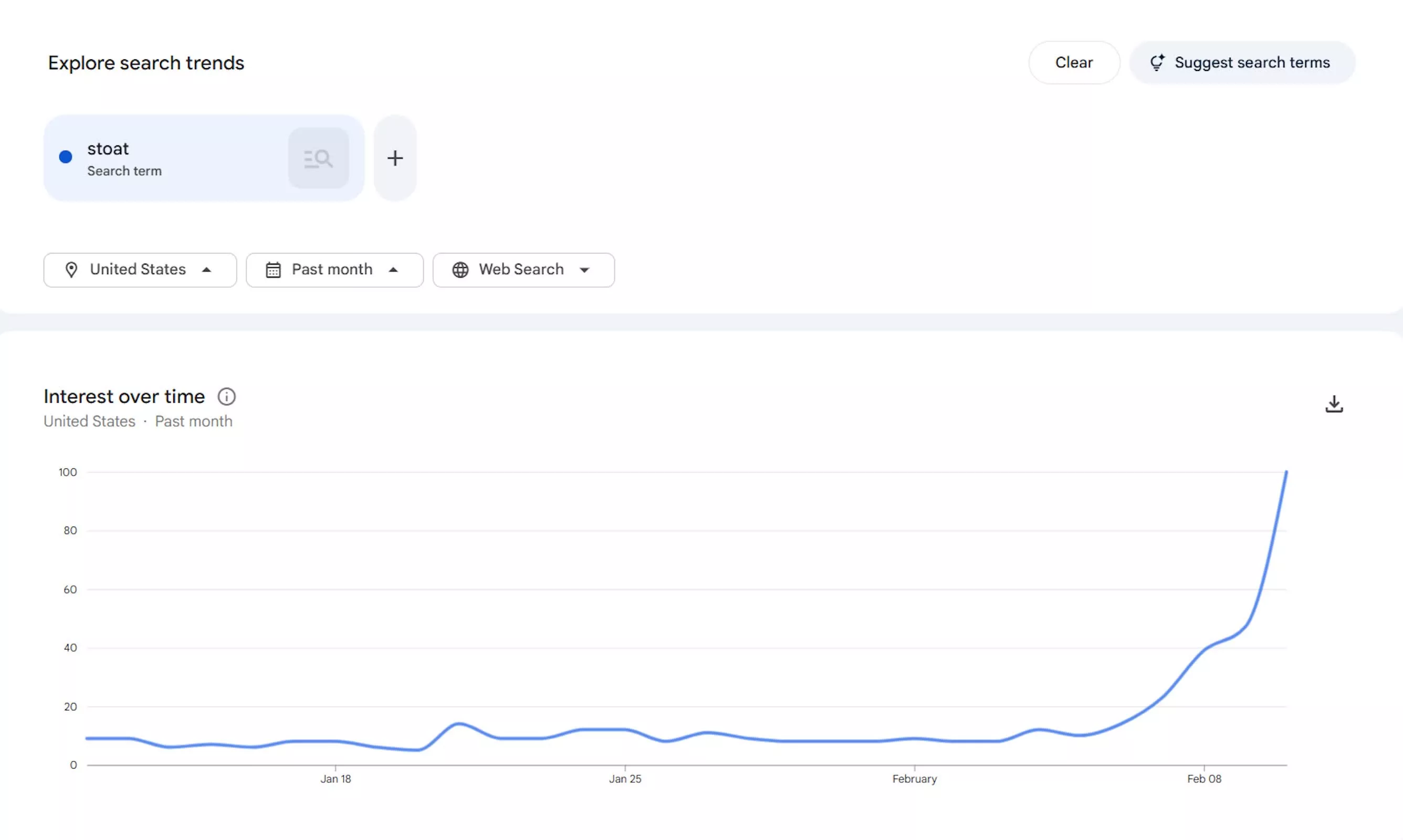
The beneficiaries of that backlash are a familiar set of decentralized and open-source platforms. Stoat, the rebranded version of Revolt, saw search traffic jump by nearly 9,900%, with the older "Revolt" term rising another 4,100%.
Stoat markets itself as a privacy-first chat platform with open-source transparency, echoing early Discord's appeal before its corporate repositioning.

Matrix, a decentralized communication protocol, recorded a 2,133% increase in searches; classic IRC climbed 1,500%; and Mumble, the original low-latency voice solution prized by early gamers, rose by 1,000%.
Discord's age-verification system isn't without precedent. Components of the policy have been in testing in the UK and Australia since late 2025 as part of broader age-compliance efforts tied to online safety regulations. The company's decision to hardcode "Teen-by-Default" settings for the global user base appears to extend those experiments worldwide, effectively treating every user like a minor until proven otherwise.
For a platform built on frictionless communication, Discord now faces a paradox: enhancing safety by introducing one of the most intrusive verification models seen in mainstream social media. Whether users trust the system – or leave for services better aligned with their privacy expectations – will define the company's next major chapter.

Permalink to story:

 
Nobody can trust Discord. Their company model is pure evil, and their data breaches have already exposed user data, including IDs.

Perhaps they should have left the ID eurojank in Europe where it came from, instead of forcing it on everyone. Oh well. Nobody will miss them.
 
Nobody can trust Discord. Their company model is pure evil, and their data breaches have already exposed user data, including IDs.

Perhaps they should have left the ID eurojank in Europe where it came from, instead of forcing it on everyone. Oh well. Nobody will miss them.

It's not pure evil. You don't have to commit a human sacrifice to use it. However I do think that Discord is going to go under or barely stay a float with their policy.
 
Matrix is the original decentralised chat system and Mumble is the original low-latency solution for early gamers?

Teamspeak. The answer to both is Teamspeak. Nobody is talking about it (here or in other articles I've seen) even tho it's fully decentralised by design, still allows self-hosting, and I am fairly certain it's quite a lot older than Mumble too.
 
" pushing users elsewhere " Users is a vague term. There is an article on Techspot about anti cheating methods being used with Fortnite which is going to force "users" somewhere else. I'm not a Discord user though I have an account. There is a reason Discord is doing this, "Once implemented, unverified accounts will lose access to age-restricted channels, blurred images will remain permanently obscured, and direct messages will be limited to existing friend lists." Age restricted channels, see that? A company is actually trying to be a good servant, maybe, but all they get is grief from "users".
 
" pushing users elsewhere " Users is a vague term. There is an article on Techspot about anti cheating methods being used with Fortnite which is going to force "users" somewhere else. I'm not a Discord user though I have an account. There is a reason Discord is doing this, "Once implemented, unverified accounts will lose access to age-restricted channels, blurred images will remain permanently obscured, and direct messages will be limited to existing friend lists." Age restricted channels, see that? A company is actually trying to be a good servant, maybe, but all they get is grief from "users".
A "good servant" would MAC ban the people who keep trying to spread that content to minors, or are proven predators. Notably, they do not force ID to post links, so the preds can still use discord to harvest their prey, then direct them offsite, all without IDing.

This fixes nothing but it does destroy your privacy for the illusion of security.
 
" pushing users elsewhere " Users is a vague term. There is an article on Techspot about anti cheating methods being used with Fortnite which is going to force "users" somewhere else. I'm not a Discord user though I have an account. There is a reason Discord is doing this, "Once implemented, unverified accounts will lose access to age-restricted channels, blurred images will remain permanently obscured, and direct messages will be limited to existing friend lists." Age restricted channels, see that? A company is actually trying to be a good servant, maybe, but all they get is grief from "users".
I don’t buy their good intentions sorry. I live in the UK and we’ve had to provide ID to access all features since September last year. They got hacked into in October and loads of ID they claimed “was never stored” was stolen.

That hasn’t been forgotten but does Discord care? No. I view this partial ID approach as a warm up for ID being mandatory to access the platform full stop some time from now.
 
" pushing users elsewhere " Users is a vague term. There is an article on Techspot about anti cheating methods being used with Fortnite which is going to force "users" somewhere else. I'm not a Discord user though I have an account. There is a reason Discord is doing this, "Once implemented, unverified accounts will lose access to age-restricted channels, blurred images will remain permanently obscured, and direct messages will be limited to existing friend lists." Age restricted channels, see that? A company is actually trying to be a good servant, maybe, but all they get is grief from "users".
I think the idea of age verification itself, protecting minors from adult content, makes sense in principle. Online platforms should be responsible about keeping kids safe, and laws in some countries are pushing them that direction.

But the way it’s done matters a lot. If verification requires uploading sensitive IDs to private companies, that raises real privacy and security concerns. People aren’t just whining...they’re worried about how their data gets stored, used, or shared.
 
I think the idea of age verification itself, protecting minors from adult content, makes sense in principle. Online platforms should be responsible about keeping kids safe, and laws in some countries are pushing them that direction.

But the way it’s done matters a lot. If verification requires uploading sensitive IDs to private companies, that raises real privacy and security concerns. People aren’t just whining...they’re worried about how their data gets stored, used, or shared.
100% this.

Protecting minors online is a legitimate objective. But “scan your face or upload your passport” is not an appropriate way to achieve it—and treating it as the default solution is a lazy, half-assed approach.

Discord’s rollout is a textbook example of compliance by overcollection. Instead of asking, “What’s the minimum data required to prove someone is over X age?” they’re demanding you hand over high-risk identity data to a private company that already experienced an identity data breach. That’s not just clumsy—it’s indefensible, from a security design standpoint.

There are already better models available—including privacy-preserving age tokens and third-party verification systems that confirm age without storing sensitive documents. When a company chooses the most intrusive option instead of the most responsible one, users are justified in walking away. Market pushback seems the only signal that encourages companies to implement safety measures without sacrificing privacy. As such, I support abandoning them to the waste-bin of history if this is the best they can do.
 
I mean it’s called discord…
(disagreement between people.)
Discor_evil_S2E1.png
 
My Discord account is just over 10 years old now. Unless I signed up when I was 7 or younger, I should be considered an adult by Discord lol. Can I get a pass?

EDIT: It sounds like I won’t need to verify my age. TechSpot should improve their reporting because the article is wrong and borderline lying in many places:
Discord said:
Discord will implement its age inference model, a new system that runs in the background to help determine whether an account belongs to an adult, without always requiring users to verify their age. Some users may be asked to use multiple methods if more information is needed to assign an age group.

Key privacy protections of Discord’s age-assurance approach include:

- On-device processing: Video selfies for facial age estimation never leave a user’s device.
- Quick deletion: Identity documents submitted to our vendor partners are deleted quickly— in most cases, immediately after age confirmation.
- Straightforward verification: In most cases, users complete the process once and their Discord experience adapts to their verified age group. Users may be asked to use multiple methods only when more information is needed to assign an age group.
- Private status: A user’s age verification status cannot be seen by other users.
[…]
- Discord is not requiring everyone to complete a face scan or upload an ID to use Discord.
- The vast majority of people can continue using Discord exactly as they do today, without ever being asked to confirm their age.
- You need to be an adult to access age-restricted experiences such as age-restricted servers and channels or to modify certain safety settings.

For the majority of adult users, we will be able to confirm your age group using information we already have. We use age prediction to determine, with high confidence, when a user is an adult. This allows many adults to access age-appropriate features without completing an explicit age check.
 
Last edited:
100% this.

Protecting minors online is a legitimate objective. But “scan your face or upload your passport” is not an appropriate way to achieve it—and treating it as the default solution is a lazy, half-assed approach.

Discord’s rollout is a textbook example of compliance by overcollection. Instead of asking, “What’s the minimum data required to prove someone is over X age?” they’re demanding you hand over high-risk identity data to a private company that already experienced an identity data breach. That’s not just clumsy—it’s indefensible, from a security design standpoint.

There are already better models available—including privacy-preserving age tokens and third-party verification systems that confirm age without storing sensitive documents. When a company chooses the most intrusive option instead of the most responsible one, users are justified in walking away. Market pushback seems the only signal that encourages companies to implement safety measures without sacrificing privacy. As such, I support abandoning them to the waste-bin of history if this is the best they can do.
And how does one establish this "age token"? How are you able to attach this to a person without someone, at some point, knowing their identity? Same with third party verification, the only way THEY cna verify is if they somehow know who you are too.

All these systems rely on your private information at the end of the chain.
 
And how does one establish this "age token"? How are you able to attach this to a person without someone, at some point, knowing their identity? Same with third party verification, the only way THEY cna verify is if they somehow know who you are too.

All these systems rely on your private information at the end of the chain.

This has been proven and implement many a time - see GNU Taler which also used in switzerland for some things. It is possible to do this without giving out personal information
 
Matrix is the original decentralised chat system and Mumble is the original low-latency solution for early gamers?

Teamspeak. The answer to both is Teamspeak. Nobody is talking about it (here or in other articles I've seen) even tho it's fully decentralised by design, still allows self-hosting, and I am fairly certain it's quite a lot older than Mumble too.
TS is, indeed, the original voice tool and has been used by many across a lot of games since 2001. I've used it since 2005 when I started playing EVE and continue to use it today as it's easy to set up and simple to manage.

Mumble is more stable when hosting large numbers of people but my corp (guild/clan) prefers TS over Mumble.
 
As I had mentioned in a response before - the issue isn't age verification, the issue is the stupid implementation and having it handled intransparently by shady companies without disclosing actual mechanisms and opening them up for review. Zero knowledge proof exists and has been implemented - regulators need to mandate that and review implementations. Task people who know their **** like the CCC with providing an implementation.
 
These age gates will change the internet permanently, and not at all in the ways these legislators think. People simply disappear into private, p2p and underground services while governments try to restrict more and more. The hard truth is that governments cant lock down internet without breaking it in the process.
 
Doesn't matter how it's done because the trust element has long been broken. Everyone has been lied to time and time again by social media companies whilst they abuse their position and shamelessly lie in every way possible to make as much money as possible. Everything about age verification could be done by 3rd party entities beyond doubt using proxied networks with volatile memory... and still no one would trust. We've been fkd over way too many times.
 
TS is, indeed, the original voice tool and has been used by many across a lot of games since 2001. I've used it since 2005 when I started playing EVE and continue to use it today as it's easy to set up and simple to manage.

Mumble is more stable when hosting large numbers of people but my corp (guild/clan) prefers TS over Mumble.
Sorry, the original used by gamers was Roger Wilco.
 
Back