What just happened? Asrock recently revealed its new HUDIMM memory technology, aiming to help keep PC costs down as the industry navigates an unprecedented supply chain strain driven by the AI boom. The new modules are not yet available in stores, but early benchmark results suggest that the cheaper DRAM may not have a significant impact on gaming frame rates.
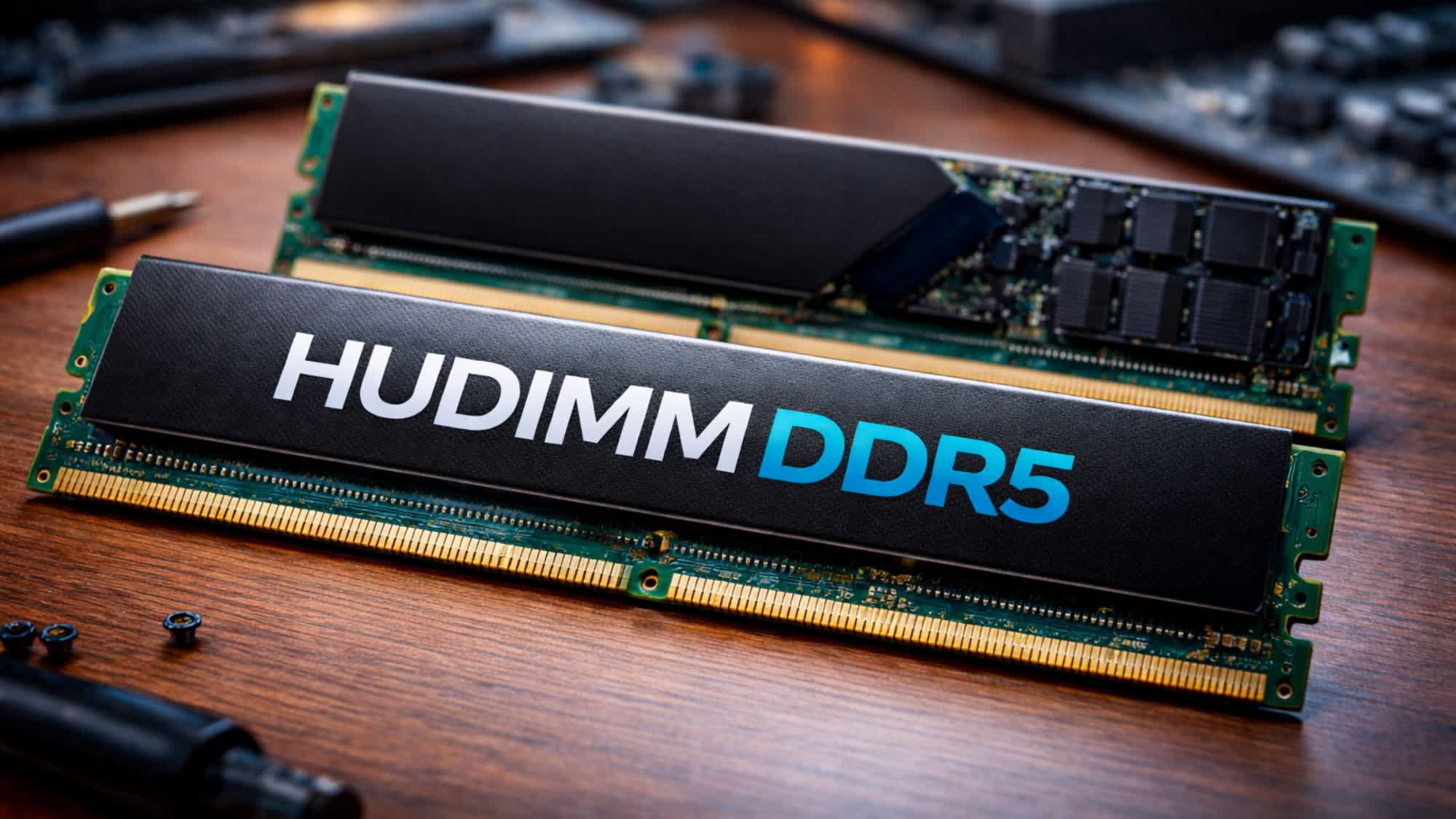
The new HUDIMM memory modules are expected to significantly reduce memory bandwidth and I/O throughput, but the change should not affect overall performance in gaming-focused systems. According to benchmark sessions recorded by YouTuber Bryan B., a "simulated" HUDIMM DDR5 module appears capable of competing with two standard DDR5 UDIMM sticks.
HUDIMM is a patent-pending memory design intended to halve the number of integrated circuits used in standard DDR5 memory. A HUDIMM module uses a single 32-bit sub-channel to move data back and forth, while DDR5 modules have traditionally used a dual 32-bit sub-channel architecture to maximize capacity and bandwidth.
Asrock said HUDIMM DDR5 modules should be cheaper than UDIMM DDR5 alternatives, offering a response to ongoing pressures in the semiconductor supply chain. HUDIMM could help keep PC prices in check for both OEM system integrators and consumers looking to buy an affordable new computer that is not specifically designed for heavy gaming workloads.
Bryan B. highlighted the potential capabilities of HUDIMM memory for gaming in a recent video. He explored different approaches to simulate HUDIMM modules, which would theoretically provide half the memory bandwidth of a standard UDIMM module.
In the end, the YouTuber compared a single 16GB DDR5 UDIMM module against a 2×16GB DDR5 dual-channel configuration. He benchmarked the simulated HUDIMM scenario against the dual-channel setup using both an AMD Ryzen 7 9800X3D and a Core Ultra 7 265K.
The results suggest HUDIMM could be an interesting option for lower-cost gaming systems. Titles such as Cyberpunk 2077, Counter-Strike 2, and Marvel Rivals showed little performance difference between 1×16GB and 2×16GB configurations at 1080p, suggesting that modern x86 CPUs do not necessarily require dual UDIMM DDR5 modules to deliver strong gaming performance.
That said, the simulated HUDIMM results should be taken with a grain of salt for now. The actual memory products are not yet available for proper testing and may ultimately behave differently from a standard UDIMM DDR5 configuration. Additionally, Bryan B.'s selection of benchmarked games was relatively limited.
Early tests show minimal performance impact from new budget HUDIMM DDR5 memory


