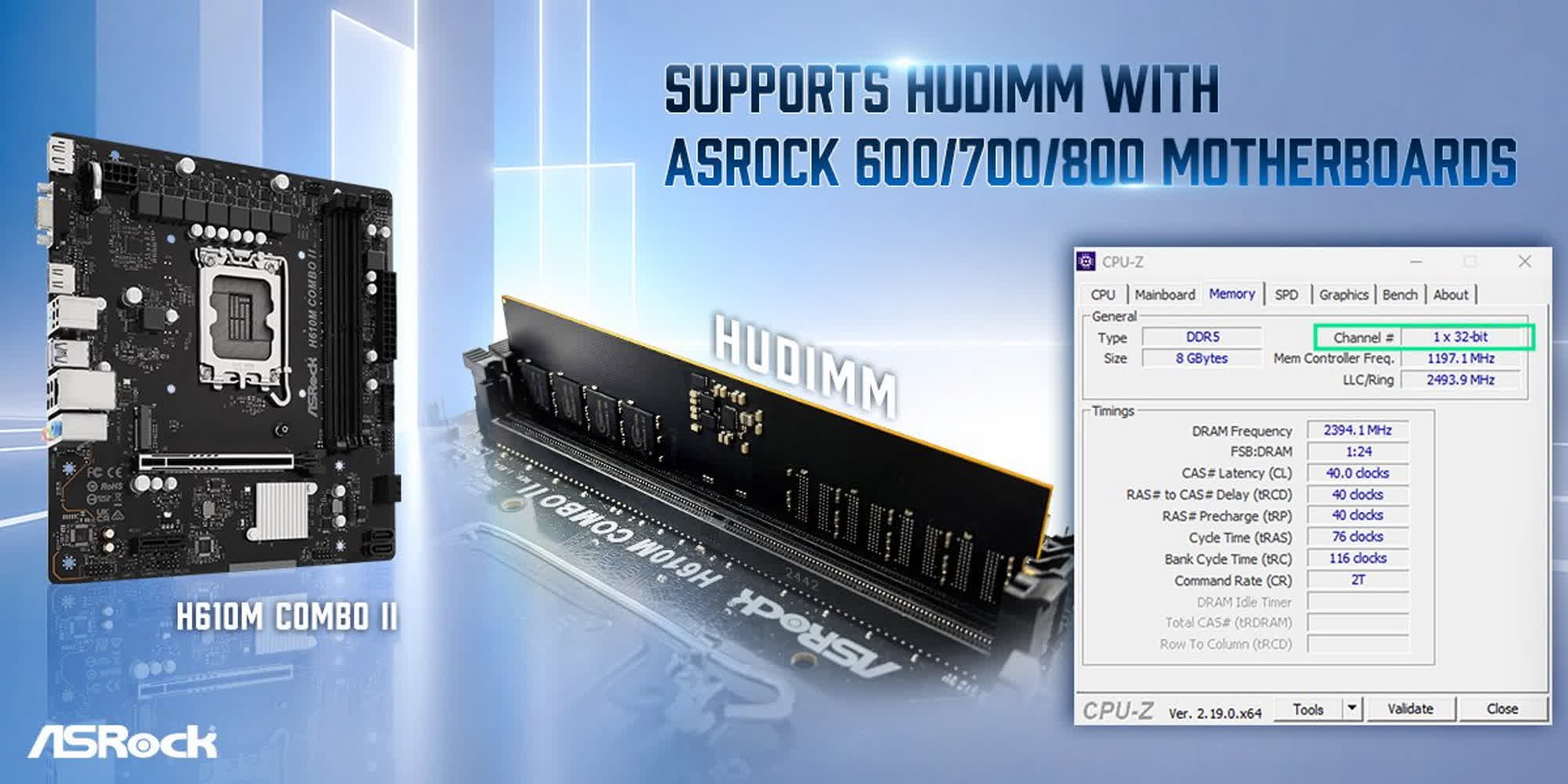
Please Burst: Asrock recently introduced the HUDIMM standard, a new type of DDR5 RAM module designed to slash performance and keep the PC memory market affordable throughout some never-before-seen market conditions. The new HUDIMM modules are essentially a worse edition of traditional DDR5, because memory prices inflated by enterprise and AI demand have pushed capable consumer hardware increasingly out of reach for mainstream buyers.
The company describes HUDIMM as a patent-pending solution aimed at giving system integrators more flexibility and a lower cost of entry. Standard DDR5 modules use a two sub-channel architecture, with a 2×32-bit configuration optimized for both capacity and throughput.
HUDIMM cuts that in half, moving to a single 32-bit sub-channel and reducing the number of DRAM chips per stick accordingly. The result is reduced bandwidth and lower memory density, trade-offs Asrock is positioning as acceptable given what the alternative currently costs.
Asrock co-developed the standard alongside Intel and TeamGroup. Intel has already moved to support HUDIMM modules across motherboards built on its 600, 700, and 800-series chipsets, and described the technology as a necessary response to present market conditions – a way to serve customers who need affordable computing devices and for whom peak memory performance is no longer the primary concern.
Intel added that HUDIMM should carry forward the broader benefits of the DDR5 platform at a lower price point for the foreseeable future. Whether consumers see a deliberate performance cut as an "innovation" is another matter.
TeamGroup, for its part, says the one sub-channel design was developed to address the current demand environment for DRAM. Together with GPUs, storage, and essentially everything else, memory chips are now being harvested like fresh crop by enterprises and Big Tech players looking to build more data centers than the planet can arguably sustain.
That pressure has rippled into the consumer market, where component pricing now reflects dynamics that have little to do with typical PC upgrade cycles, and quite a lot to do with infrastructure buildouts most buyers will never directly benefit from.
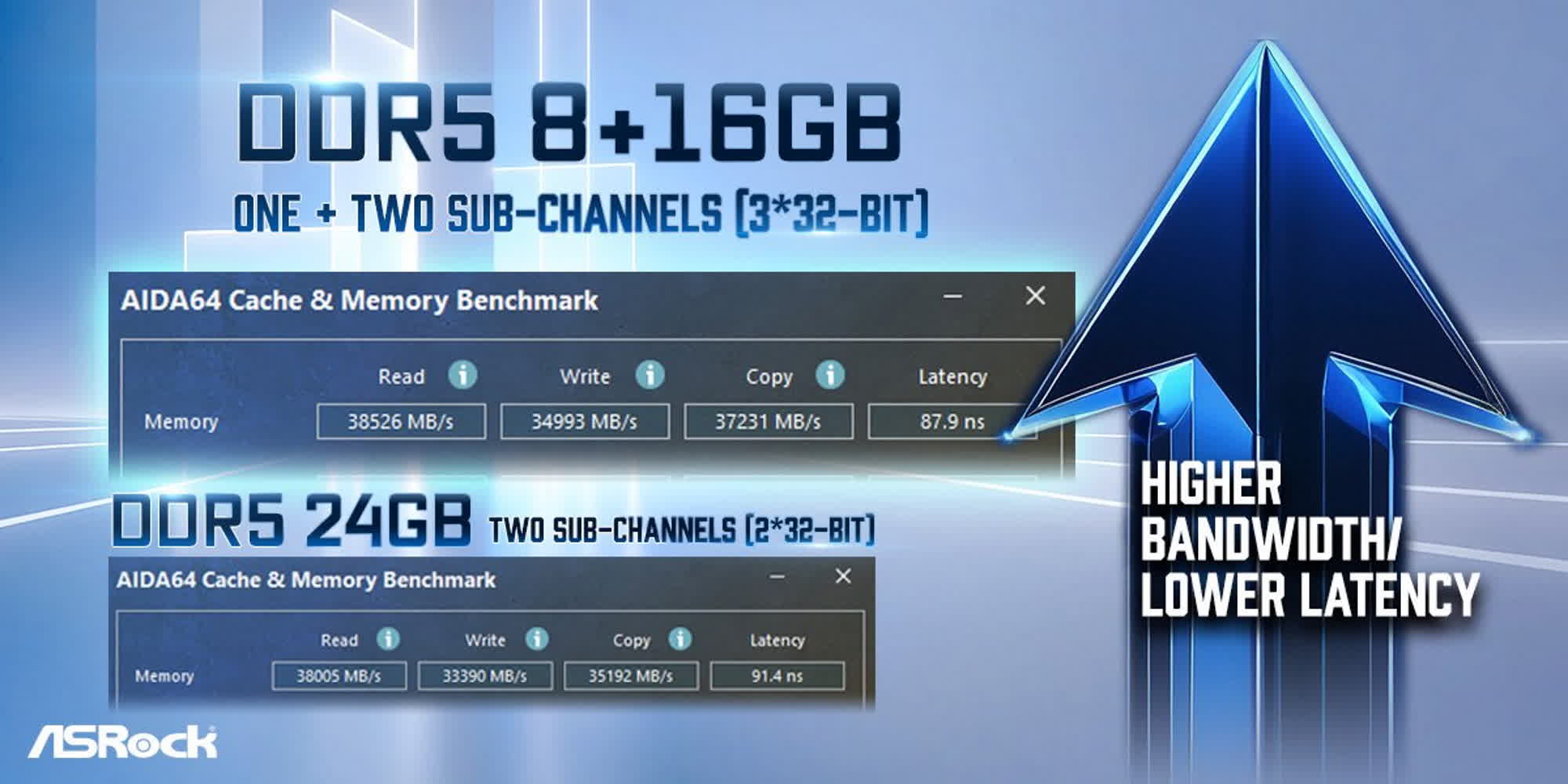
Asrock is also highlighting HUDIMM's compatibility with mixed-module configurations as a partial remedy for its performance limitations. On the Asrock H610M-Combo-II motherboard, pairing an 8GB HUDIMM module with a standard 16GB DDR5 module can, according to the company, produce better bandwidth results than running a single 24GB DDR5 module alone.
Support for the standard is also being extended to smaller form factors. Asrock plans to bring HUDIMM to its DeskMini line through an HSODIMM variant, targeting the laptop and mobile-adjacent segment of the market where affordability concerns are similarly acute.