Looking ahead: Quantum computing's greatest promise remains its greatest paradox: the same conditions that let qubits perform extraordinary feats of calculation also make them exceptionally fragile. Even the slightest vibration, photon, or heat fluctuation can erase information. Researchers at Chalmers University of Technology in Sweden have now taken a counterintuitive step toward solving that problem – by using noise, rather than eliminating it.

In a paper recently published in Nature Communications, the Chalmers team unveiled what they call a minimal quantum refrigerator. The device operates not by shielding qubits from disturbances but by exploiting controlled randomness – precisely tuned microwave noise – to direct heat flow within superconducting circuits.
This unconventional approach provides a new mechanism to stabilize quantum systems that are otherwise overwhelmed by microscopic energy changes.
At the center of the experiment is a superconducting "artificial molecule," built not from atoms but from electronic circuits. Like a natural molecule, it exchanges energy through two microwave channels, which serve as hot and cold reservoirs.
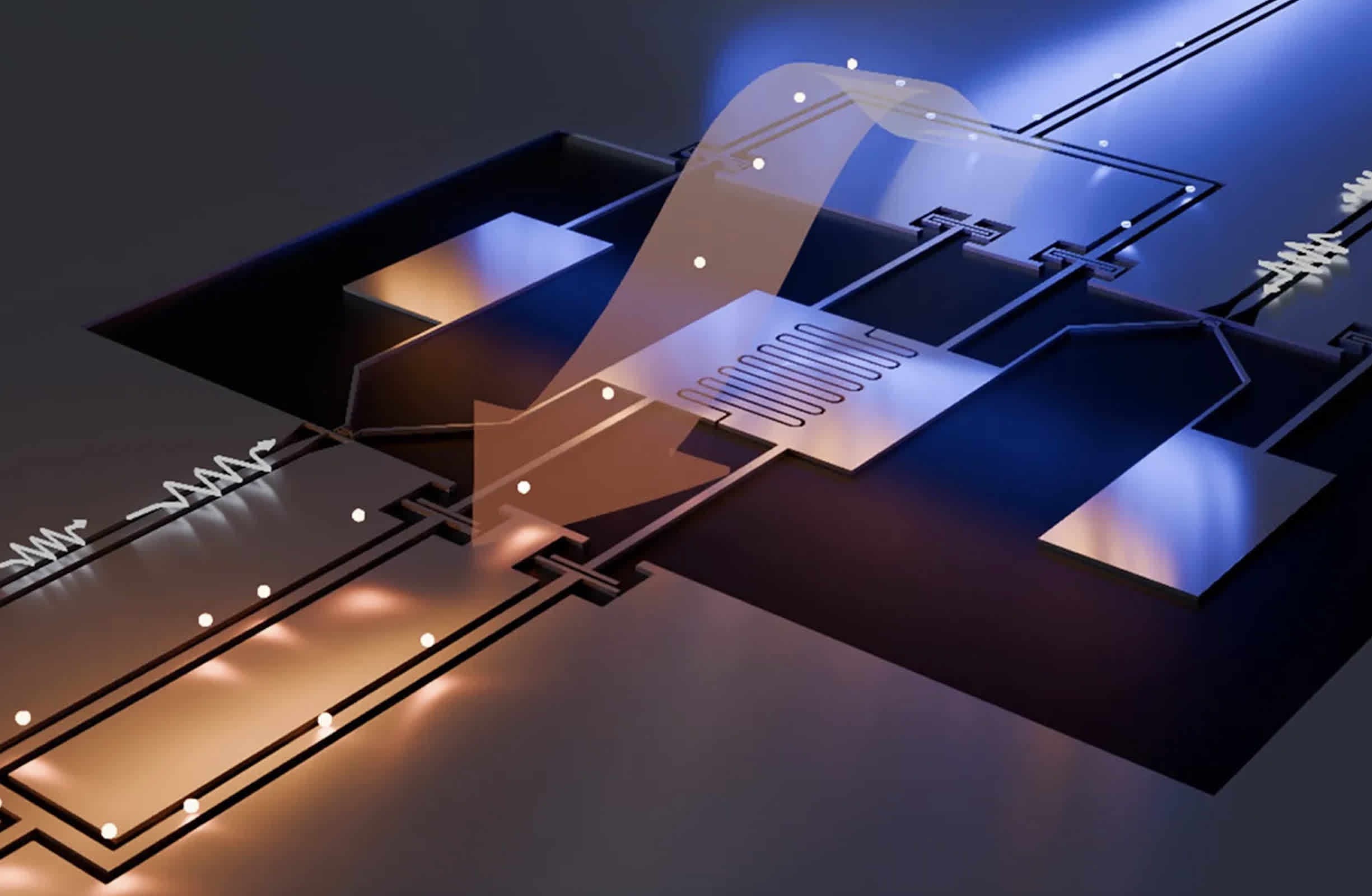
Two microwave channels, shown in red and blue, serve as hot and cold energy sources connected to a pair of coupled qubits. By sending controlled microwave noise into the system, researchers can drive and control how heat flows between the qubits.
When researchers introduce a controlled band of random signal fluctuations through a third channel, the injected noise initiates and modulates thermal transport between the reservoirs, effectively functioning as a switch for heat flow.
Simon Sundelin, a doctoral student in quantum technology and lead author of the study, describes the principle as one of guided dissipation: by deliberately shaping the noise spectrum, the team can measure and control heat currents on the order of attowatts, revealing how heat behaves at nearly immeasurable scales.
To put that in perspective: if such a tiny current were used to warm a drop of water, it would take longer than the age of the universe to raise its temperature by a single degree Celsius.
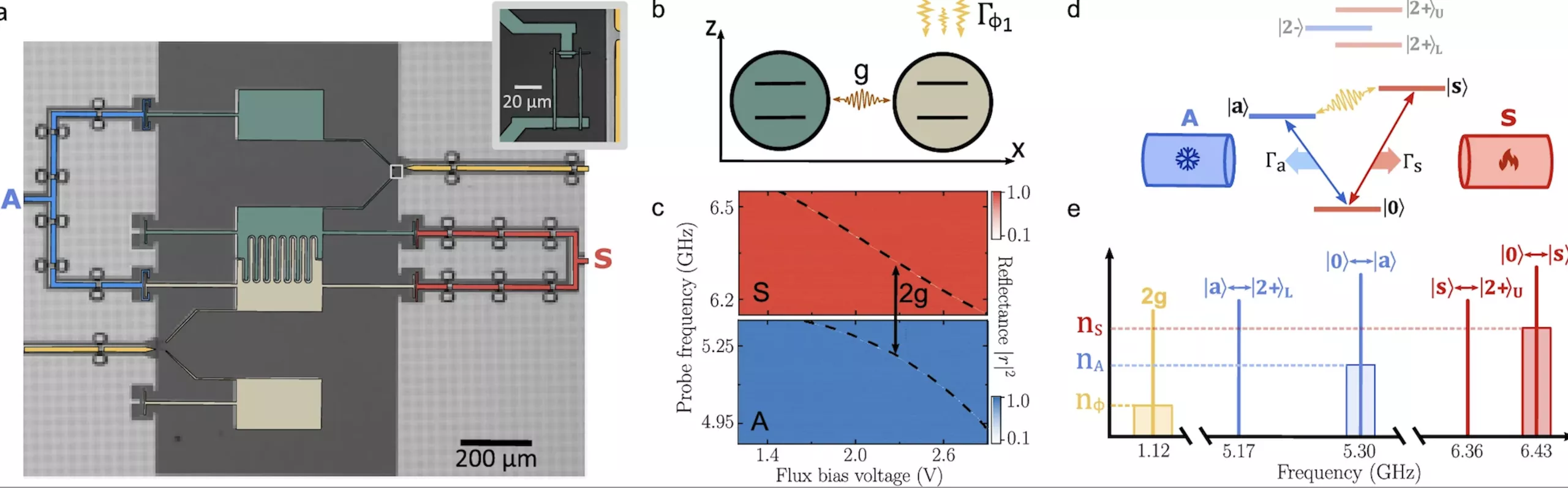
The image shows two tiny quantum circuits (transmon qubits) linked by microwave guides and control lines. By adjusting electrical signals through these connections, researchers can tune how the qubits interact and share energy, helping them study how quantum states change and lose coherence.
The idea draws from a long-standing theoretical concept known as Brownian refrigeration: the notion that random motion, under the right conditions, can generate a directional cooling effect.
Simone Gasparinetti, an associate professor of quantum technology at Chalmers and the study's senior author, calls the group's device the most complete realization of that theory so far. By giving noise a constructive role, the researchers have found a way to balance thermodynamic flow at a scale where conventional cryogenic refrigeration falls short.
Quantum processors based on superconducting circuits – like those built by IBM, Google, and others – must operate at temperatures near absolute zero, roughly – 273°C. Under those conditions, electrons move without resistance, enabling the entangled states that underpin quantum logic.
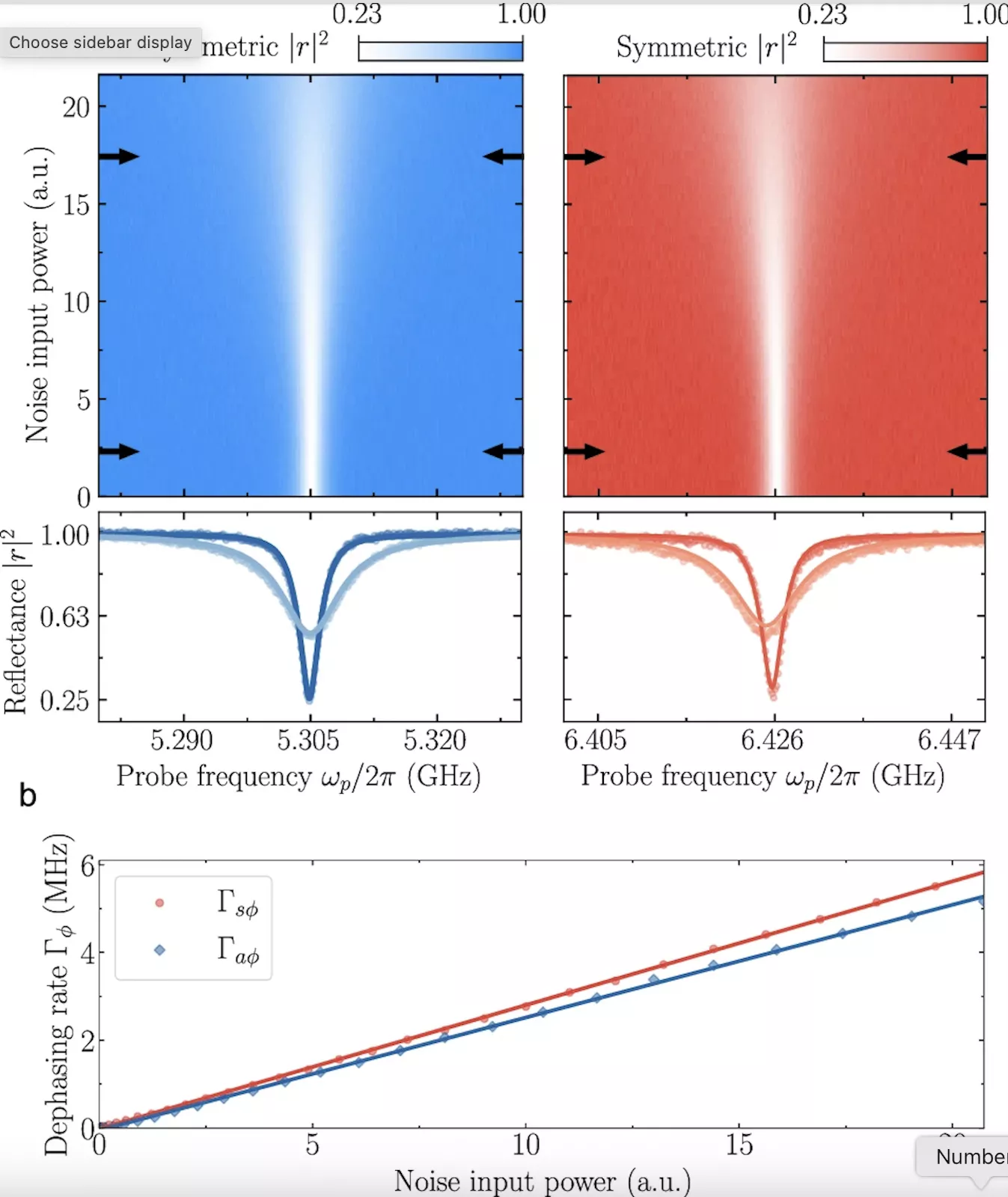
The illustration shows how the reflected signal from the device changes with probe frequency and added noise for two modes of the system – symmetric (red) and antisymmetric (blue). As the noise increases, the plots show that each mode loses coherence, allowing the researchers to measure its dephasing rate.
And yet, even at near-zero temperatures, heat remains one of quantum computing's most stubborn adversaries. In large-scale architectures, the number of potential heat and noise sources rises dramatically, making direct thermal control crucial for any realistic quantum machine.
Chalmers' minimal refrigerator, intriguingly, isn't limited to cooling. Depending on how its reservoirs are tuned, it can also operate as a heat engine or even an amplifier. That versatility could prove critical for designing modular quantum components that manage dissipation locally across a processor.
Aamir Ali, a co-author of the study, notes that what distinguishes this approach is its scale: it enables heat regulation "from within" the quantum circuit itself, rather than relying entirely on external bulk refrigeration.
The advance does not eliminate the formidable barriers to practical quantum computing, but it reframes one of its central problems. Rather than treating noise as a purely destructive force, Chalmers' work shows that, when properly engineered, randomness can become part of the solution.
Engineers just found a way to cool quantum systems using microwave noise


