
Ask virtually anyone what's happening in the tech industry right now, and you'll hear the same answer: the AI is coming, the AI is coming. But while that high-level trend is obvious, what's been less clear is that a hybrid AI model – one that spans major public cloud providers, on-premises data centers and private clouds, as well as edge computing devices – is driving the most significant change.
To better understand this shift, TECHnalysis Research commissioned a survey of over 1,000 IT decision-makers from medium and large organizations across ten US industries. The results are compelling. The study shows that the era of "cloud-first" thinking for AI workloads is rapidly giving way to a more nuanced, hybrid approach that balances the strengths of public cloud, private infrastructure, and the edge.
For years, the public cloud was heralded as the ultimate destination for enterprise workloads, promising scalability, flexibility, and cost savings. Yet as artificial intelligence has become central to business strategy, organizations are re-evaluating where their most critical workloads should live.
The survey reveals that a massive wave of companies is actively moving AI workloads back from the public cloud to private infrastructure, driven by concerns over cost, security, and privacy. This isn't a retreat from innovation – it's a sign of market maturity. Enterprises are embracing a "cloud-smart" strategy: using the public cloud for training, private infrastructure for sensitive data, and the edge for real-time inference.
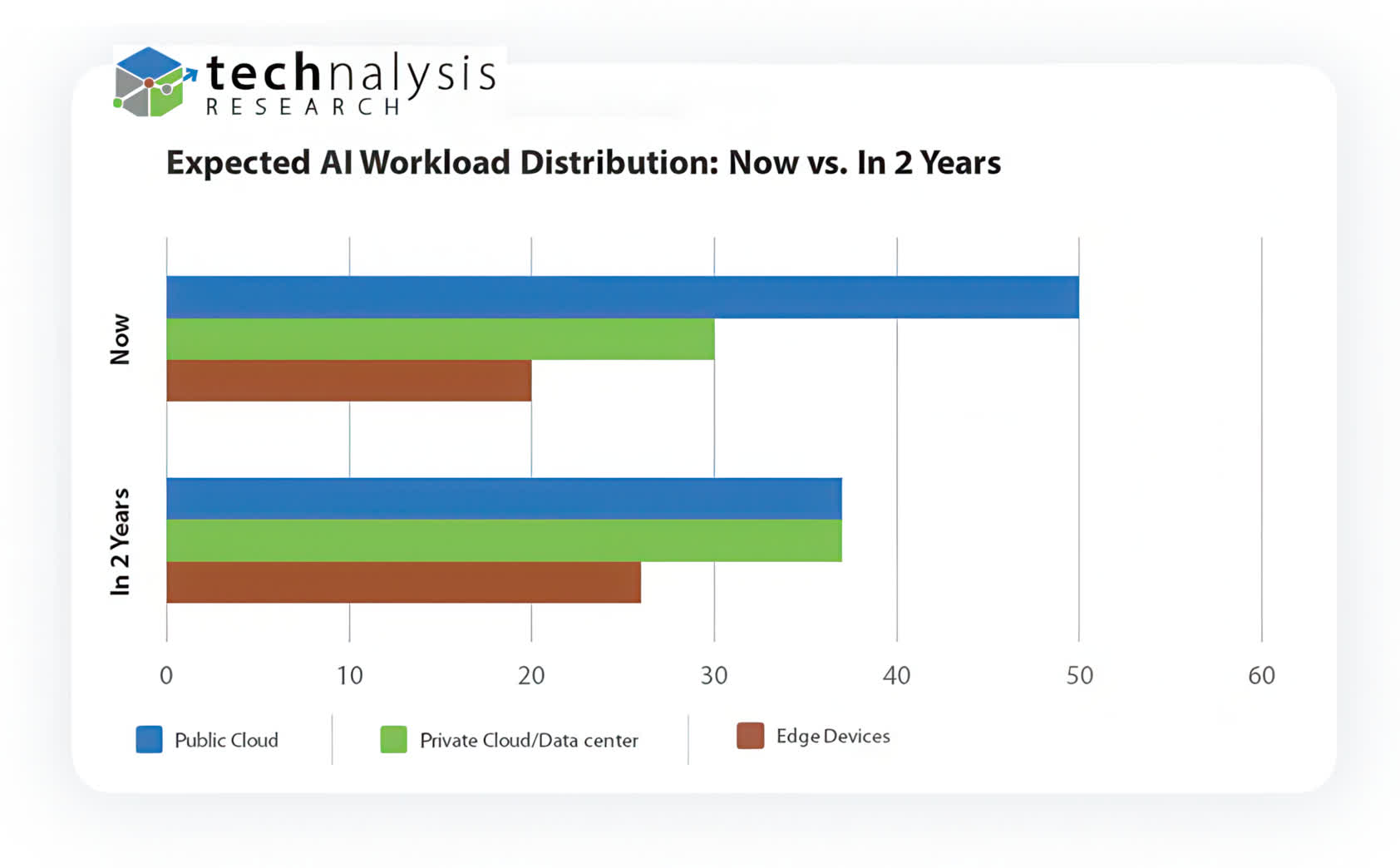
Fig. 1
Let's look at the numbers. Eighty percent of organizations in the study have already repatriated AI workloads, are planning to do so, or are considering it. Only one-fifth say they have no plans to bring anything back on-prem. That's not a fringe trend – it's the market maturing. And the shift is backed by budget: more than three-quarters expect their investment in on-premises AI infrastructure to rise over the next one to three years. In short, capital is moving toward local compute.
To be clear, this doesn't mean companies are abandoning the cloud for AI. In fact, for today's most common GenAI and ML use cases – including content generation, predictive analytics, and code generation – the public cloud remains the dominant platform. The nuance is that it's no longer the only platform – and for some categories, it's no longer the best one. Robotics and automation already lean edge-first, a reminder that physical-world use cases have very different requirements.
The net result is that more than 80% of IT decision-makers believe a hybrid architecture is important for their organization, and nearly three-quarters are actively pursuing or developing plans for hybrid AI deployments. The top drivers for this shift are clear. Cost reduction is paramount, as running all AI workloads in the public cloud has proven expensive. Data security and compliance are essential, particularly for regulated industries, and keeping sensitive information on-premises or on-device is now a critical requirement for many new AI applications.
According to the survey, 80% of organizations have already repatriated AI workloads, are planning to, or are considering it. Only 20% have no plans to do so. The top reasons mirror the drivers of hybrid AI: cost control, privacy, and security. Many organizations also want to take advantage of their existing on-premises infrastructure investments, and more than 77% expect their on-prem AI spending to increase over the next one to three years.
But hybrid AI isn't just about the cloud and the data center – it also includes the edge. Nearly 60% of organizations have already deployed AI to edge devices or are planning to. The benefits of edge AI are clear: real-time performance, personalization, and stronger data privacy through local processing. The challenges, however, are substantial. Organizations face device resource constraints, the difficulty of managing and updating models across thousands of distributed devices, the need to develop edge-optimized models, and ongoing concerns around data security and privacy.
Hybrid AI is no longer a niche strategy – it's the new default for enterprise computing
One of the study's most surprising findings concerns how organizations expect AI workload distribution to evolve. Looking two years ahead, respondents forecast a roughly balanced three-way split of AI workloads across public cloud, private cloud or on-premises data centers, and edge devices.
This is a profound change. It implies that infrastructure teams, data guardians, and app developers will need to think horizontally – about building and governing AI systems designed from the start to land in multiple places with consistent security, observability, and lifecycle management. It also means enterprises will need to standardize on ways to move models and data between environments without friction.
Another notable finding from the study is the growing importance of NPUs for AI PCs, which can serve as key edge devices. Despite a slower-than-expected start for AI PC software, decision-maker awareness and intent are unmistakable. Eighty-five percent say on-device NPUs are important to their AI applications today, and that figure climbs past 90% when looking two years out.
The market has moved past "cloud-first" to "cloud-smart," balancing workloads based on specific needs. The key drivers – cost, security, and privacy – are universal, and the future is a balanced three-way split across public cloud, private data centers, and edge devices. Hybrid AI is no longer a niche strategy – it's the new default for enterprise computing.
The Executive Summary for the TECHnalysis Research study "The Future of AI is Hybrid" is available for free here.
Bob O'Donnell is the founder and chief analyst of TECHnalysis Research, LLC a technology consulting firm that provides strategic consulting and market research services to the technology industry and professional financial community. You can follow him on X @bobodtech
Enterprise AI shifts toward a balanced cloud, edge, and on-prem mix


