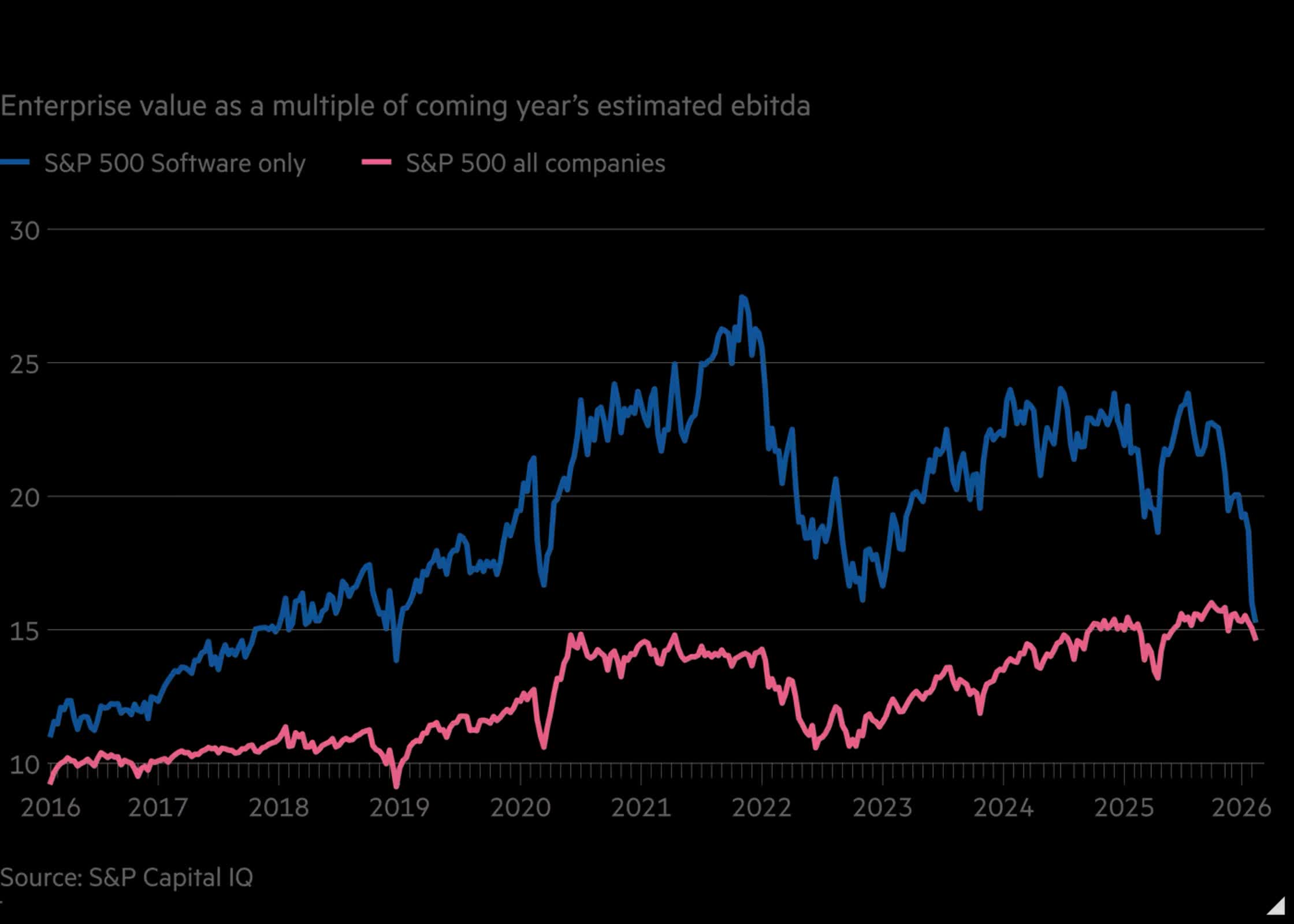
Bottom line: The economics of enterprise software are entering their most dramatic recalibration since the shift to the cloud. As autonomous AI agents begin to handle work once performed exclusively by humans, the fundamentals of how software is priced – and how investors value these firms – are being redrawn in real time.

For decades, the predictable rhythm of the per-seat licensing model shaped the industry. Businesses paid fixed subscriptions based on headcount, and software makers enjoyed stable, recurring revenue.
It was a simple equation: more employees meant more licenses, and once those users were embedded into a system, they rarely left. This steadiness allowed valuations to swell and made software-as-a-service a private equity favorite – dependable, debt-friendly, and easy to forecast.
That predictability is now under strain. AI-powered agents no longer fit the per-seat logic. When software performs thousands of autonomous tasks – querying databases, generating reports, or summarizing cases – the natural measurement shifts from users to usage.

Instead of counting human users, the meter now runs on how many tasks are done, how many queries are run, and how many data tokens are used. In other words, the software bill starts to behave more like a utility charge than a subscription.
Snowflake has already crossed that bridge. The data infrastructure company bills customers based on actual consumption, matching computing and storage costs more closely to activity. Databricks, a data analytics powerhouse valued at roughly $134 billion (according to Crunchbase), does the same.
ServiceNow is testing a more cautious hybrid approach, where predictable monthly fees coexist with pay-as-you-use add-ons. "Some customers aren't ready for purely consumption-based models," product chief Amit Zavery said last month.
Salesforce's early experiments illustrate the learning curve. The company's first AI pricing structure – $2 per conversation for its customer relations agent, Agentforce – sparked customer complaints. It has since adopted a menu of options: paying by action, such as updating a record or summarizing a case, or pre-purchasing credits for flexible use.
Other customers still prefer a single unmetered fee. This patchwork reflects a market in trial-and-error mode, balancing technical precision with commercial tolerance.
Even if subscriptions become more fluid, many enterprise relationships will remain sticky. A company deeply embedded in Salesforce or Workday software is unlikely to reboot its infrastructure overnight. Switching costs – time, training, and data migration – remain powerful defensive moats.
However, investors are bracing for more volatility. If recurring revenue becomes seasonal or event-driven, software valuations may begin to resemble those of cyclical sectors like retail or luxury goods, where demand ebbs and flows.
What is clear is that total software spending will likely rise, not fall. As AI agents proliferate, enterprises may eventually view them as digital workers – virtual counterparts to human employees – paid not through payroll but through IT budgets.
The boundary between those two ledgers is already fading. Goldman Sachs estimates that by 2037, US software expenditure could nearly triple to $2.8 trillion, fueled by automation-driven productivity gains. However uneven the distribution may be, the opportunity is vast enough to sustain incumbents and newcomers alike.
Image credit: The Financial Times
Enterprise software experiments with task-based pricing in the AI era


