Tiny details: QR codes are designed to efficiently and securely store digital data in a compact, two-dimensional form. Researchers at TU Wien took this principle further – delving into the microscopic world – and even earned a place in the Guinness World Records as a result.
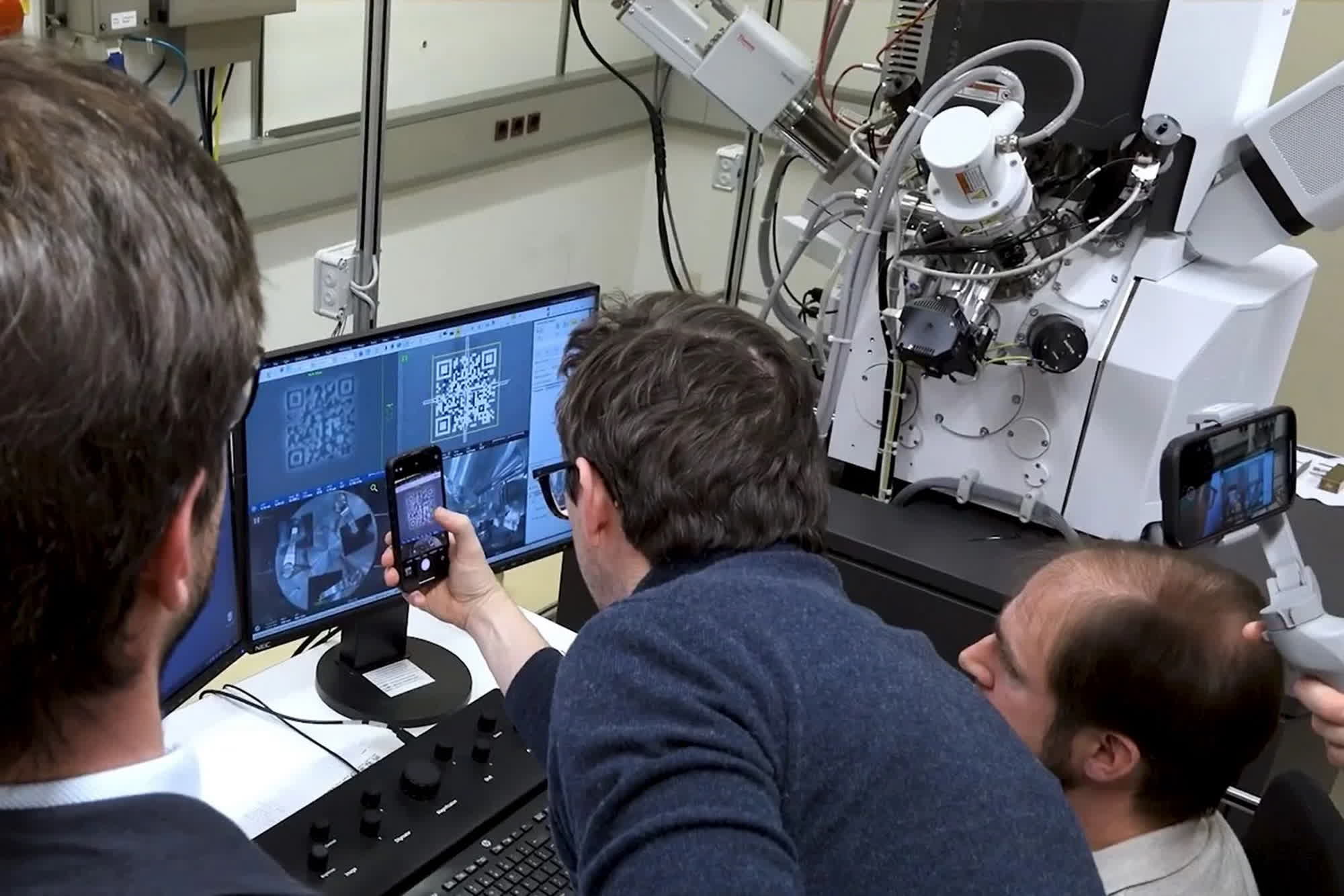
A team of researchers at TU Wien recently announced that they have "etched" the smallest QR code ever on a ceramic film. Covering an area of just 1.98 square micrometers, the code is smaller than many bacteria and features pixels only 49 nanometers in size. The researchers' ultimate goal is to develop a ceramic-based storage technology capable of withstanding the test of time.
The new QR code is so tiny, the TU Wien team explained, that visible light cannot reveal its structural details. Instead of an optical microscope, the scientists used an advanced electron microscope to read the data stored in the code.
Creating nanoscopic structures just a few atoms long is no longer impossible. However, individual atoms are too unstable to serve as reliable data storage. According to Paul Mayrhofer, Professor at TU Wien's Institute of Materials Science and Technology, the team successfully developed a stable nanoscopic QR code that can be read repeatedly with the right equipment.
TU Wien collaborated with Cerabyte to develop a thin ceramic layer capable of maintaining stability under extreme conditions. The resulting storage density is unprecedented: more than 2 terabytes of data could theoretically fit on a single sheet of A4 paper. Unlike conventional storage media, the ceramic film is designed to be "indestructible" and requires no maintenance or power cycles to preserve its data.
TU Wien's Alexander Kirnbauer emphasizes that much of the digital data stored on today's media will become unrecoverable in just a few years. While early civilizations carved knowledge into stone – records we can still read today – our information age risks fading away unless we expend enormous amounts of energy to continually refresh and maintain it.
Ceramic materials may offer a viable alternative, providing data storage that can endure for centuries or even millennia. TU Wien's partner, Cerabyte, is developing a ceramic-based method capable of petabyte-scale data density. Even storage giant Western Digital has provided funding to the Austrian startup, signaling that ceramic nanolayer technology may be more than just another speculative trend.
Kirnbauer said, "With ceramic storage media, we are pursuing a similar approach to that of ancient cultures, whose inscriptions we can still read today. We write information into stable, inert materials that can withstand the passage of time and remain fully accessible to future generations."
TU Wien's nanoscopic QR code is just 37 percent the size of the previous record-holder, and Guinness has officially recognized the achievement. The Austrian researchers are now focused on improving the materials and increasing data writing speeds so that the technology can eventually be applied industrially outside the lab. They are also exploring ways to store data structures more complex than QR codes.
Etching the world's smallest QR code in ceramic pushes data storage to the nanoscale


