Extreme upscaling: What happens when DLSS turns 38x22 pixels into 4K?

Daniel Sims

Posts: 2,480   +75
Staff
The big picture: Nvidia DLSS has been a divisive feature since its introduction almost exactly seven years ago. While some users accuse developers of relying too heavily on upscaling to maintain high frame rates, others praise its ability to reconstruct clear images from fewer pixels. Pushing the latest implementation to its limits helps reveal how it pulls off this feat.

YouTuber 2kiliksphilip recently demonstrated how Nvidia DLSS behaves when upscaling from absurdly low resolutions to 4K. While games are not playable in this form, the experiment highlights both the technology's effectiveness and the progress it has made since the introduction of DLSS 2.0 about five years ago.

DLSS Super Resolution officially allows users to choose between four modes with preset resolution scales: Quality mode upscales from 66% of the output resolution, Balanced from 58%, Performance from 50%, and Ultra Performance from 33%. However, the popular Special K mod enables users to select any percentage, including 1% – which, at 3840 x 2160 (4K), works out to just 38 x 22 pixels.

The popular 'Special K' mod enables users to select any scaling percentage, even 1% – which for 4K works out to just 38 x 22 pixels.
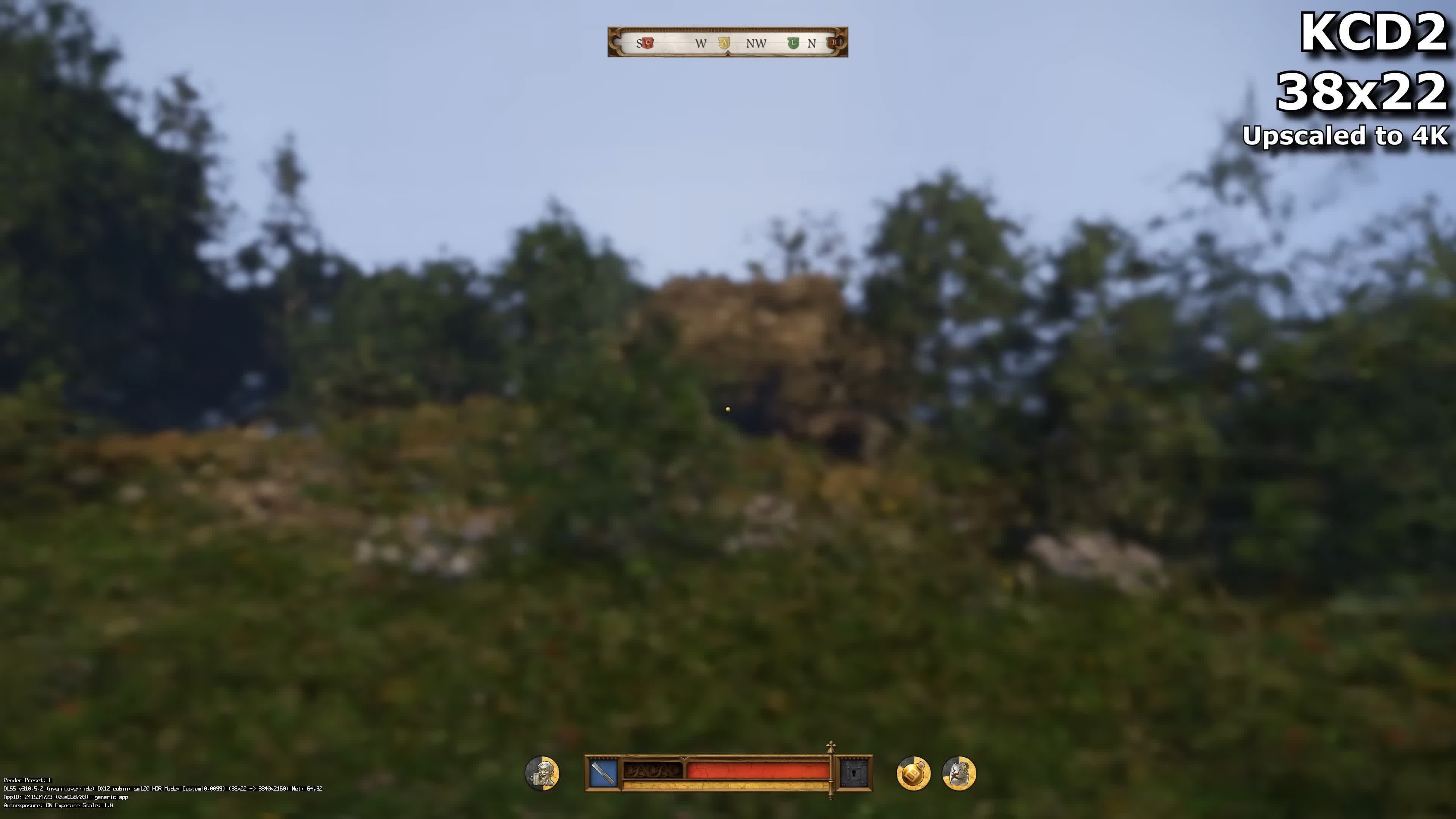
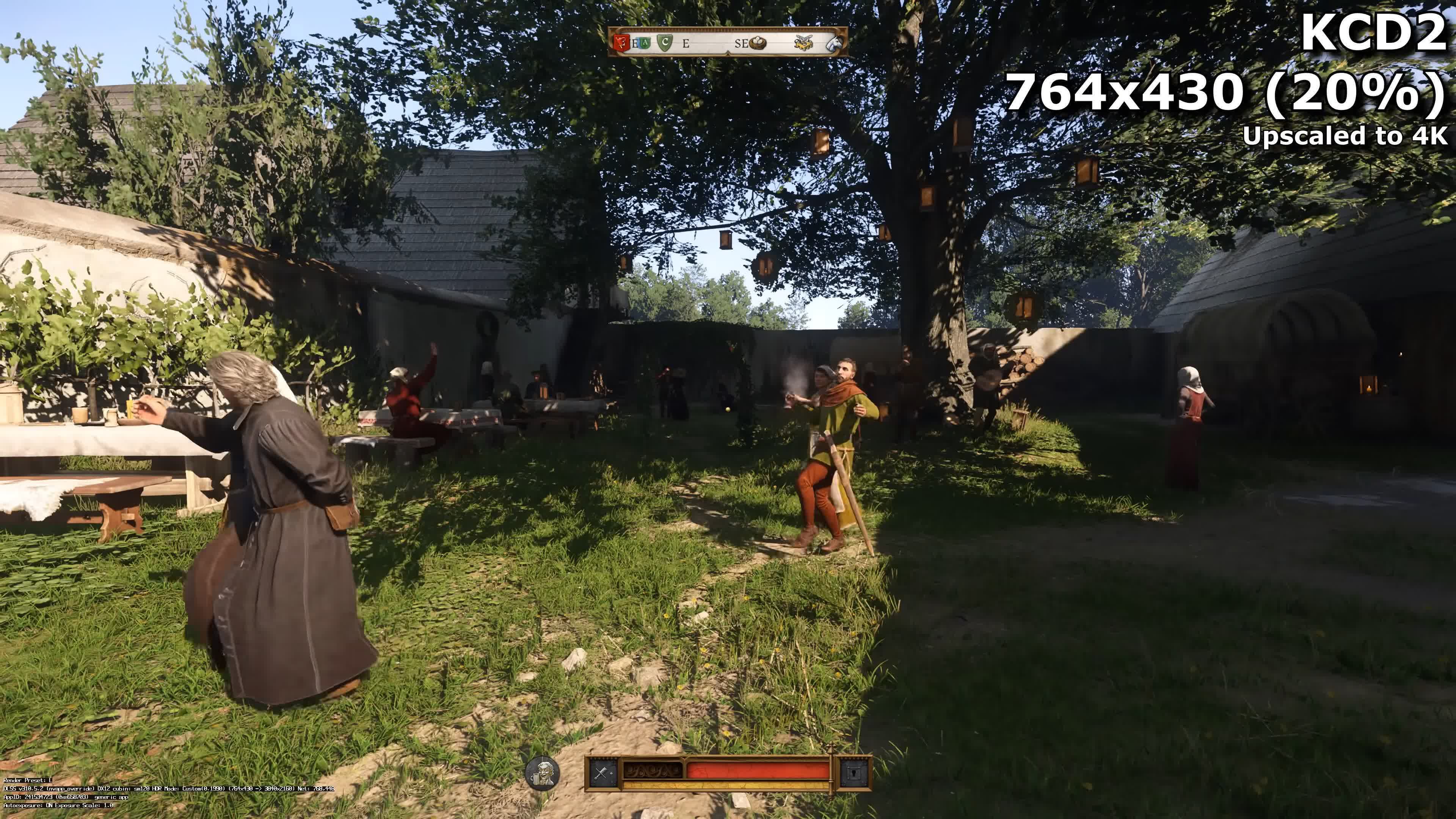
Under these conditions, which multiply the number of pixels by a factor of roughly 10,000, Red Dead Redemption 2 and Kingdom Come: Deliverance II resemble the experience of a legally blind person. However, moving the camera quickly and observing fast-moving objects reveals how DLSS combines data from previous frames with motion vectors to infer what a high-resolution image should look like.

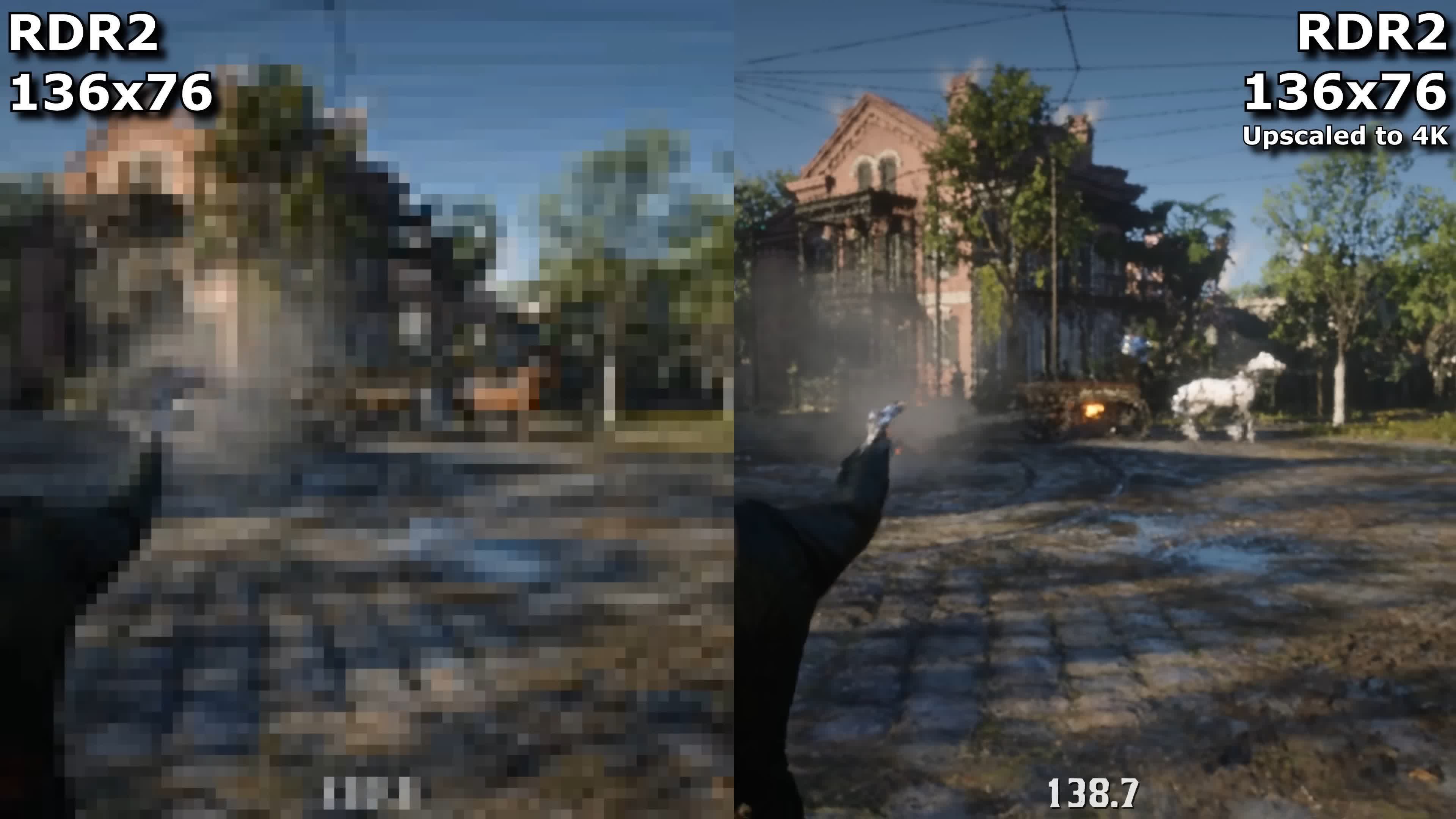
Comparing a native 136 x 76 image to the same pixel count upscaled to 4K in the Red Dead Redemption 2 benchmark highlights the impressive amount of detail DLSS can recover. The two images are both extremely blurry, yet they are worlds apart.

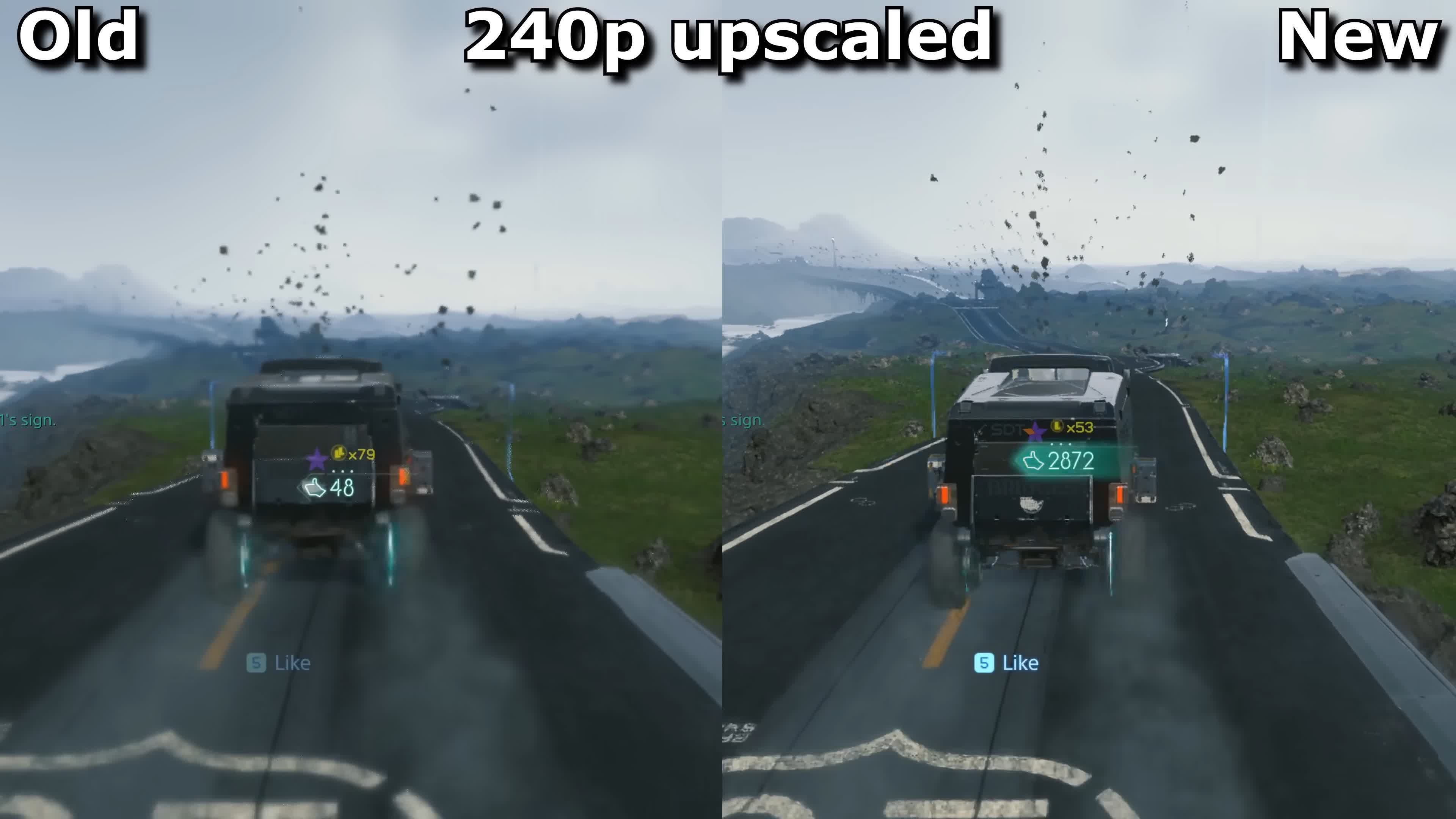
The difference between DLSS 4.5's preset L, released a few weeks ago, and DLSS 2.0, which launched in 2022, also becomes clearer at extreme upscaling ratios. The YouTuber demonstrated this by comparing Death Stranding footage upscaled from 320 x 240 to 4K in version 4.5 with a similar video he published five years ago.

Also read: Nvidia DLSS 4.5 vs DLSS 4: Good But Not Flawless
The experiment further reveals the minimum internal resolution at which Kingdom Come: Deliverance II begins to resemble a usable 4K image: 764 x 430, or 20% of 4K. Even so, this setting likely offers little performance advantage over the lowest official preset, which upscales from 720p to 4K. At such low resolutions, most games are limited by the CPU rather than the graphics card.

Although some argue that upscaling has encouraged complacency in performance optimization, the video also serves as a reminder of what the technology replaced: anti-aliasing. Upscaling is simply the latest in a long line of techniques designed to mask sub-native resolutions, a practice that stretches back decades.

Permalink to story:

 
I know it is a love it or hate it feature, though I cannot help but find this feature wonderful. Not specifically Nvidia's, but in general, the idea we can use well trained upscaling and frame generation, to assist against what is a rapidly approaching wall of innovation in silicon due to shrinkage and thermal limits. Our natural limits without moving beyond what we have today.

It should not (though I'm not foolish to think it isn't) be an excuse to stop innovating or pushing the limits. In handhelds especially. While there is no shortage of competition, Nvidia's version at the moment remains the premium. AMD and Intel both have the opportunity; I hope they take it.
 
This would be great for handheld. AMD needs to fortifying its position in the handheld with rdna4 instead of ancient rdna 3.5 imo.

RDNA4 is pretty much obsolete and very likely no longer viable for iGPU at this point, beyond the benefit of full FSR4 Redstone support. It is bad enough that AMD has effectively quit the laptop dGPU market and is barely clinging to 6% of the desktop dGPU market these days, but, now, they're having to contend with the enormous leap in performance from Intel's newly launched Xe3. Alarm bells need to be sounding for AMD. They've let Intel gain too much ground in iGPU, which was pretty much their last safe haven from nVidia. They should skip straight to RDNA5 for iGPU, which itself needs to be revolutionary, and launch within the next 12 months at the latest. There's no excuse they couldn't do this either, as Intel seems to have no qualms debuting new GPU architectures in iGPU form...
 
I know it is a love it or hate it feature, though I cannot help but find this feature wonderful. Not specifically Nvidia's, but in general, the idea we can use well trained upscaling and frame generation, to assist against what is a rapidly approaching wall of innovation in silicon due to shrinkage and thermal limits. Our natural limits without moving beyond what we have today.

It should not (though I'm not foolish to think it isn't) be an excuse to stop innovating or pushing the limits. In handhelds especially. While there is no shortage of competition, Nvidia's version at the moment remains the premium. AMD and Intel both have the opportunity; I hope they take it.

Don't give Huang any ideas. That's probably how 8GB GPUs will run next-gen games.

AI tricks like these ARE the next frontier for innovation. Brute-strength, direct rendering (and optimization) is the old way of doing things and has run its course.
 
This is what AI is supposed to be about. Bringing 4K 120 fps gaming to low-end laptops and PC.

In 10 years, I'm certain that the modern day PC setup will be a thing of the past. We will probably move to a CPU, GPU and RAM - maybe even SSD - on a single chip and these children with credit cards won't be able to waste their money anymore.
 
I know it is a love it or hate it feature, though I cannot help but find this feature wonderful. Not specifically Nvidia's, but in general, the idea we can use well trained upscaling and frame generation, to assist against what is a rapidly approaching wall of innovation in silicon due to shrinkage and thermal limits. Our natural limits without moving beyond what we have today.

It should not (though I'm not foolish to think it isn't) be an excuse to stop innovating or pushing the limits. In handhelds especially. While there is no shortage of competition, Nvidia's version at the moment remains the premium. AMD and Intel both have the opportunity; I hope they take it.
Quantum computing might free us of current limits and restart the race for supremacy
 
It's like watching an episode of NCIS.

+1 :)

Only then they would have those pixels coming from a reflection in a window from a reflection in a drinking glass. Of course after rotating the viewing angle randomly. AND they would be able to pull DNA from the image as well.
 
Must admit I was quite impressed. I particularly liked the way it upscaled the number of likes in the vehicle image from 46 to 2072.
 
The Red Dead 2 and Death Stranding stills in the article are particularly impressive I must say. While I wouldn't say Red Dead 2 looks good, I am impressed that it managed to make 76p look more like a 360p or 480p image. Death Stranding, depending on what it looks like in motion, I would call playable on something like a lower spec system, and even then I'm sure a lower spec system could do better than a source resolution of 240p.
 
RDNA4 is pretty much obsolete and very likely no longer viable for iGPU at this point, beyond the benefit of full FSR4 Redstone support. It is bad enough that AMD has effectively quit the laptop dGPU market and is barely clinging to 6% of the desktop dGPU market these days, but, now, they're having to contend with the enormous leap in performance from Intel's newly launched Xe3. Alarm bells need to be sounding for AMD. They've let Intel gain too much ground in iGPU, which was pretty much their last safe haven from nVidia. They should skip straight to RDNA5 for iGPU, which itself needs to be revolutionary, and launch within the next 12 months at the latest. There's no excuse they couldn't do this either, as Intel seems to have no qualms debuting new GPU architectures in iGPU form...

It's not like AMD can't make a faster iGPU, the thing is they are limited by the contracts with MS and Sony. We could easily have igpus that meet or even beat the PS5 by now, but Sony/MS won't allow it.

Intel has no such hurdles, so they can bring faster igpus to mobile which is booming right now with the portable gaming pcs.

 
I'll trade this trash and RT for clean, well-optimized games without TAA any day.

Yup, the reason DLSS can look better than native is because TAA SUCKS big time.
There has been no real advancement in AA in years, we have been stuck with TAA for too long.
At least we have DLAA
 
It's not like AMD can't make a faster iGPU, the thing is they are limited by the contracts with MS and Sony. We could easily have igpus that meet or even beat the PS5 by now, but Sony/MS won't allow it.

Intel has no such hurdles, so they can bring faster igpus to mobile which is booming right now with the portable gaming pcs.

What's your source on there being contractual GPU performance limitations set against AMD? I can't find anything to corroborate this. The claim doesn't even makes sense, since gaming PCs and laptops cost significantly more than consoles anyways.

Furthermore, one would imagine that if such a (highly unlikely) contract existed, it would apply to dGPUs more than iGPUs anyways, since desktops and consoles are stationary, whereas laptops are portable. There's just no way I can imagine AMD agreeing to kneecap themselves so significantly in the more rapidly evolving PC market...
 
What's your source on there being contractual GPU performance limitations set against AMD? I can't find anything to corroborate this. The claim doesn't even makes sense, since gaming PCs and laptops cost significantly more than consoles anyways.

Furthermore, one would imagine that if such a (highly unlikely) contract existed, it would apply to dGPUs more than iGPUs anyways, since desktops and consoles are stationary, whereas laptops are portable. There's just no way I can imagine AMD agreeing to kneecap themselves so significantly in the more rapidly evolving PC market...
Past history my friend. It took almost a decade for AMD to release an iGPU that could rival the PS4, and they don't have one that beats the PS5 yet.

Now that more competition is coming from intel/nvidia/ARM/Apple, AMD might change its stance.
 
Past history my friend. It took almost a decade for AMD to release an iGPU that could rival the PS4, and they don't have one that beats the PS5 yet.

Now that more competition is coming from intel/nvidia/ARM/Apple, AMD might change its stance.
That might be because the PS5 pulls about 300W.
Makes no sense in a portable device and in a desktop, people demand modularity.
 
That might be because the PS5 pulls about 300W.
Makes no sense in a portable device and in a desktop, people demand modularity.
Intel Panther Lake handhelds may match Sony’s rumored PS6 “Canis” performance, but at twice the power - VideoCardz.com https://share.google/SLo5OeLE6D3nssBKd

According to this article Intel' upcoming Intel Core Ultra G3 series Panther lake apu will be as powerful as a ps5 or ps6 portable at 30 watts of power for handheld market. The ps6 portable is now rumored for 2028. By then XE4 Druid is scheduled.
 
Intel Panther Lake handhelds may match Sony’s rumored PS6 “Canis” performance, but at twice the power - VideoCardz.com https://share.google/SLo5OeLE6D3nssBKd

According to this article Intel' upcoming Intel Core Ultra G3 series Panther lake apu will be as powerful as a ps5 or ps6 portable at 30 watts of power for handheld market. The ps6 portable is now rumored for 2028.
It's not like AMD can't make a faster iGPU, the thing is they are limited by the contracts with MS and Sony. We could easily have igpus that meet or even beat the PS5 by now, but Sony/MS won't allow it.

Intel has no such hurdles, so they can bring faster igpus to mobile which is booming right now with the portable gaming pcs.
AMD already has fastest igpu, see 8060s.....faster than any Intel igpu.
 
This would be great for handheld. AMD needs to fortifying its position in the handheld with rdna4 instead of ancient rdna 3.5 imo.
I mean, definitely can be decent for handheld. Depends on what game and what kind of performance you're really looking for though. I've always said that upscaling is the best for handhelds and thin & light laptops.
 
What AMD can do now to fend off Intel in the iGPU market (to some limited extent) is emphasize how Intel is doing this "let's go to 'maintenance mode only' driver support after like 1 year" thing they are doing now. (I must say this makes me SO GLAD I'm a full time Linux user, I have a freakin' Core 2 Duo system and THAT has fully supported GPU drivers -- not just "some old driver we haven't removed" but a fully modern Mesa Gallium 3D driver that still receives bug fixes, speedups, and improvements. Not that it performs miracles, it doesn't magically make this very slow DX9-era GPU a fast DX12 GPU or anything. But my newer Intel GPU systems all have very good 3D support.)

OK... back on topic... AMD should find some way to throw shade for Intel making mobile GPUs that are at least acceptable for gaming, then decide to neglect the drivers. All AMD needs to do is support those Ryzens for even 5 years and (among those who still use Windows, and want some mobile gaming) they'll get a loyal following.
 
What AMD can do now to fend off Intel in the iGPU market (to some limited extent) is emphasize how Intel is doing this "let's go to 'maintenance mode only' driver support after like 1 year" thing they are doing now. (I must say this makes me SO GLAD I'm a full time Linux user, I have a freakin' Core 2 Duo system and THAT has fully supported GPU drivers -- not just "some old driver we haven't removed" but a fully modern Mesa Gallium 3D driver that still receives bug fixes, speedups, and improvements. Not that it performs miracles, it doesn't magically make this very slow DX9-era GPU a fast DX12 GPU or anything. But my newer Intel GPU systems all have very good 3D support.)

OK... back on topic... AMD should find some way to throw shade for Intel making mobile GPUs that are at least acceptable for gaming, then decide to neglect the drivers. All AMD needs to do is support those Ryzens for even 5 years and (among those who still use Windows, and want some mobile gaming) they'll get a loyal following.
On Windows at least, the B580 has been pretty regularly getting big boosts in driver updates. I'm surprised that sed at how close it comes to the 9060XT in the most recent benchmarks I saw. Intel recently put up job listings looking for experience in Linux GPU driver development, so they're not forgetting us Linux users either.
 
Back