Fake faces generated by AI are now "too good to be true," researchers warn

Alfonso Maruccia

Posts: 2,634   +988
Staff
The takeaway: The ability of AI models to produce convincing, human-like images has gone too far. A new study suggests that detecting AI-generated faces is now too difficult for most people. Even more concerning, so-called "super recognizers" perform only marginally better. The visual clues that once exposed AI-generated images are becoming increasingly difficult to spot, though they have not disappeared entirely.
Think you can quickly identify fake faces generated by AI models? Think again. According to a recently published study by Australian researchers, AI-generated faces are now essentially too difficult to spot – except for a small minority of people who are exceptionally skilled at analyzing facial features. As a result, security and identity verification processes could suffer, though there are still steps we can take to mitigate the problem.

The study was conducted by researchers at UNSW Sydney and the Australian National University (ANU) and has now been published in the British Journal of Psychology. The team warns that "synthetic AI faces" can appear more realistic than photographs of actual people – and their data supports that conclusion.

According to James Dunn, a researcher at the UNSW School of Psychology, people have long been confident in their ability to detect AI-generated faces. Early AI systems were notorious for producing distorted or garbled images, but newer, more advanced models can now generate ultra-realistic faces with remarkable ease.
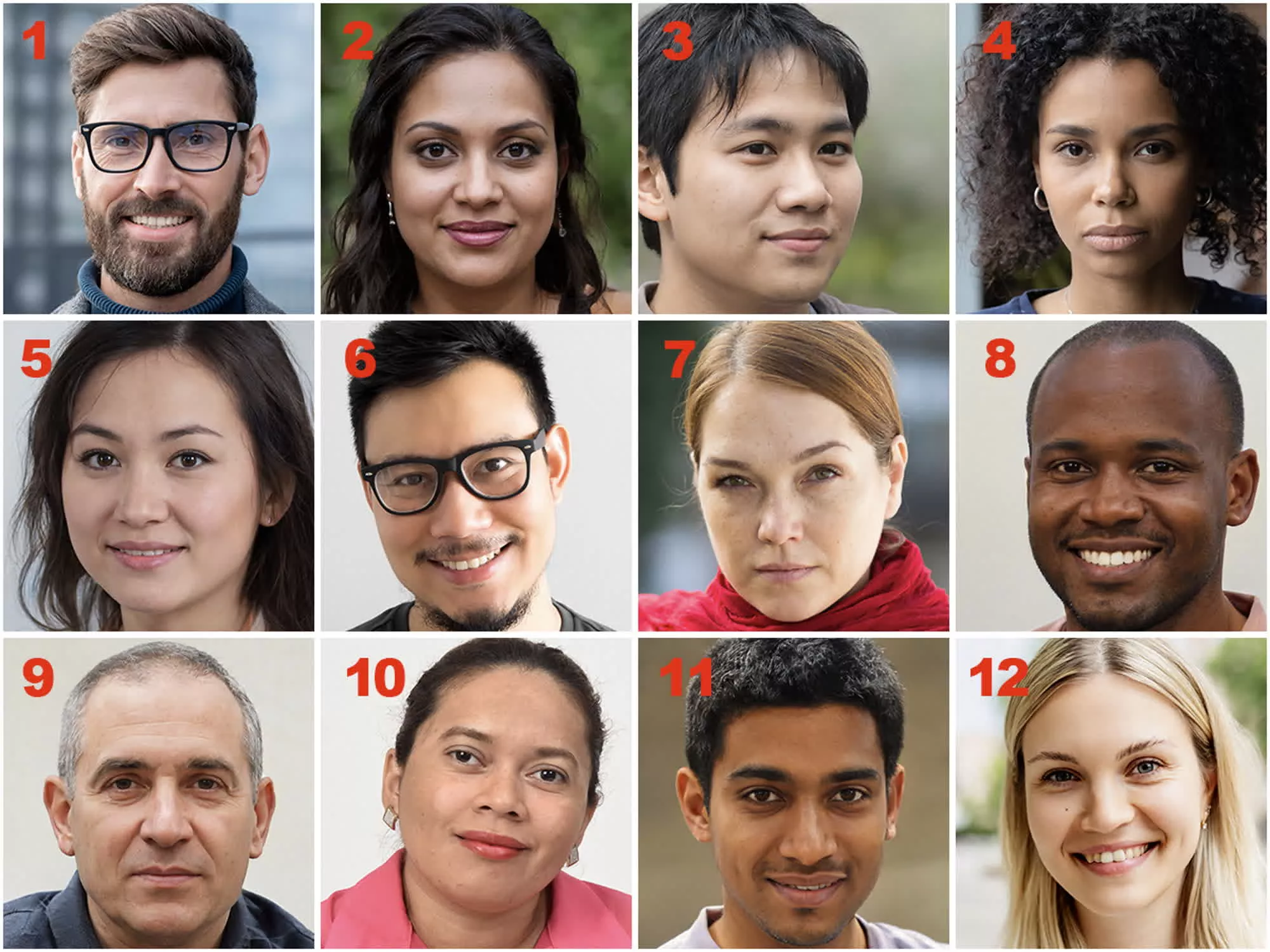
The two Australian universities recruited 125 participants, including 36 "super recognizers" known for their exceptional face-recognition abilities. The control group consisted of 89 participants. Researchers asked all of them to complete an online test in which they were shown a series of both AI-generated and real human faces.

Dunn said the results showed that people with average detection skills performed only slightly better than chance. Even the super-recognizer group outperformed the average participants by only a small margin. However, all participants were equally overconfident in their perceived ability to spot AI-generated images.

Modern AI-generated faces can appear highly realistic, displaying none of the obvious visual artifacts produced by earlier models. These kinds of errors are now far less common, making AI-generated faces more effective at deceiving users. As a result, the researchers warn that a dangerous combination of overconfidence and increasingly convincing deepfakes could put individuals and organizations at risk. Scammers, fraudsters, and cybercriminals are likely already exploiting realistic AI faces for illegal activities.

According to ANU Associate Professor Amy Dawel, today's AI-generated faces "aren't given away by what's wrong with them, but by what's too right. Rather than obvious glitches, they tend to be unusually average – highly symmetrical, well-proportioned, and statistically typical."

High levels of symmetry and overly average-looking traits should now be considered potential red flags for AI-generated fakes, Dawel said. Super recognizers may be somewhat better at detecting these subtle patterns.

The researchers now plan to study how certain individuals function as "super AI face detectors" in order to improve anti-fake technologies and detection strategies for the broader public.

The UNSW Face Test is available online with a free demo, allowing anyone to assess their own AI face-detection skills. According to my results, I may qualify as a "super recognizer," having correctly identified 12 out of 20 AI-generated faces – twice. The average score is around 11 out of 20.

Permalink to story:

 
15 out of 20, once. I think what gives it away is a sort of "representative" look, for want of a better term, as if the generated picture were summing up the clichés of good looks, and the depth of field is fishy. The human picture is subject to more "defects" in the face—"noise," in beauty.
 
No one should be surprised by this… AI improves by leaps and bounds every year… by next year, the average will probably 9/20… then 2… then 0…

We’ll just have to adapt… like humanity always does…
 
Hands are the real challenge. It has and is a bane for artists and AI.

First try I got 15 out of 20. I wish I could see which I got wrong...
 
Last edited:

Your score on the AI face-detection demo:


18 out of 20


For context, the average person scores about 11 out of 20, so if you scored better than this you might be a super-AI-face detector.

Average performance is only slightly better than chance performance (10/20). This means that many people—regardless of background—find distinguishing AI-generated faces from real ones surprisingly difficult.
 
But maybe it will motivate people to go outside and interact in person.
But how will you know if they actually went outside and interacted in person, or if it's simply an AI representation of a person having gone outside and interacted in person, unless you are 100% there with them at the time?

And, for the things that it really matters about, and might be incredibly important to a large number of people, there is no way for you to be there in person. So basically if there aren't 20 people you know and really trust present that can verify a thing actually happened, there is no way to ensure you're not being fooled.
 
But how will you know if they actually went outside and interacted in person, or if it's simply an AI representation of a person having gone outside and interacted in person, unless you are 100% there with them at the time?

And, for the things that it really matters about, and might be incredibly important to a large number of people, there is no way for you to be there in person. So basically if there aren't 20 people you know and really trust present that can verify a thing actually happened, there is no way to ensure you're not being fooled.
You are conflating my two points.

You can't trust media anymore. Which in some ways undermines propaganda if you think about it. But also causes many problems.

Totally separate: Stop worrying about it and go outside and interact with your friends and neighbors. Much of what we see online (even back when it was "true") is out of our control.
 
Totally separate: Stop worrying about it and go outside and interact with your friends and neighbors. Much of what we see online (even back when it was "true") is out of our control.
You'll get no argument there. And in fact, basically ALL of what we see online is out of our control, but that doesn't mean we should simply stop caring about things outside our own neighborhoods or families.If we simply act like ostriches outside of our own friends and neighbors, the ones who aren't are going to fack the whole thing beyond fixing.

Hell, they're already doing it with the whole world watching.
 
The faces really fake when somewhere on the world among 8 Billion people there is someone that looks like that?
 
8 / 20, I wonder if poor score is related to me being autistic ? I would be very interested in that, It also explains why people are reacting strongly to some AI faces that I can't see the problem with I guess.
 
I play a lot with Ai-generated pics.
Faces often have 'glitches' not seen in live humans.
OTOH many look totally real and even seem to have personalities.
Even after experimenting with this for three years plus I'm pretty sure I couldn't say if a picture is a good AI-generated one or an actual human.
I might add that it was a lot easier when I started with this but the AI models have improved greatly and keep improving steadily. I even notice when they can succesfully render stuff that was impossible for them a few months back.
As for AI in general I'm super wary of it and haven't even looked at chatbots and always disable any AI on my devices/machines (except for my iPhone's camera I don't know how to disable the camera AI). At this point I think Ai's bound to be abused and the possibilities for that are increasing rapidly. I'm also aware that AI can be super useful in science and technology when properly used. No idea where this is going and whether we will manage to harness the bad and profit from the good.
 
I fed each image to Gemini... it got 14/20....
Interestingly, Perplexitiy (I have the pro version included with my ISP) refused to do it saying it was "not allowed to".
 
15 out of 20, once. I think what gives it away is a sort of "representative" look, for want of a better term, as if the generated picture were summing up the clichés of good looks, and the depth of field is fishy. The human picture is subject to more "defects" in the face—"noise," in beauty.

A static picture is easy to do, now try making a believable moving one!! and the whole body... billions spent on this, while unemployment rises??
and then there is this..

Inaccurate evidence from ai tool led to police pursuing ban on israeli football fans
 
Last edited:
Surprisingly I got 16 out of 20...

Yeah if the skin is perfect, hair is perfect, and person is "pretty" its fake.
 
Back