Funding cuts and political pressure drive US researchers overseas

Skye Jacobs

Posts: 2,012   +59
Staff
The big picture: A growing number of American researchers are exploring scientific careers outside the United States, spurred by deep funding reductions and political interference that have upended the nation's research environment. Recent figures from Nature's global science jobs platform highlight this trend: in the first quarter of 2025, applications from US-based scientists for overseas positions climbed by 32 percent compared to a year earlier. Meanwhile, the number of American users searching for international roles increased by 35 percent, and March alone saw a 68 percent year-over-year spike in views of non-US job postings.

The exodus is largely driven by abrupt federal funding withdrawals and project cancellations. Last month, over 200 grants supporting HIV and AIDS research were terminated. The National Institutes of Health also cut back on Covid-19 research funding and eliminated $400 million in research grants at Columbia University, citing campus unrest related to the Israel-Palestine conflict.

These changes have sent shockwaves through the research community. James Richards, head of Global Talent Solutions at Springer Nature, which operates the Nature Careers jobs board, described the current situation as unparalleled: "To see this big drop in views and applications to the US – and the similar rise in those looking to leave – is unprecedented," he told Nature.

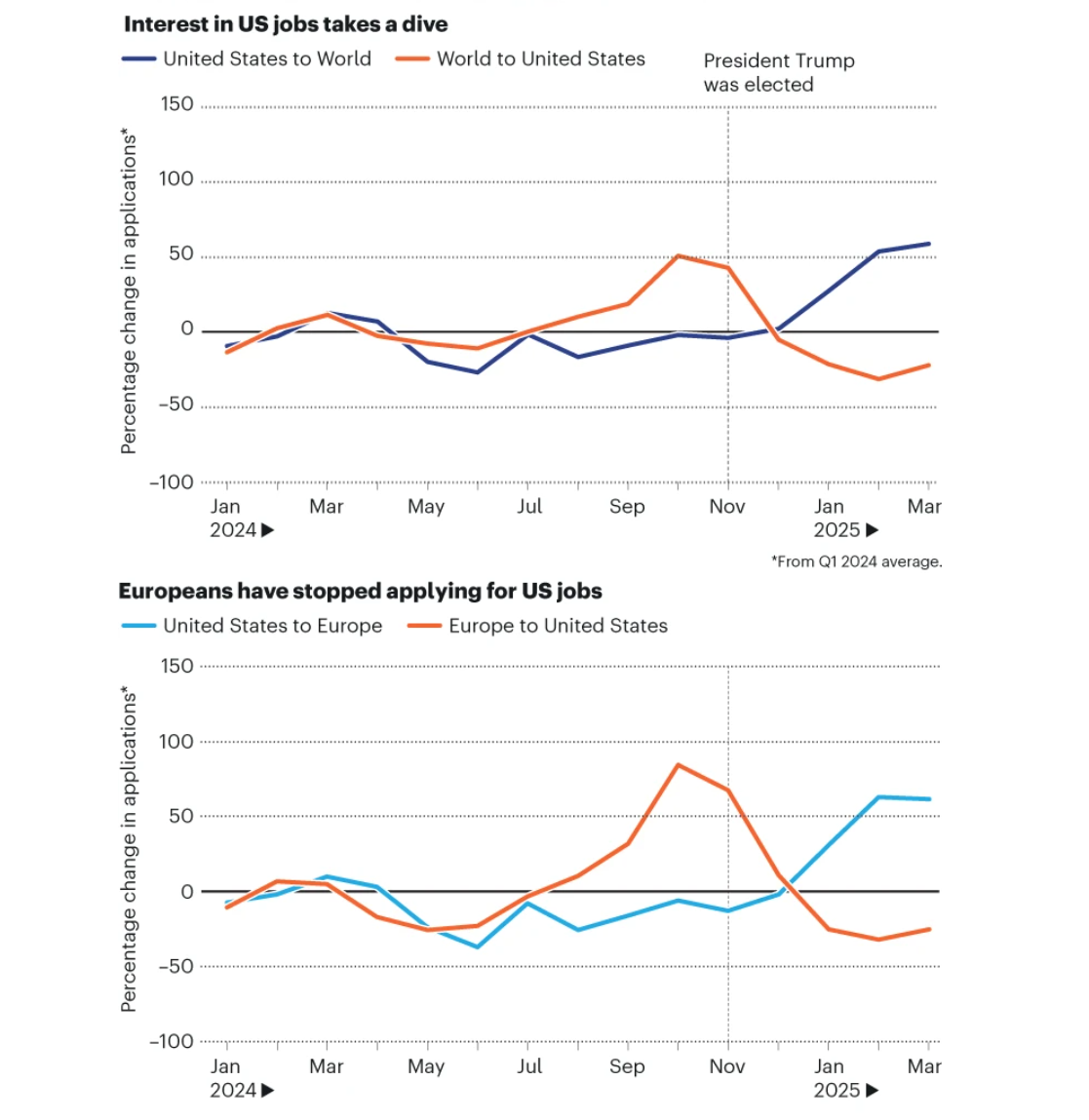
A separate Nature poll found that 75 percent of US researchers surveyed are contemplating leaving the country. The shift is especially notable in Canada, where applications from American scientists rose by 41 percent in early 2025, while Canadian interest in US positions fell by 13 percent.
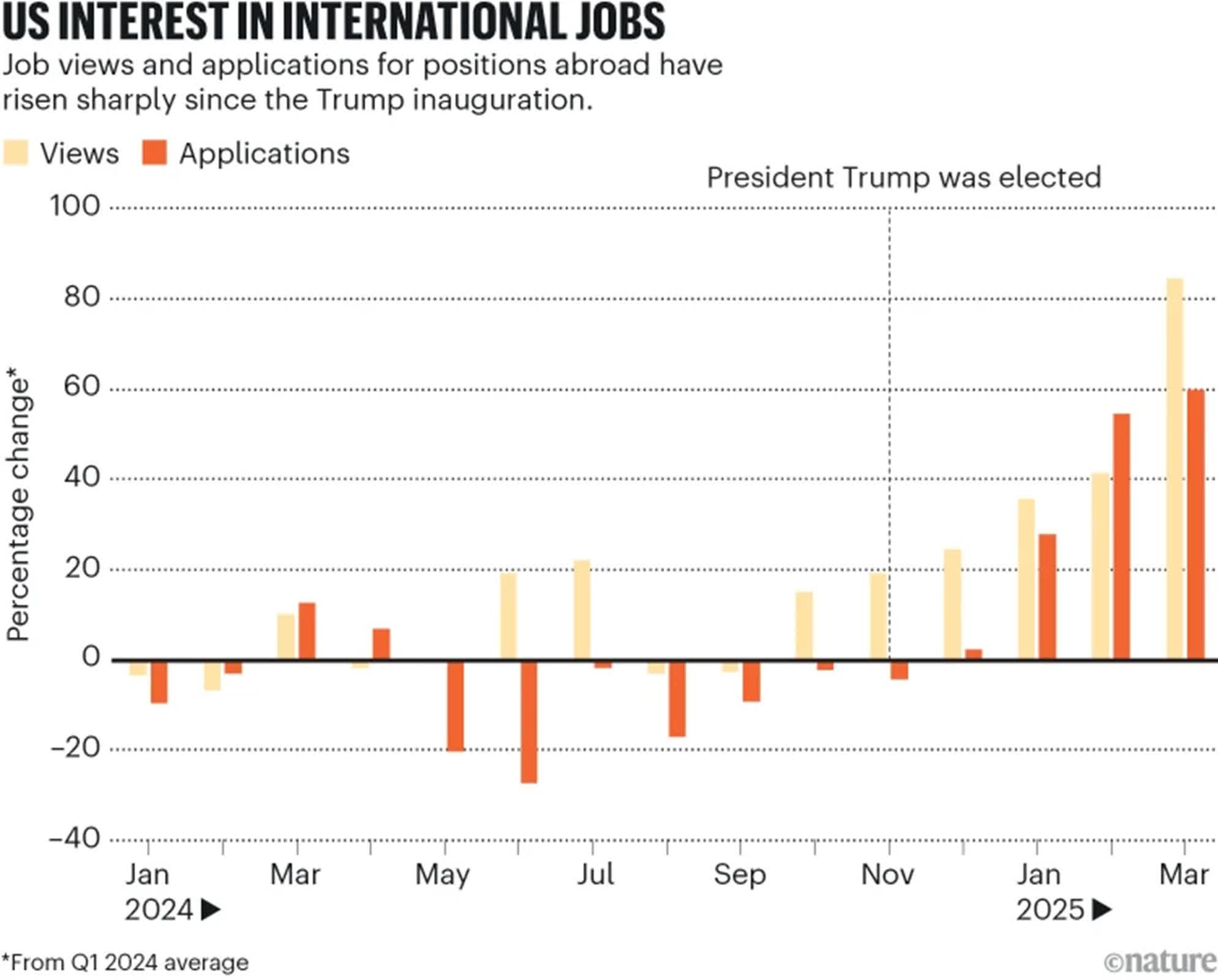
For individual scientists, the instability is personal. Chemical engineer Valerie Niemann, who previously worked at Stanford University, recently accepted a postdoctoral role at the University of Bern in Switzerland. "People don't know how long their postdocs will be," she told the publication. "We can't apply for fellowships because we don't know how long they're going to exist."

Universities in Europe are taking steps to accommodate displaced researchers. In March, Aix-Marseille University in France launched the Safe Place for Science initiative, dedicating €15 million to support scholars in climate, health, and environmental fields – especially those affected by US policy changes.
Within its first month, the program received 298 applications, 70 percent from US scientists. "What's happening is terrible for American research," said university president Éric Berton. "We felt it was our duty to do what we could to show scientists there was a little light in the south of France where they could do their research, be a lot freer and where they were wanted."

Interest in European opportunities is rising sharply: US applications to European jobs on the Nature Careers board increased by 32 percent in March, while European applications to US roles declined by 41 percent.
Germany's Max Planck Society also reports heightened interest from American researchers and a surge in applications from Asia. Spokesperson Christina Beck attributes this to scientists "possibly reorienting themselves and preferring Europe to the US."

The Society recently introduced a Transatlantic Program to establish joint research centers with US partners and create new positions for junior and senior scientists who can no longer work in the United States.

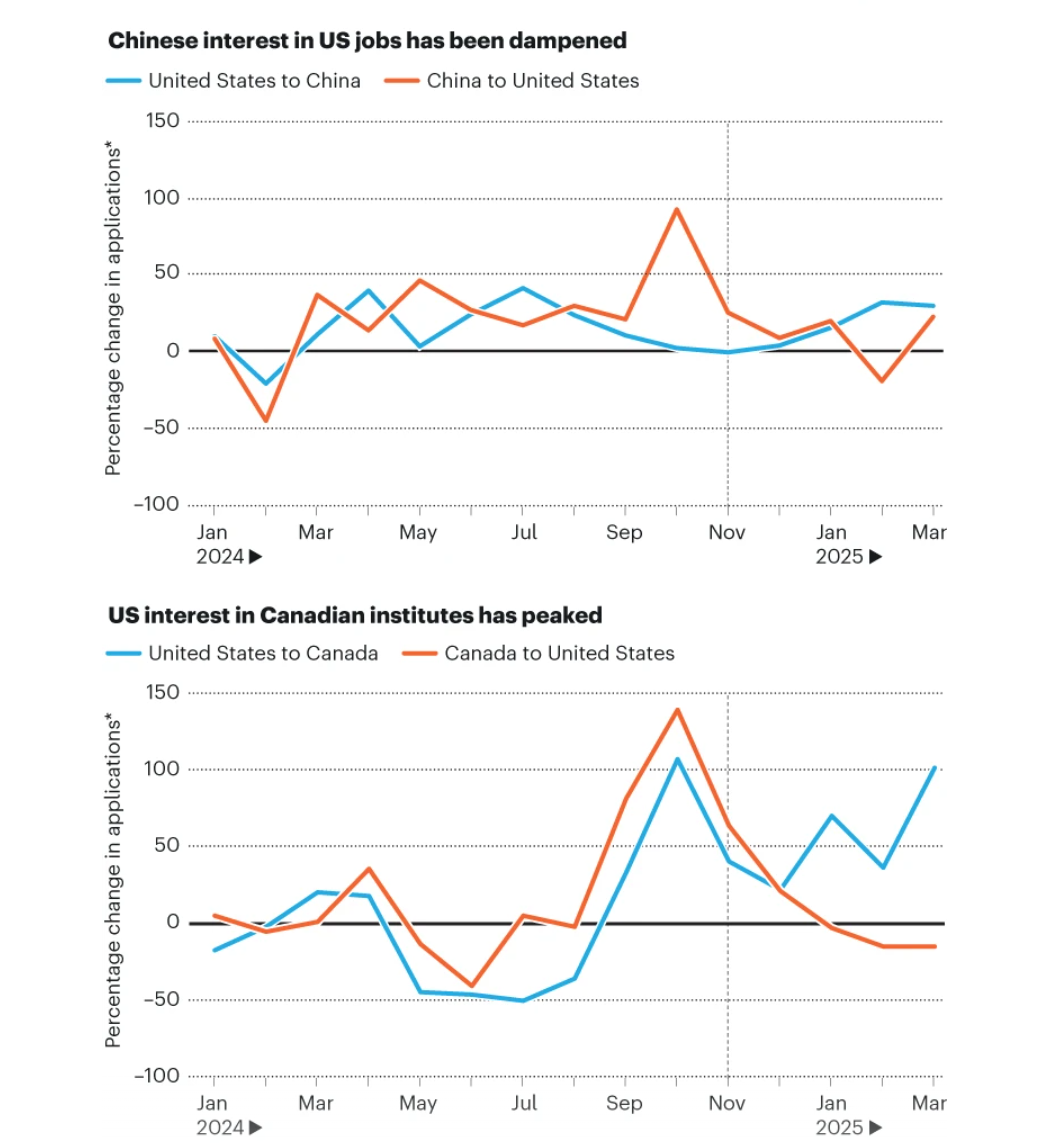
The migration trend isn't limited to Europe, however. Chinese recruiters are actively targeting US scientists, and American interest in research jobs in China rose by 30 percent in views and 20 percent in applications in early 2025. Other Asian countries are also seeing increased attention from US-based researchers.

The shifting landscape is affecting morale among American scientists. Michael Friedlander, director of the Fralin Biomedical Research Institute at Virginia Tech, notes that more graduate students and postdocs are questioning their future in science.

A February survey by the National Postdoctoral Association revealed that 43 percent of respondents felt their jobs were at risk, 35 percent reported delays or threats to their research, and 9 percent said they could not speak freely at work.

As more US scientists consider relocating, Niemann's decision to move abroad is emblematic of their difficult choices as the US research environment becomes increasingly unstable.

"It's a good time to move on, given the political climate," she said, adding that many of her colleagues share her sentiment. The United States, once a global magnet for scientific talent, now faces an uncertain future as researchers weigh their options in a rapidly changing world.

Permalink to story:

 
The big picture: A growing number of American researchers are exploring scientific careers outside the United States ... applications from US-based scientists for overseas positions climbed by 32 percent compared to a year earlier ...
How the 'growing number' looks like? I mean, as an actual, exact number?
What 32% means, how many people?
How these numbers changed during the last 30 years?

That's the kind of questions a serious article would have tried to answer.
 
How the 'growing number' looks like? I mean, as an actual, exact number?
What 32% means, how many people?
How these numbers changed during the last 30 years?

That's the kind of questions a serious article would have tried to answer.

-More is more, and what is harder to quantify is if these folks are involved or critical to heavy duty hard science research or the basket weaving habits of the endangered frog or what.

Its sad, the US has always "brain drained" other countries and that has been yet another secret super power of ours. We gain a smart person and the other country loses one, so it's really a 2 point advantage. Huge, beautiful trade deficit in our favor.

Guess we'll get a primary export now! Intelligence!
 
"Nature data shows dramatic rise in international job searches by US scientists"

There's a dramatic rise of Redditors searching for immigration requirements after every election. This is like when someone writes an article about "people are all avoiding X brand" because they interviewed 5 people behind the local high school.
 
How the 'growing number' looks like? I mean, as an actual, exact number?
What 32% means, how many people?
How these numbers changed during the last 30 years?

That's the kind of questions a serious article would have tried to answer.
No, this is the questioning that comes from a "we're not sinking, we're not sinking" denier. The writing is on the wall, but if you choose not to see it, you won't, regardless of the data provided.
 
During WW2, US supremacy in science, including atomic bomb, was built by creative, open minded people fleeing fascist regime. It seems, now They are fleeing another one.
 
No, this is the questioning that comes from a "we're not sinking, we're not sinking" denier. The writing is on the wall, but if you choose not to see it, you won't, regardless of the data provided.
What exactly is sinking and what writing is on what wall? These are just two meaningless sentences.
 
-More is more, and what is harder to quantify is if these folks are involved or critical to heavy duty hard science research or the basket weaving habits of the endangered frog or what.

Its sad, the US has always "brain drained" other countries and that has been yet another secret super power of ours. We gain a smart person and the other country loses one, so it's really a 2 point advantage. Huge, beautiful trade deficit in our favor.

Guess we'll get a primary export now! Intelligence!
More is more, OK, but there's more that matters, and there's more that doesn't matter at all. Having data only as percentage points, without absolute numbers, it's not possible to distinguish.
If the 32% increase mentioned in the article means 132 people instead of 100, the whole thing doesn't matter at all.
Another important thing is historical data. Maybe 32% is a lot, maybe such fluctuations happen often. The article tries to imply this is unprecedented, but without data that's just a frivolous assumption.

And you are of course right that the quality is the most important thing. If these are 'climate change' or quantum gender studies 'researchers', there's nothing to worry about. The US is not less attractive to researchers in the fields that matter.
 
More is more, OK, but there's more that matters, and there's more that doesn't matter at all. Having data only as percentage points, without absolute numbers, it's not possible to distinguish.
If the 32% increase mentioned in the article means 132 people instead of 100, the whole thing doesn't matter at all.
Another important thing is historical data. Maybe 32% is a lot, maybe such fluctuations happen often. The article tries to imply this is unprecedented, but without data that's just a frivolous assumption.

And you are of course right that the quality is the most important thing. If these are 'climate change' or quantum gender studies 'researchers', there's nothing to worry about. The US is not less attractive to researchers in the fields that matter.

-If those 32 people were doing one of a kind research that no one else has the brain to replicate, then it's a bigger loss than 100,000 undergrad lab monkies would ever be.

The US definitely got at least 32 German scientists that fled Nazi Germany and made huge contributions that helped the US win the war.
 
Back