Gartner projects $644 billion in 2025 AI spending, but few understand GenAI's actual value

Alfonso Maruccia

Posts: 2,583   +972
Staff
Editor's take: Judging from the discourse in my communication bubble, almost no one likes AI technologies. The most enthusiastic AI evangelists are vendors interested in selling you something AI related to cash in on the craze or the companies creating it and shoving it down our throats.

A recent Gartner analysis reports that spending on generative AI (GenAI) will grow to unprecedented levels in 2025, even though very few organizations understand how this technology can help their businesses or profit prospects. Experts believe this market "paradox" trend will persist through 2025 and 2026.

Global spending on GenAI will reach around $644 billion in 2025, a 76.4-percent increase compared to 2024. This spending trend comes despite the technology's lack of actual usefulness and error rate. Gartner VP Analyst John-David Lovelock says foundational model providers are investing billions in developing and enhancing their solutions regardless of the growing concerns about the technology.
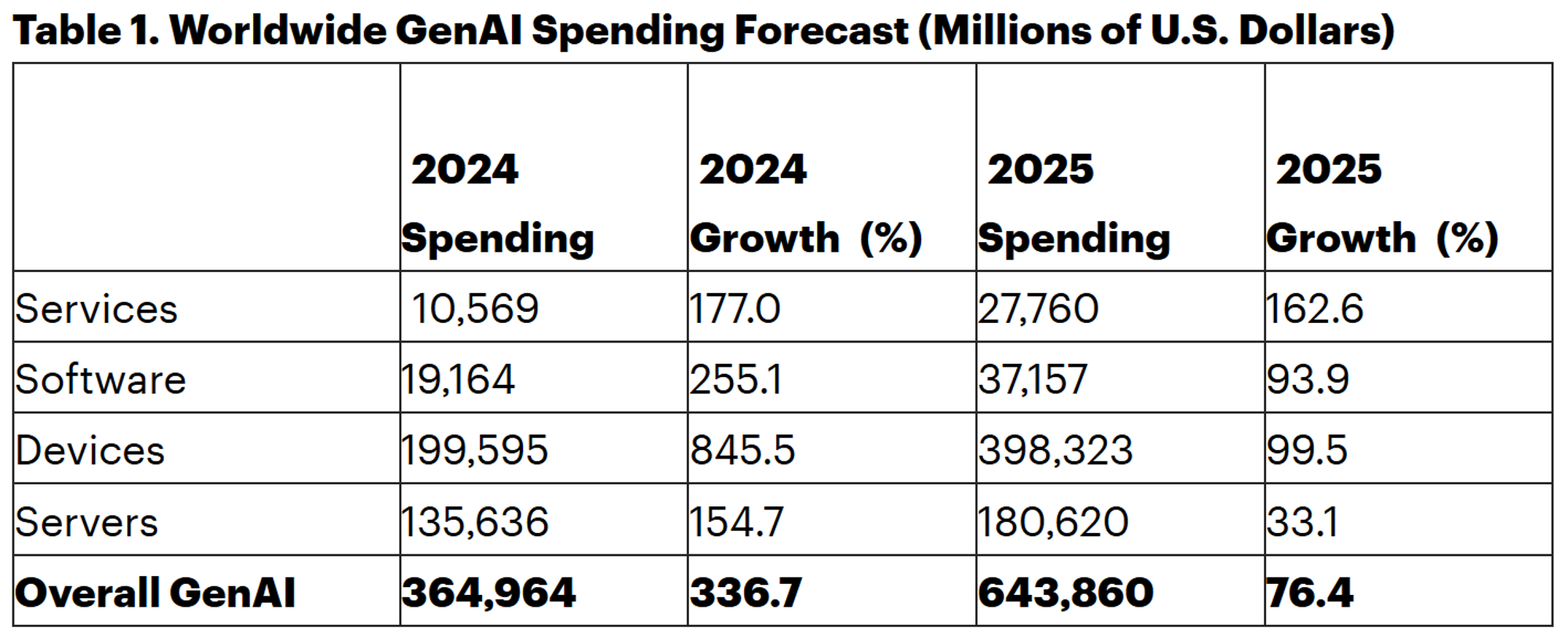
This year, internal projects with lofty goals will face increased scrutiny, Lovelock stated. Chief investment officers will likely opt for commercial, off-the-shelf solutions, while proof-of-concept experimentations and self-developed implementations should become the exception. GenAI prospects haven't been as ambitious lately, but the technology should still significantly impact all IT spending this year.

Experts expect AI technologies to become integral to all kinds of business operations and consumer products. This forced integration will be primarily due to AI capabilities baked directly into consumer hardware, with servers, smartphones, and PCs absorbing 80 percent of the projected GenAI spending.

Lovelock notes that the growing prevalence of AI-enabled devices is driving market growth, with these consumer electronics expected to make up nearly the entire market by 2028. However, end consumers don't seem as enthusiastic about GenAI, as they're not actively seeking these "extra" features when shopping for new devices. Regardless, manufacturers continue embedding AI as a standard in mass-market products, ultimately forcing consumers to adopt it.

Developers have adopted a service model that says, "You will consume our product, even if you don't want it." It sounds like a page out of Microsoft's playbook back in the day.

Permalink to story:

 
As Forrest Gump said "Stupid is as stupid does"

But the sent of money drives many insane.
 
Every business knows what it wants from AI: dramatically cutting their payroll. But actually getting to that point is a bit like that 4-line meme that ends with "Profit!" Its funny how 30 years ago we thought all the dirty, physically difficult jobs would be done by robots in the future and we'd all be white-collar workers. And its turning out exactly the opposite.
 
Last edited:
Reminds me when every single business out there was hell bent to use blockchain in everything they did. Now it's AI...and pretty much the same way, CEO's tripping over themselves to integrate AI whether it fits or not. I can't wait....."NEW Tide laundry detergent....NOW with AI".
 
Reminds me when every single business out there was hell bent to use blockchain in everything they did. Now it's AI...and pretty much the same way, CEO's tripping over themselves to integrate AI whether it fits or not. I can't wait....."NEW Tide laundry detergent....NOW with AI".
Like AI thermalpaste, cases, RGB?
 
Its funny how 30 years ago we thought all the dirty, physically difficult jobs would be done by robots in the future and we'd all be white-collar workers. And its turning out exactly the opposite.
Robots are already doing lots of physical jobs. Humanoid robots are one of the most active fields of research, development, investment and all. I read somewhere they are already using them in warehouses. So it's not exactly the opposite, robots will be doing the physical work. Just some white collar jobs can be replaced or assisted by pure software, which is a lot easier. That's the low hanging fruit.
 
Robots are already doing lots of physical jobs. Humanoid robots are one of the most active fields of research, development, investment and all. I read somewhere they are already using them in warehouses. So it's not exactly the opposite, robots will be doing the physical work. Just some white collar jobs can be replaced or assisted by pure software, which is a lot easier. That's the low hanging fruit.
IMO, the problem with AI replacing any job, especially white collar jobs, is accuracy. Anyone relying on AI for accurate answers is taking a big risk.

Until that problem is completely solved, AI will be nothing more than snake-oil that companies sell because they can make a profit on it.
 
IMO, the problem with AI replacing any job, especially white collar jobs, is accuracy. Anyone relying on AI for accurate answers is taking a big risk.

Until that problem is completely solved, AI will be nothing more than snake-oil that companies sell because they can make a profit on it.
I agree that accuracy is a problem, but that problem is being solved fast. Consider the progress since 2022 - hallucinations today are far less.
People also make lots of mistakes, that's one of the reasons to automate. Models don't need to be 100% accurate, they just need to make less errors than us.
 
AI is a leap as big as the printing press on it's own but no one ever seems to equate AI with Quantum computing which will be far & beyond anything we can imagine. The two together will literally change mankind beyond anything we've ever experienced. Sadly it will be militarised before we do anything good with it.
 
Back