Hard drives aren't done yet: Western Digital is pushing HDD performance toward SSD territory

Skye Jacobs

Posts: 2,018   +59
Staff
Forward-looking: Western Digital is bringing fresh momentum to an aging storage category with two ambitious technologies aimed at redefining mechanical hard drive performance limits. The company's new High Bandwidth Drive architecture and Dual Pivot actuator system aim to narrow the gap between traditional spinning disks and QLC-based solid-state drives – a gap that has long put HDDs on the defensive in high-performance environments such as AI workloads and hyperscale data centers.
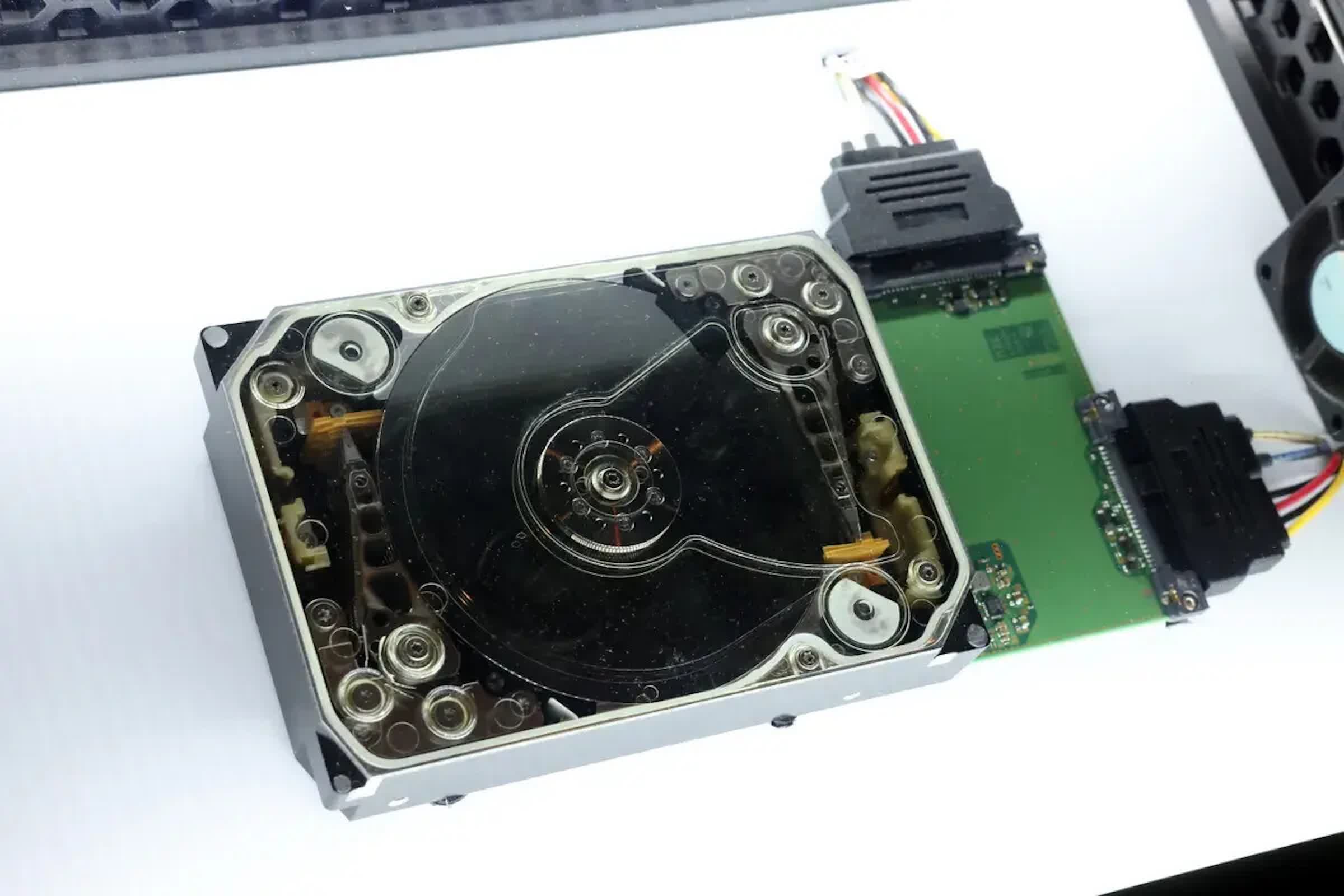
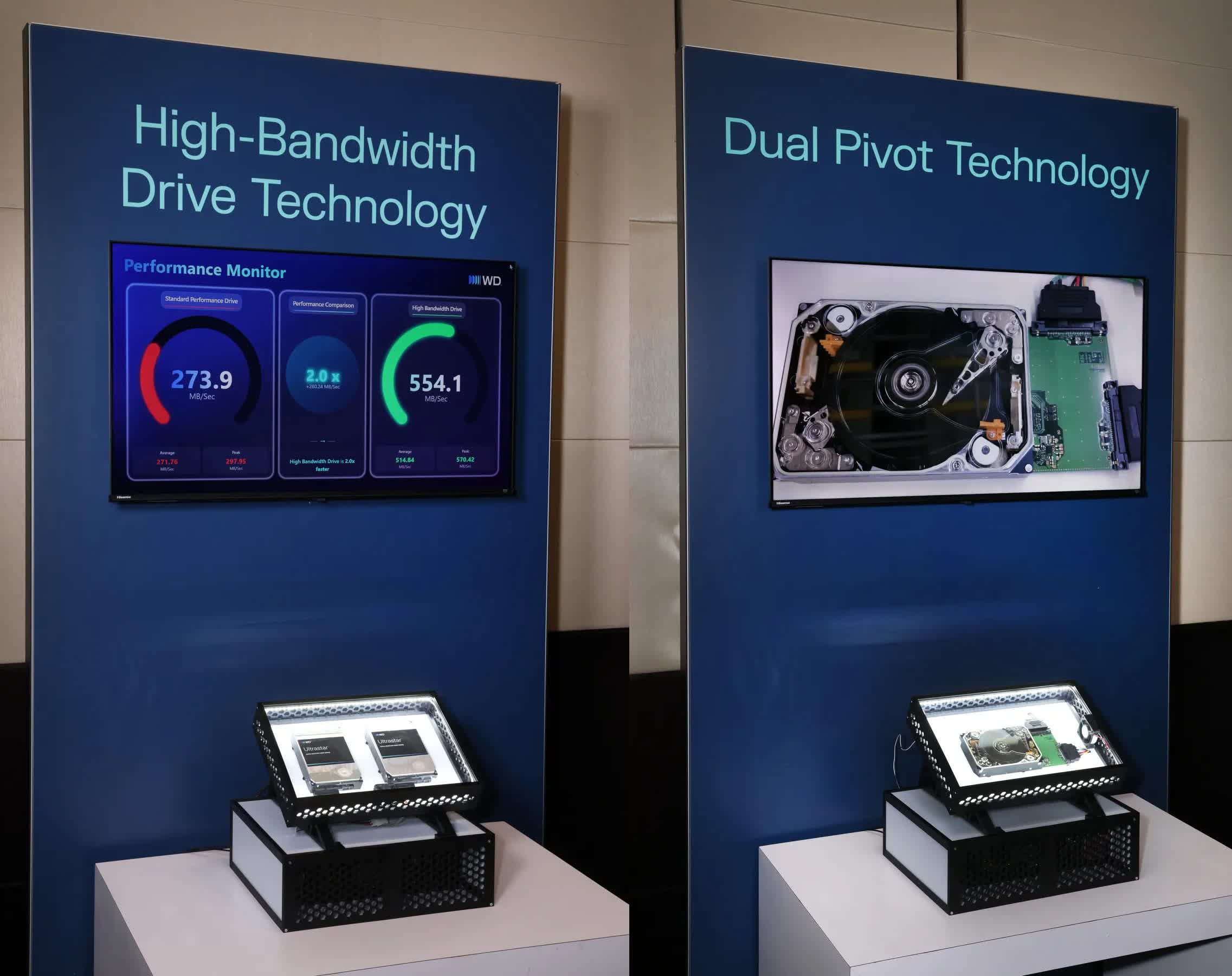
The new High Bandwidth Drive concept represents a shift in how data moves between platters and the interface. Instead of the standard one-head-per-surface design that reads or writes sequentially, the new approach allows multiple read/write heads to operate in parallel across several tracks.

This design effectively doubles the input/output bandwidth and provides a scaling path up to eight times the current throughput. Western Digital says these multi-head prototypes are already in the hands of select customers for validation, suggesting the architecture is close to production maturity.

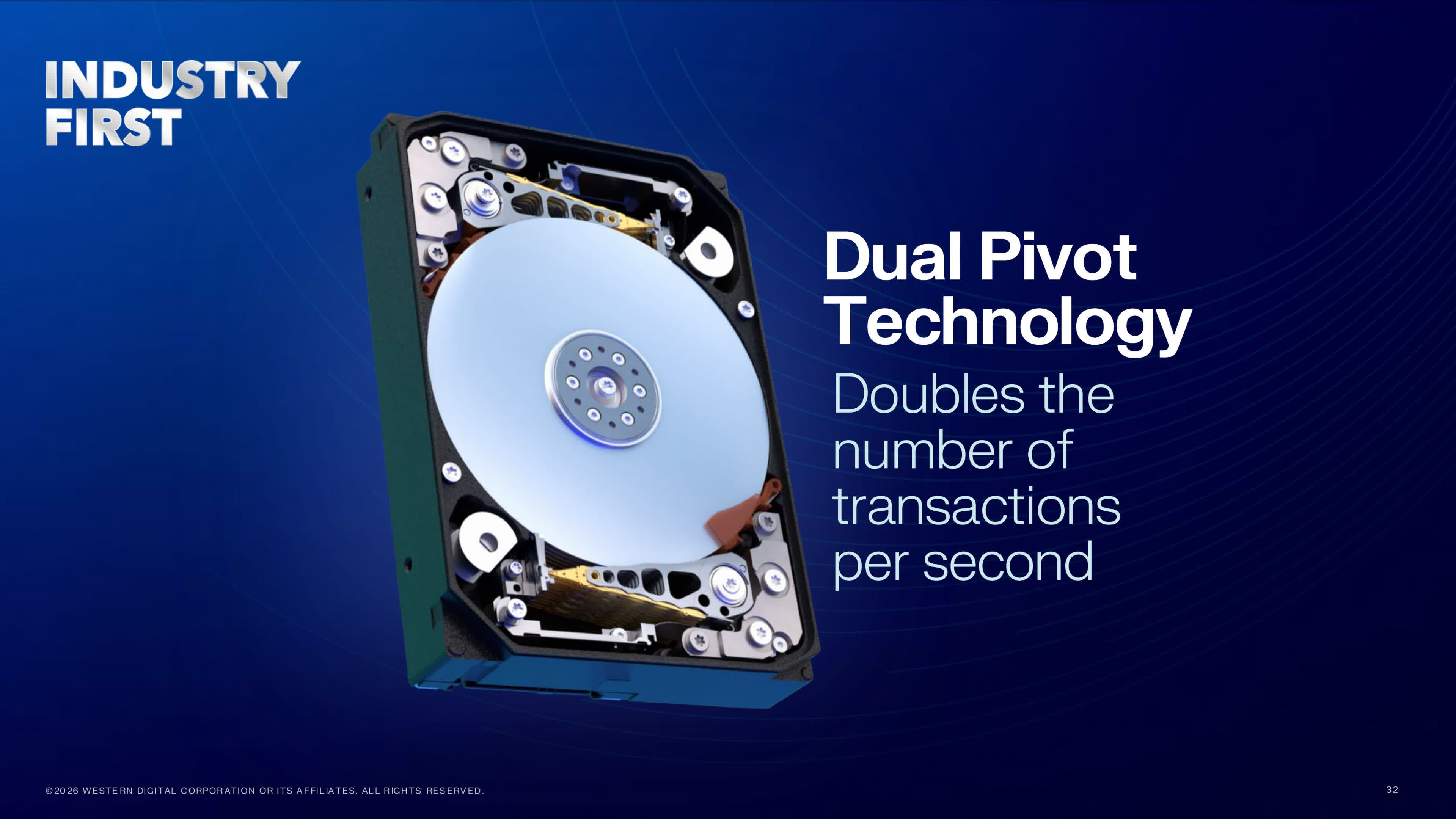
Alongside that effort, the company is developing what it calls Dual Pivot Technology – a reengineered actuator mechanism that uses two independent arms, each operating from a separate pivot, rather than a single shared pivot.
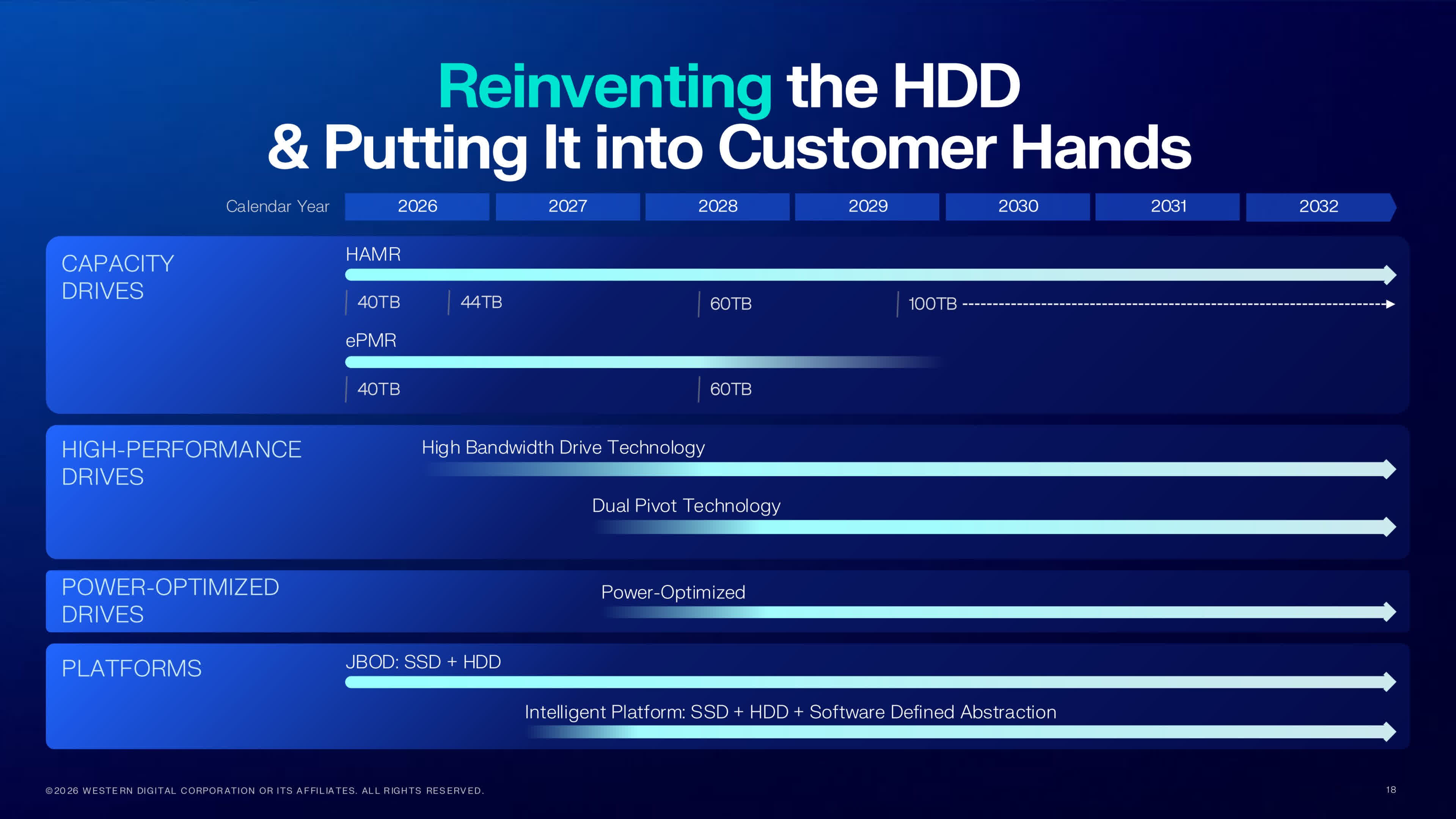
Unlike older dual-actuator designs that sacrificed storage density to achieve higher performance, Western Digital's variant maintains full drive capacity while still boosting throughput. By distributing read and write operations across both actuator assemblies, the company projects a performance gain of roughly 2× over today's top drives, for an aggregate 4× increase in I/O bandwidth when combined with the multi-head design.

The result could be a class of 3.5-inch drives capable of reaching capacities near 100 terabytes while delivering SSD-like access speeds at a fraction of the cost per terabyte. Those economies are especially appealing as cloud and AI operators confront explosive data growth.
Western Digital expects its Dual Pivot technology to move from laboratory development into customer sampling before the end of the decade, with commercial availability around 2028.

Even as it pursues raw speed, the company is also addressing efficiency in another corner of the market. Western Digital's upcoming Power-Optimized HDDs are designed to occupy a middle ground between spinning disk and tape storage.
These drives retain the mechanical nature of HDDs but are tuned for long-term data retention with lower random I/O rates and 20% lower power draw. The goal is to enable cold data – the kind that infrequently moves but must remain accessible – to be retrieved in seconds rather than the hours it takes with tape systems. That tradeoff makes them a potential fit for AI training archives and large-scale data lakes, where both capacity and access speed are critical.

Permalink to story:

 
Spinning rust is still the best for data storage, making it faster, is making it even better as the choice for data storage
 
The HDD era is certainly over but HDD's are a staple that won't go away

Need for speed in HDD's is highly overrated for the average individual / business computer user and gaming. Video and image rendering for smaller files / quantities relies on CPU /GPU rather than on disk speed. Sure it's nice to have a speedy SSD at today's price of $120 1tb for a laptop or desktop. But if you need space for videos and images 4tb is a better starting point. With today's AI craziness, 4tb HDD's start at $150-200 while 4TB SSD's are $500 or more. Returning SDD / HDD price parity will certainly reduce the demand for HDD's but until then HDD's seem to be a better market choice for larger storage.

Ignore SSD's as long as the prices are crazy, your productivity or pleasure probably won't suffer with HDD's greater latency. You might not even notice
 
Last edited:
The last paragraph in the article indicates these new hard drive technologies will not be found in consumer class hard drives, at least not for a few years. It's data center stuff and will be spendy.
 
Funny that they say it's a new technology when it actual fact it's an old technology brought back from the dead
 
Every few years someone declares HDDs dead, and every time the hard drive industry shows up with more arms, more heads, and somehow 100TB in the same metal box. Spinning rust just refuses to leave the data center.
 
I think HDDs still have a lot of use, even for personal computers.
But once the quality dropped they became a lot less attractive as home storage.
When there are 500 of them plugged in a datacenters, they can break after a year of use and
still be usable. But when you are not sure it can last 5 years, what is the point, even if it is a beautiful 20TB drive.

I am disappointed that they keep working toward bigger size but not reliability. There was never a breakthrough that would make hard drives like Nokia phones.
 
Way to go Western Digital! Have always preferred HDDs over SSDs, which IMHO are little more than glorified SD cards and thumb drives.

If you've ever taken either apart, you can see the remarkable difference in build quality between the two components. It's like comparing a BIC lighter to a Zippo.

Sometimes old schoold is best. This is one of them.
 
Way to go Western Digital! Have always preferred HDDs over SSDs, which IMHO are little more than glorified SD cards and thumb drives.
I think I get what you are saying here, but that is like saying a
Mustang Shelby GT500 is little more than a glorified go cart. ;)

But when you are not sure it can last 5 years, what is the point, even if it is a beautiful 20TB drive.
I have had some Seagate Ironwolf drives in my Synology NAS
for 7-8 years now and are still going.
Try one of those! (y) (Y):D
 
Last edited:
It blows my mind that SSD capacity, in terms of $/space, has not sprinted past mechanical, spinning disks. Look how complicated they are versus rows of chips on an IC. They just refuse to permanently die!
 
I have a lot off hard drives. I have this one drive that I have from around 2012. 1 TB. I ran hard drive sentinel last week and it still had 100% health. I am not always keen for software diagnostics except for Main hardware cpu etc. The new drives should be more affordable than ssd (should*) but the arm system is a little worrisome as we know when they give problems, there's no real fix.
 
This could be very good, if it works properly. I'll be following this for sure. Not getting over excited, just moderately optimistic.
 
Assuming price per terabyte significantly cheaper a price in a budget SSD, it could sell well.
I am spewing nonsense of course, for as long as there is AI, everything will sell for double the old price.
 
Ignore SSD's as long as the prices are crazy, your productivity or pleasure probably won't suffer with HDD's greater latency. You might not even notice
I very much doubt that. Of course I will notice a 10s vs 120s load time. I will notice the added noise of HDD and the higher power and lower battery on a mobile device.

I noticed the difference back in 2012 when I got my first SSD. And software was smaller back then, meaning less stuff to load. New games are also developed with SSD's as a requirement.
Also HDD prices are also going up so it's not like you even get massive price savings anymore.
Every few years someone declares HDDs dead, and every time the hard drive industry shows up with more arms, more heads, and somehow 100TB in the same metal box. Spinning rust just refuses to leave the data center.
You mean every time HDD companies claim how in a few years from now they're somehow, some way double or triple the HDD capacity?

I've heard this ten times already and it's getting tiresome:
40TB was promised for 2026. We are at 32TB in 2026.
100TB was promised for 2030. We are at 32TB in 2026.

Average rate of capacity advancement has been only ~2TB per year. In order to reach 100TB in 2030 the rate of advancement would need to be 17TB a year.

We're nowhere close to that. There has never been a 17TB jump in a single year in HDD development history, ever.

Who believes this BS anyway? Dumb investors who know nothing about tech?
It blows my mind that SSD capacity, in terms of $/space, has not sprinted past mechanical, spinning disks. Look how complicated they are versus rows of chips on an IC. They just refuse to permanently die!
That is because SSD progress has stalled after TLC NAND. QLC has not taken over like TLC took over MLC. The price of 8TB models has not come down and there are zero 16TB or 32TB models for consumers.

If SSD had progressed normally we would likely have now 32TB PLC based M.2 SSD's already near the 32TB HDD price.

As for the new itself - good. Capacity has doubled over the past 15 years, but speeds have stayed the same. It's like two cities growing ever bigger, but still connected by this small dirt road. HDD's need to get faster before they grow bigger.
 
Back