How a secret gambling syndicate won a $95 million Texas lottery by buying every number combination

midian182

Posts: 11,722   +177
Staff member
WTF?! It's something many people have thought about: when a lottery jackpot reaches an enormous figure, would it be possible to buy every combination of numbers to guarantee a win? There are plenty of reasons why this is usually impossible or just doesn't work, but a team that included a legendary gambler showed it could be done by winning a $95 million Texas lottery jackpot.

The story started in the spring of 2023, when London banker-turned-bookmaker Bernard Marantelli wanted to buy every ticket combination in an upcoming Texas lottery to guarantee the jackpot win, which was closing in on $95 million.

With tickets priced at $1 each and 25.8 million combinations, the profit would be almost $60 million, writes the Wall Street Journal. This assumes no one else picked the winning combination; otherwise, the prize would have been split.

Marantelli put together a team that included famed Tasmanian gambler Zeljko Ranogajec (aka John Wilson), who bankrolled the operation. His reputation for pulling off capers at gambling venues had earned him the nickname "The Joker."

The plan was to use the machines that allow people to play the lottery by picking their numbers and receiving a printed ticket. In 2023, Texas allowed online lottery-ticket vendors to open shops to print tickets for their customers.

Marantelli flew to Texas and established four makeshift ticket-printing hubs, including a warehouse and a defunct dentist's office. They acquired official lottery terminals from a struggling online lottery vendor, Lottery.com, and printed nonstop for three days.

The team had converted each number combination into a QR code, which were scanned into the terminals by crew members using their phones. They were printing over 100 tickets every second to purchase 99.3% of every possible combination of the six numbers from 1 to 54.

The printed tickets were organized into boxes so the winning numbers could be easily located.

Surely enough, one of the tickets won the jackpot. It was the only winner. After taking a lump sum payout of $57.8 million, the team walked away with a profit of around $20 million.
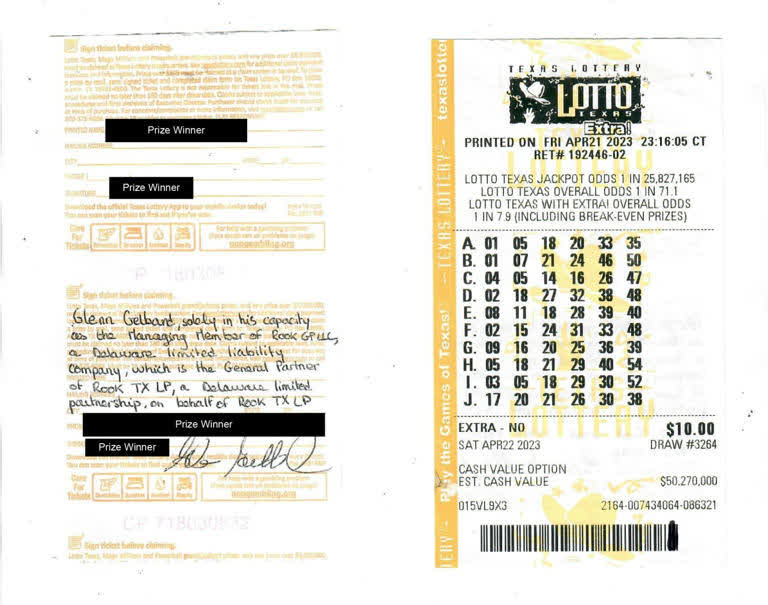
Lottery.com executive Greg Potts wrote in an internal email "This is a huge win for the company," highlighting that the firm would make a profit of nearly $264,000 on its sales commission.

The win was claimed anonymously under the name "Rook TX," and soon became public knowledge when the Houston Chronicle broke the story.

Texas officials, including Governor Greg Abbott, ordered investigations, and self-appointed Texas-gambling watchdog Dawn Nettles sued Lottery.com and the winners for defrauding regular players. The defendants have not yet responded to the allegations.

"If the investigation turns up information that would lead to a potential prosecution, that should be undertaken," Abbott said last month. "And if the investigation leads to, let's say, inadequate measures that they have at the Commission, those measures need to be reformed."

Texas Lieutenant Governor Dan Patrick called the scheme "the biggest theft from the people of Texas in the history of Texas", more than "all the bank robberies, all the train robberies in the Old West, everyone who's stolen anything" combined.

Bulk buying lottery tickets is technically legal. A lawyer representing Rook TX told The Wall Street Journal that "all applicable laws, rules and regulations were followed."

Since the win, others have tried to repeat the formula. Retailers have received offers to lease out their lottery terminals for mass ticket printing.

The Texas Lottery Commission has tried to make this practice more difficult, including no longer providing low-traffic lottery outlets with extra terminals. The commission has also pushed out a software update that limits the number of tickets a terminal can sell in a day.

Masthead: Philip Oroni

Permalink to story:

 
Sure, you need enormous amounts of capital to make this plan work but I think it’s legal. What the heck is the state complaining about anyways? If they didn’t do the math that allowed somebody to game the system in such a fashion then it’s their own fault.

Let them keep their winnings and drop the suit. It was not theft.
 
Only a politician would call someone legally winning the lotto after buying $25.8 million of tickets "theft".

It's especially funny as the government skims about 70% of lottery revenue and then taxes winnings as income.

And "defrauding" "regular" players is laughable too. If another "regular" person picked the right number they would have split the winnings so... where is the fraud?
 
Sure, you need enormous amounts of capital to make this plan work but I think it’s legal. What the heck is the state complaining about anyways? If they didn’t do the math that allowed somebody to game the system in such a fashion then it’s their own fault.

Let them keep their winnings and drop the suit. It was not theft.
In theory, if more people do it, it will no longer become profitable because too many people are winning. So the practice could counter act itself. I guess the only real question would be, is the lottery still profitable for the state?
 
The reason the this is a problem, and while it may be legal, needs to be stopped immediately is that the lottery is represented as "game" in which you stand a remote chance of winning the jackpot. It's why people play. The reason states do it is that they sell far more tickets then they pay out. For this to continue, no one would by tickets, knowing they could, at best, win half of the jackpot or less. The ticket printing groups, once multiple are involved would only make half or less of the jackpot, but the specter of these groups jumping in at any time keeps everybody away, and the state shuts it down because it goes from generating revenue to losing big time.
 
The lottery is a tax on poor people. It is especially nefarious that governments even run lotteries to begin with, since lotteries are a bad financial habit. Ergo, the government is profiting off of people who are making poor financial decisions, and is therefore incentivized to encourage them to continue making those poor decisions.
 
In theory, if more people do it, it will no longer become profitable because too many people are winning. So the practice could counter act itself. I guess the only real question would be, is the lottery still profitable for the state?

No, more people winning would split the jackpot. If another person won the jackpot by chance, they and this group would each get 50%, meaning the group would lose money.
 
No matter the game, someone will find a way to game the system. Don't be mad if you put your game out there and someone figures out how to win in a way you either didn't think would be possible or just didn't think of before hand.
 
Perfectly legal. Took a pretty big risk because sharing the pot would have lost them a lot. The odds of sharing would be pretty high because once the jackpot gets really big it attracts even more play.

For reference, to do this with the Powerball jackpot in the US the grand prize would have to get up to $1.7B once the cash option and taxes are taken into consideration. If you shared it you would really screwed and once the jackpot is that high they are selling almost every number combination.
 
Perfectly legal. Took a pretty big risk because sharing the pot would have lost them a lot. The odds of sharing would be pretty high because once the jackpot gets really big it attracts even more play.

For reference, to do this with the Powerball jackpot in the US the grand prize would have to get up to $1.7B once the cash option and taxes are taken into consideration. If you shared it you would really screwed and once the jackpot is that high they are selling almost every number combination.


Correct. Another irony here is any suggestion that the state of TX made only $60M on a $90M payout. That ignores the prior pots which didn’t get paid out until that point. Lotteries are a very profitable venture for governments, unfortunately.
 
In theory, if more people do it, it will no longer become profitable because too many people are winning. So the practice could counter act itself. I guess the only real question would be, is the lottery still profitable for the state?
The lottery is designed by the state, they literally control the odds. Simply make the odds unfavorable to such schemes and boom, problem disappears.
 
I wonder how it was paid. Request for 25.8M tickets in sequence as a single debit or split into smaller amounts. Clearly not one at a time - so many $1 dollar debits from a single account would break something.
 
I'll add my legal perspective (Disclaimer: I have a law degree but neither practice for a living nor do I have $US 25.8M with which to buy Texas lottery tickets with so I'm not winning the next jackpot. FML. :( ). Nothing illegal has happened here. The interesting thing about lotteries is that essentially the entire legal burden is upon the entity holding the game itself to be a legit and fair game that isn't rigged. This goes all the way back to federal laws enacted after the infamous late 50's rigged NBC "Twenty One" game show scandal.

This doesn't mean there is no legal burden on the game player/lottery ticket buyer. You are obligated to prove both your legal identity and that you acquired the ticket through legal means. For example, here in my native Canada, there have been scandals where store owners have either rigged lottery ticket terminals to falsely claim legit winning tickets were non-winners and then kept it themselves or swapped out legit winning tickets that users had them check with legit non-winning tickets they kept on hand for just such an occasion. This actually resulted in a complete overhaul where stores were all equipped with digital ticket checkers so buyers wouldn't have to hand their tickets over to the store owner for checking that is still in use today.

Based on the facts that I am reading here, nothing illegal has happened. The lottery game was not rigged and had a legit payout. It had astronomical odds against winning as all lotteries do, but not impossible ones which would have actually made the game illegal. The buyers legit purchased their ticket machines and their tickets and legitimately put in their $US 25.8 million to obtain every combination. Despite what people think, when it comes to games of chance like this there is no "beating the odds." There is only MEETING the odds, which is exactly what these professional gamblers did.

The real problem here, IMHO, is that by proving it can be done the way they did it, the gamblers have completely upended the idea that you or I can buy a ticket or two at minimal cost and have a fair and legit chance of winning the big payoff. Only rich people would be able to play a lottery and not only that, actually guarantee a win provided they are competent at counting and have enough millions to do so. It should send a shiver down the spine of every North American state and provincial run lottery that they will be targeted next.

And just to add to the karmic irony of this story, the reason it interests me so much and I've posted such a long comment here is... I actually know two people over the years who have legit won millions in the local Ontario provincial Lotto 6/49 lottery without resorting to this scheme. Just bought a random lottery ticket for the heck of it and won. Couldn't have happened to nicer people in both cases. Well, except for, you know... me. :D
 
Hmm., it seems to me that once the lottery payout becomes large enough that buying every possible number becomes profitable, the lottery itself has already taken-in a very large quantity of money. I guess, somebody already said as much, just differently.

As I have no idea what system the lotteries use when increasing the amount of the payout, but they surely retain the odds of winning against the possibility of too many payouts Vs. the amounts paid.

So, the day after a massive payout, they must offer enough as the starting point to entice people to play. Each day no winner, they add a certain percentage of the take from yesterday's ticket sales, to the award, but is that percentage anyway near 100%; I doubt it. Thus, by the time the pot becomes large enough for making the scheme profitable, how much more than that amount has the lottery taken in? It surely makes the payout seem small, by comparison.
 
Back