Humanity returns to the Moon, but Outlook still doesn't work

Daniel Sims

Posts: 2,480   +75
Staff
Facepalm: Even the first humans to leave Earth's orbit in more than 50 years aren't immune to the quirks of Windows software. Shortly after NASA launched the Artemis II spacecraft for its first crewed lunar mission since the 1970s, astronauts on board ran into a problem familiar to just about any office worker: they couldn't get Microsoft Outlook to start.
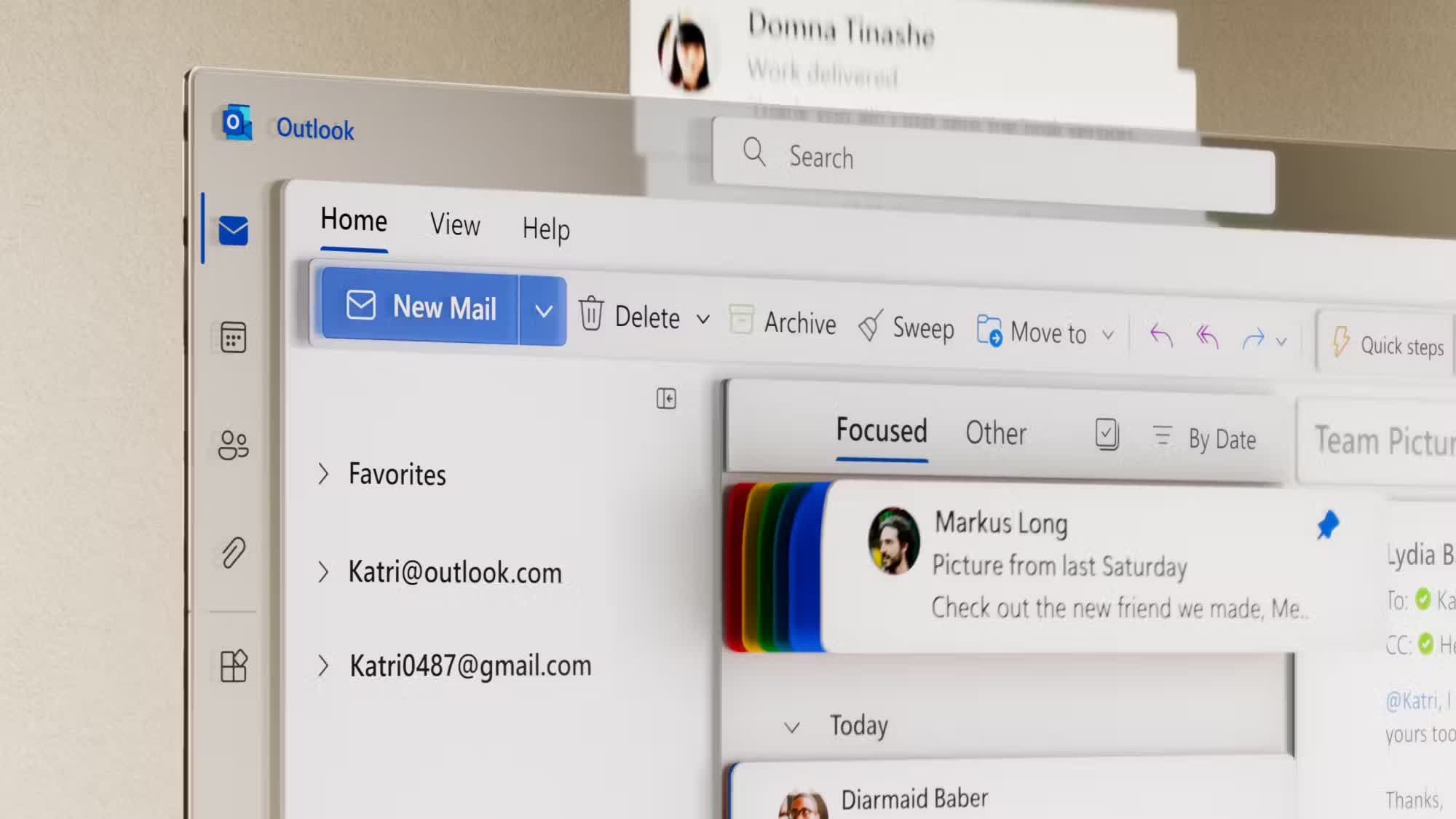
A clip from NASA's livestream quickly circulated on social media, capturing the moment astronauts flagged the problem. The glitch added an unexpectedly relatable note to an otherwise historic launch.

During the stream, one crewmember asks ground control to remotely troubleshoot an onboard system that appears to be running two non-functioning Outlook windows at the same time. Additional, less specific computer-related issues can also be heard in the background.

The duplicate Outlook instances may point to a long-standing quirk in Windows 11, where two versions of the email client often appear side by side in the Start menu. Microsoft began preinstalling the newer Outlook experience in 2024, while still offering download links to the older version.

Outlook, like much of Microsoft's software stack, has a reputation for being finicky. The company said last year it would overhaul the email client with a stronger focus on AI, but has since eased off its aggressive push to weave AI deeper into Windows 11, pivoting instead toward performance and reliability. Whether that shift translates into meaningful improvements remains an open question.

Some argue the issues run deeper than bugs or UI confusion. In early March, product growth newsletter author Aakash Gupta suggested Microsoft has little incentive to fix Outlook's underlying problems because its primary customers aren't individual users, but enterprises buying bundled IT services that include Outlook, Azure, and security tools.

NASA is among those customers, and for many organizations, switching away from Microsoft's ecosystem can be prohibitively expensive, dampening pressure to improve the product. By comparison, Gmail is often viewed more favorably, in part because Google built it to scale across a massive user base, with enterprise adoption following later.

Artemis II is the first crewed lunar mission since Apollo 17 in 1972, sending four astronauts on a 10-day journey around the Moon. The mission will allow them to observe regions of the Moon's dark side that humans have never directly seen, capture high-resolution imagery, and validate systems ahead of a planned crewed landing targeted for early 2028.

Permalink to story:

 
I've had this exact problem a few times. Outlook is really that bad. And so are most of Microsoft products.
This is a company that doesn't care about quality.
 
Every time I log in into my Outlook, it sends confirmation letter to my Gmail account. Somebody who designed the software for it, just made sure, Outlook wouldn't be a primary option for its users.
 
I've had this exact problem a few times. Outlook is really that bad. And so are most of Microsoft products.
This is a company that doesn't care about quality.

"New" Outlook is further proof of this. Worse performing, nearly quadruple the memory usage, and incomplete feature-set, yet they keep doubling down on it for what like 4+ years now and still no one wants it. They refuse to abandon it and stick with native; but with this new promise to make Windows better performing with more native code, will they finally drop it? Yeah don't hold your breath. Imagine an OPERATING SYSTEM not using native code. The fact they even thought it was a good idea to go down that path gives me no faith any of it will ever be fixed without gutting the company and starting over.
 
Imagine an OPERATING SYSTEM not using native code...
I don't know *any* OS that doesn't use a percentage of non-native code. Even Linux: the kernel and core components are native C/C++, but for any major distro, a significant amount of the system management, utilities, and bundled apps are non-native.
 
I don't know *any* OS that doesn't use a percentage of non-native code. Even Linux: the kernel and core components are native C/C++, but for any major distro, a significant amount of the system management, utilities, and bundled apps are non-native.
I'm not a programmer so I don't know exactly the correct terminology, but I am pretty sure no Linux DE is using React or Webview on basic system tools, for example application launchers (Start Menu) and file managers. Please advise if you know of one. I don't think Linux DE use either anywhere actually, not any I have tried. Are you referring to something like Python, etc? That's nowhere near as bad as this React/Webview clown show.
 
Old Outlook was quite alright, never had any issue after years of using it at work. After we moved to M365 something is constantly broken. Even worse, I hate the new look compared to the old one, as well as search in it, absolutely atrocious.

Thankfully I can still use the old one until our IT department decides to remove it completely...

It's always baffling to me how a major corporation can make something that works good, and then run it into the ground with updates noone asked for...
 
I'm not a programmer so I don't know exactly the correct terminology, but I am pretty sure no Linux DE is using React or Webview on basic system tools, for example application launchers (Start Menu) and file managers. Please advise if you know of one. I don't think Linux DE use either anywhere actually, not any I have tried. Are you referring to something like Python, etc? That's nowhere near as bad as this React/Webview clown show.
Python's in there certainly, as well as a Frankensteinian mish-mash of bash and perl scripts, all for basic system functions. It's rather clever of you to phrase the question as such, though -- since the basic Linux launchers and file managers don't render web content, they're obviously not going to use a web content renderer, are they?

However, if you DO wish to render web content in Linux, you'll be using some non-native library similar to Webview, such as Webrender or Chromium. Or worse, an app like Domterm, written largely in Javascript (ack, ack!). And since Microsoft's Webview is Chromium based, the line you're attempting to draw is illusory.
 
Python's in there certainly, as well as a Frankensteinian mish-mash of bash and perl scripts, all for basic system functions. It's rather clever of you to phrase the question as such, though -- since the basic Linux launchers and file managers don't render web content, they're obviously not going to use a web content renderer, are they?

However, if you DO wish to render web content in Linux, you'll be using some non-native library similar to Webview, such as Webrender or Chromium. Or worse, an app like Domterm, written largely in Javascript (ack, ack!). And since Microsoft's Webview is Chromium based, the line you're attempting to draw is illusory.
I wasn't trying to be clever. I phrased as such because Windows 11 does those things.

Yes there are many applications in Linux simply rendering web content and calling themselves an application, using stuff like Webview, Electron, etc. My point was that they are not core operating system utilities. And Linux DE do not use web programing languages like React for the DE or or core utilities.
 
My point was that they are not core operating system utilities. And Linux DE do not use web programing languages like React for the DE or or core utilities.
Your point is moot, and I'll explain why. You may not be old enough to remember, but in the early 1990s, the same anti-MS crowd was highly critical of Microsoft for integrating an IP stack into Windows. "Internet functionality is not, nor should ever be a core OS feature", they said, claiming it would not only "destroy competition", but destabilize the entire operating system. There were even several court challenges against Microsoft's bundling. Now of course, we can't imagine an OS without it.

The point is that, before much longer, HTML rendering will indeed be a "core OS requirement"; Linux will include "core components", and those components will use the same "web programming languages" to render it that MS does. One could indeed argue that this is already the case. When I install a distro like Ubuntu, for instance, very first icon it defaults to on screen is -- you guessed it -- a web browser.
 
Karma.

Outlook is a polished turd and have been so for decades. It's ancient code with layers upon layers of new paint on top.

Sadly with Windows and Microsoft Office the standard at many companies, it is difficult/impossible not having to deal with Outlook and thus it's many bugs and shortcomings. I highly recommend using Thunderbird as your mail client, if you have the chance to select something else than Outlook.
 
I'm sorry but I find Outlook very stable. I'm still with the 2007 version on my brother's computer. His att.net email was suspended for security reasons tho, even tho he never sent any outgoing email from it. That's not Outlook's fault. I heard the city of Los Angeles uses Gmail. I thought Hillary Clinton got in trouble for not using government web servers. How did LA get around this? Finally, the Artemis launch may be fake news, the way they claimed the Apollo launches were.
 
Last edited:
emClient is the best.
The free version only offers two email accounts. Thunderbird is free, and you can have unlimited email accounts. I have thirteen email accounts for almost twenty years now. You, can adjust just about anything on Thunderbird, and it's so easy to back it up.
 
"Humanity returns to the Moon, but Outlook still doesn't work"

Even INlook doesn't work... let alone Outlook...!
 
Finally, the Artemis launch may be fake news, the way they claimed the Apollo launches were.

With so many people having witnessed it firsthand, and posted live or recorded video of the launch, you'd be crazy to seriously think it is "fake news".
 
Back