IBM and Google say scalable quantum computers could arrive this decade

Skye Jacobs

Posts: 1,910   +58
Staff
TL;DR: The quest to build a practical quantum computer, a challenge that has tantalized physicists and computer scientists since the 1980s, is gaining unprecedented momentum. Recent breakthroughs have prompted technology firms to unveil blueprints that could see quantum machines grow from experimental constructs into viable, large-scale systems capable of solving problems beyond the reach of today's supercomputers.

Quantum computing, long seen as a distant goal, is moving closer to reality as leading tech firms outline fresh plans for building scalable machines. In June, IBM released an updated roadmap that it says resolves several of the field's most challenging technical obstacles, setting the stage for what could be the industry's most decisive period.

"It doesn't feel like a dream anymore. I really do feel like we've cracked the code and we'll be able to build this machine by the end of the decade," Jay Gambetta, IBM's leader for quantum initiatives, told the Financial Times.

Despite recent progress, the road ahead remains lined with formidable hurdles. Even after researchers solved the fundamental physics problems, manufacturers still face daunting engineering challenges. Oskar Painter, who leads quantum hardware development at Amazon Web Services, cautioned that building a practical quantum computer will require a massive engineering effort and could take another 15 to 30 years.

Current quantum prototypes typically use fewer than 200 qubits – the quantum equivalent of bits in conventional computers – but achieving machines with real industrial utility will require systems with a million or more. The challenge is immense, largely because qubits remain in their quantum states for only fractions of a second. As engineers pack in more qubits, interference, or "noise," multiplies, making reliable computation exponentially harder.

This challenge became clear with IBM's Condor chip, which contains 433 qubits. The chip's scale introduced "crosstalk," a type of interference between components that undermined performance.

"Stacking larger numbers of qubits together like this creates a bizarre effect we can't control anymore," said Rigetti Computing CEO Subodh Kulkarni. "That's a nasty physics problem to solve."

IBM responded by redesigning its couplers – the links connecting qubits – to reduce the system's vulnerability to interference. Earlier test systems relied on laborious individual "tuning" of qubits, a method that cannot scale to larger devices. Now, manufacturers are developing qubits with greater reliability and efficiency, requiring ongoing advances in materials science and production. Google aims to cut component costs tenfold, setting a $1 billion target for a full-scale quantum computer.

A keystone of scalability is quantum error correction, a method that allows systems to tolerate imperfect qubits. By distributing data across multiple qubits, error correction introduces redundancy to guard against failures. Julian Kelly, head of hardware at Google Quantum AI, cautioned that scaling systems too early could waste resources, produce noisy outputs, and consume significant engineering effort without delivering practical results.

Google has demonstrated a quantum chip that performs error correction at an increasing scale. It uses a technique called surface code, in which each qubit connects to its neighbors in a two-dimensional grid. Achieving meaningful computation with this setup would require more than a million qubits. IBM, by contrast, is pursuing low-density parity-check codes that could cut qubit needs by roughly 90 percent but depend on intricate long-distance connections. Kelly warned that these connections add new layers of complexity to systems that are already extremely difficult to control. Nevertheless, IBM reported a recent breakthrough in developing such connectors.
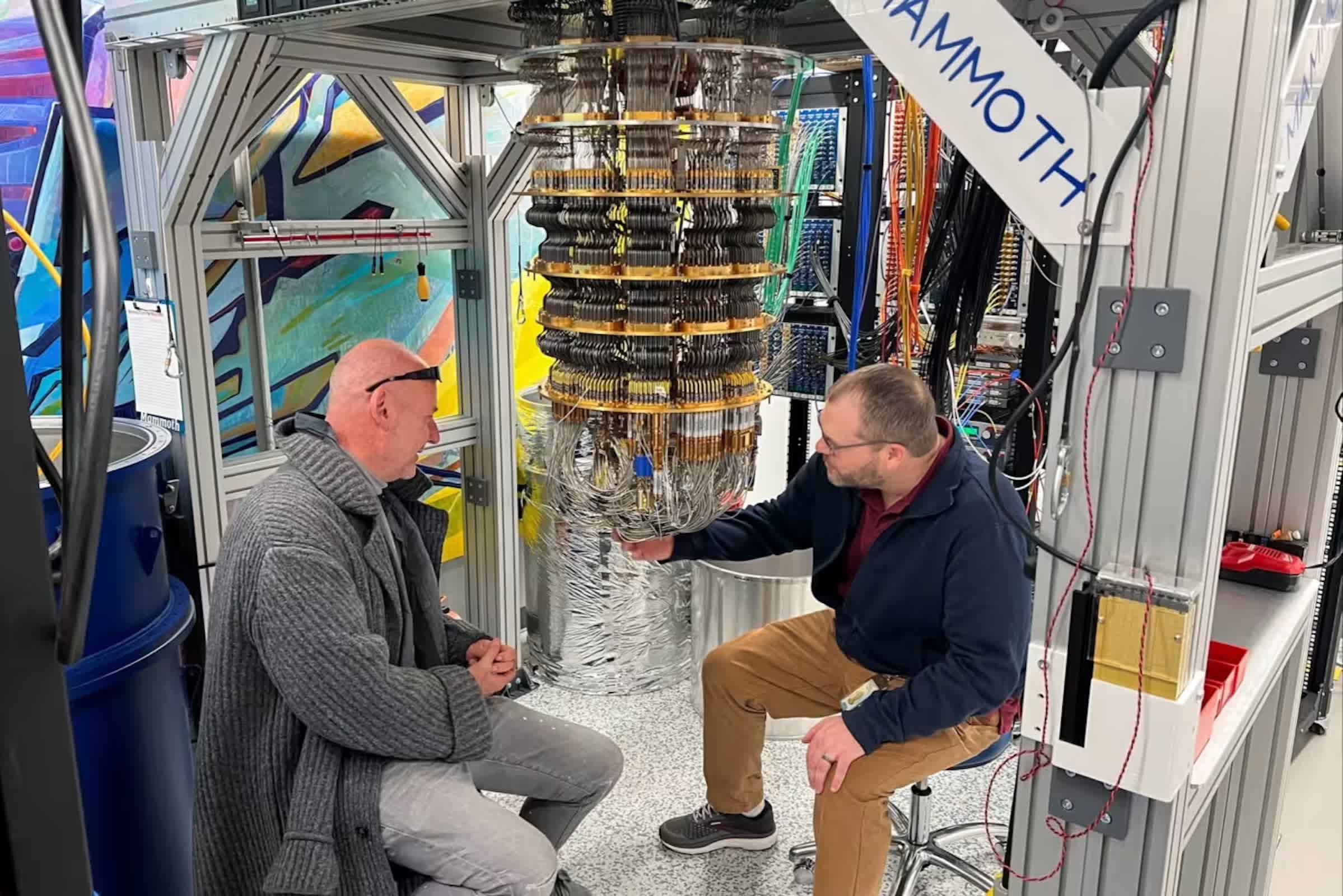
Most notable advances come from qubits built with superconducting circuits, as used in IBM and Google machines. These systems must operate near absolute zero and are notoriously hard to control. Other approaches use trapped ions, neutral atoms, or photons as qubits. While these approaches offer greater inherent stability, scaling up and integrating large numbers of qubits remains a formidable practical challenge.

"The costs and technical challenges of trying to scale will probably show which are more practical," said Sebastian Weidt, chief executive at Universal Quantum, a startup developing trapped ions.

Weidt emphasized that government support in the coming years could play a decisive role in determining which quantum technologies prove viable, ultimately limiting the field to a handful of companies capable of bringing a system to full scale.

Widespread interest in quantum computing is attracting attention from both investors and government agencies. Last year, the Pentagon's advanced research arm, DARPA, launched a broad review to identify the quantum technologies most likely to achieve rapid industrial adoption, selecting a group of leading companies to test which approaches could deliver practical, scalable systems.

Firms like Amazon and Microsoft are exploring exotic states of matter in pursuit of more reliable qubits. These next-generation technologies are still in their early stages, though proponents argue they could eventually surpass today's quantum machines. For now, industry leaders continue refining and scaling legacy architectures developed over years of lab research.

"Just because it's hard, doesn't mean it can't be done," Horvath said about the industry now on the cusp of a technological revolution.

Image credit: The Financial Times

Permalink to story:

 
Quantum Computing and Fusion, two things that are always frustratingly a decade away...

Exactly. When I was in school 15 years ago, quantum computers would outpace traditional supercomputers within 5 years.

This field reminds me of how programmers 'fix' side effects of badly designed apps without understanding the root cause of their problems.
This whole fusion / quantum field is tech based on side effects of the universe without understanding how it works on the most fundamental level.

Good luck trying to make something work that is based on countless baseless assumptions about how the universe works.

And yes, that makes it very hard to understand, but it's because it doesn't make sense from the ground up. It's like when someone makes and extremely complex and convoluted algorithm that is 0.46% faster than it's predecessors, but nobody understands and that is considered genius and ground breaking.

I always find it hilarious when a decade later someone comes up with a super simple solution that is 50% faster or something. This hasn't yet happened in the quantum field unfortunately.
 
Last edited:
Exactly. When I was in school 15 years ago, quantum computers would outpace traditional supercomputers within 5 years.

This field reminds me of how programmers 'fix' side effects of badly designed apps without understanding the root cause of their problems.
This whole fusion / quantum field is tech based on side effects of the universe without understanding how it works on the most fundamental level.

Good luck trying to make something work that is based on countless baseless assumptions about how the universe works.

And yes, that makes it very hard to understand, but it's because it doesn't make sense from the ground up. It's like when someone makes and extremely complex and convoluted algorithm that is 0.46% faster than it's predecessors, but nobody understands and that is considered genius and ground breaking.

I always find it hilarious when a decade later someone comes up with a super simple solution that is 50% faster or something. This hasn't yet happened in the quantum field unfortunately.

Experimentation is the way assumptions we have about the universe get solved. Quantum theory has been studied for 125 years revealing that the universe at the microscopic level is far more complex than we imagined. But with all we don't understand (and may never gain a full understanding) about quantum, it has helped in a better and deeper understanding of other theories from Newton, Kepler, Maxwell, Einstein...etc. The "super simple solution" is often times an accidental or unintentional discovery; rubber vulcanization, penicillin, x-rays, microwave ovens, velcro, teflon, super glue...etc. Even accidental advancements in science are ground breaking and their method of discovery often by people thinking outside the box. Daring to think differently is why they are genius!
 
Experimentation is the way assumptions we have about the universe get solved. Quantum theory has been studied for 125 years revealing that the universe at the microscopic level is far more complex than we imagined. But with all we don't understand (and may never gain a full understanding) about quantum, it has helped in a better and deeper understanding of other theories from Newton, Kepler, Maxwell, Einstein...etc. The "super simple solution" is often times an accidental or unintentional discovery; rubber vulcanization, penicillin, x-rays, microwave ovens, velcro, teflon, super glue...etc. Even accidental advancements in science are ground breaking and their method of discovery often by people thinking outside the box. Daring to think differently is why they are genius!
Certainly. At the same time there are still so many revolutions that lie ahead of us and we seem to just be flailing around in the mean time. Sometimes taking a step forward, often taking a step back, or getting stuck in a local maximum for a long time.

AI needs a lot of revolutions before it becomes smart, identifying the difference between a machine and something sentient.
Transportation is so far off from being able to be useful on a larger scale, gravity engines are not even in the realm of human possibilities right now.
Harnassing and controlling these unfathomable amounts of energy in a practical way, things like fusion, but then way more compact and practical.
Life itself. It's all around us. Yet nobody can create it from scratch (in an artificial way) or recreate it in a machine.

Also, imagine any human controlling any of these things. We're far from ready for it. Genius is not widespread. Raw emotion is everywhere. We're lucky we're not nuking each other (yet).
 
They barely have an idea how the tech works but they're marketing it as nearly ready-to-roll-out?! ... ya, that's merely a veiled admission they can't get it to work as hoped/expected.
To me, that's like robotic taxis being hyped as ready, and the software's really 80/20, but the cost of expected lawsuits will be lower than the cost to wait for the software to be 100%, so they roll them out to the public.
I suspect quantum computing will take them much more than 10 years to figure out, and by then standard computing and AI will advance suitably to render the need for quantum moot, pointless, and an enormous waste of money.
 
Exactly. When I was in school 15 years ago, quantum computers would outpace traditional supercomputers within 5 years.

This field reminds me of how programmers 'fix' side effects of badly designed apps without understanding the root cause of their problems.
This whole fusion / quantum field is tech based on side effects of the universe without understanding how it works on the most fundamental level.

Good luck trying to make something work that is based on countless baseless assumptions about how the universe works.

And yes, that makes it very hard to understand, but it's because it doesn't make sense from the ground up. It's like when someone makes and extremely complex and convoluted algorithm that is 0.46% faster than it's predecessors, but nobody understands and that is considered genius and ground breaking.

I always find it hilarious when a decade later someone comes up with a super simple solution that is 50% faster or something. This hasn't yet happened in the quantum field unfortunately.
I've always had the suspicion that quantum computing is the Emperor's New Clothes. Of course, it might prove real, but Nature is fond of putting a classical stop to "quantum advantage" for some reason: as in the case of entanglement where the no-communication theorem precludes faster-than-light signalling. It's as if, even though these things happen at a lower level, the high-level classical "API" ultimately constrains it to the "specification" of space-time---which makes sense from an engineering point of view. The same thing might be the case with quantum computing. Also, while QM and GR will always remain valid approximations to it, the succeeding theory that underlies both may change the picture markedly.

AI needs a lot of revolutions before it becomes smart, identifying the difference between a machine and something sentient.
Today's LLMs are analogues to the language faculties of our brains, but far from "strong AI" in the traditional sense; in other words, corporations have conflated "weak AI," in the form of LLMs, with "strong AI." Doubtless, other parts and an architecture beyond transformer will be needed: sensory modalities, real-time training and plasticity, long-term memory, and the implementation of sentience, which could be trivial once cracked, most animals, of which we are one, possessing some level of it.
 
Back