Jensen Huang is calling it: Human-like robots arrive in 2026

Skye Jacobs

Posts: 1,913   +58
Staff
In context: Inside the cavernous halls of CES 2026 in Las Vegas this week, humanoid robots were everywhere – some strolling, some stumbling, others standing motionless beside hopeful creators. But where others might see a work in progress, Nvidia CEO Jensen Huang sees an imminent breakthrough.
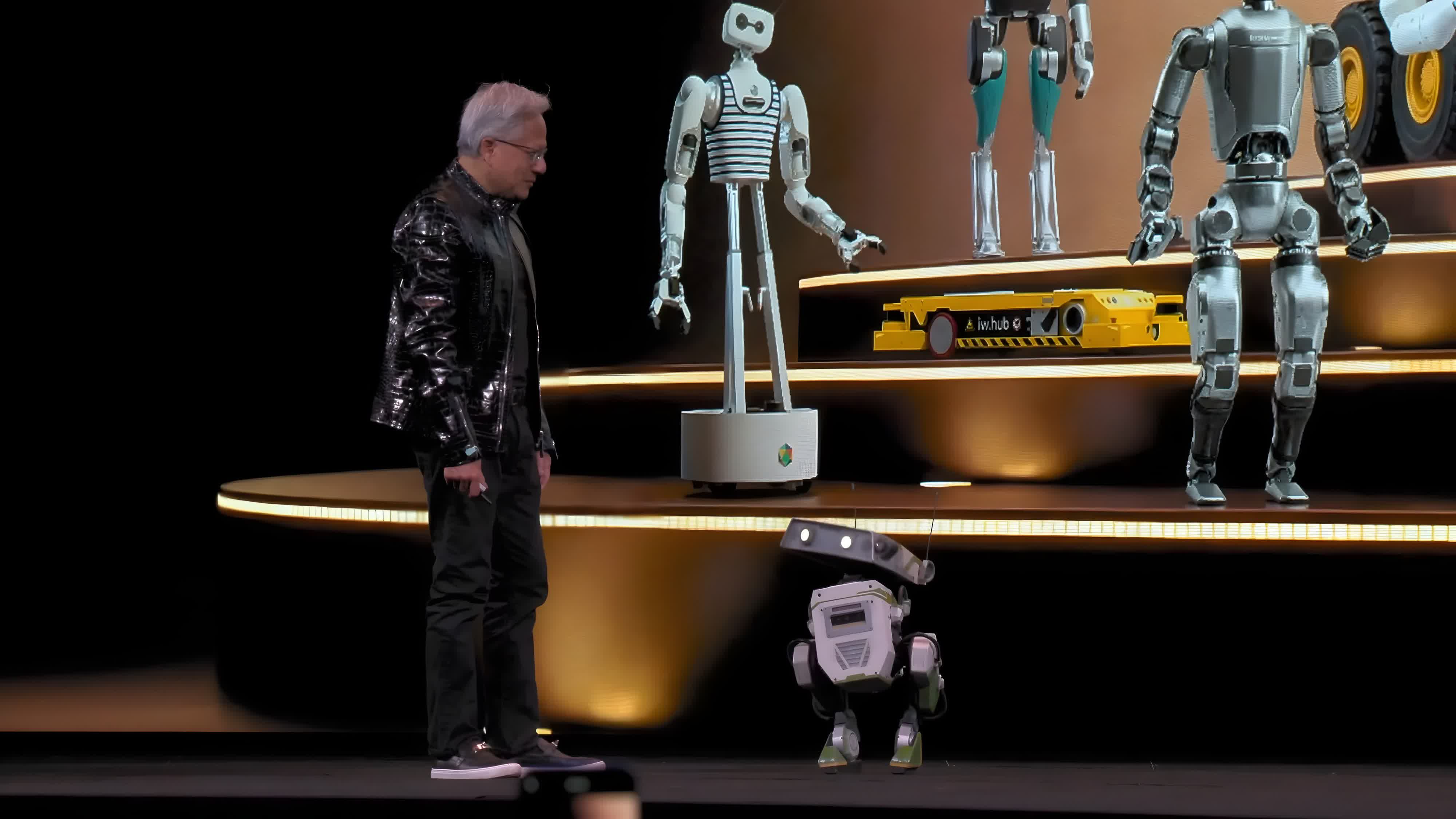
During a Q&A session on Tuesday, Huang didn't hesitate when asked how long it would take for humanoid robots to match human-level ability. "This year," he said. His confidence drew attention, especially as several nearby demonstrations revealed just how unfinished the field still looks.

Huang's optimism isn't detached from corporate interest. Nvidia dominates the AI chip market, and its success is tightly bound to advances in robotic intelligence and simulation. The company's graphics processors underpin many robotics systems that rely on AI inference for movement, visual recognition, and control.

As part of that push, Nvidia just introduced Cosmos, an AI platform built on generative models trained on vast amounts of real-world robotics and driving videos. In Huang's description, Cosmos is meant to supply the data and simulation backbone for physical AI systems, from humanoid robots to autonomous vehicles, by generating realistic, physics-aware virtual environments where these systems can be trained and tested at scale.

Despite these advancements, Huang admits the hardware isn't fully there yet. He pointed to fine motor capability as one of the hardest challenges to solve. "Fine motor skills [are] extremely hard – and the reason for that is building a hand is hard," he said. "The motor technology is hard. We don't just use our eyes. We also use touch. And the robot only has eyes, so it needs to have touch." Cosmos is intended to help close some of that gap on the software side by letting developers expose robot control systems to an enormous range of simulated interactions and edge cases before the machines ever touch real hardware.

Locomotion, too, remains imperfect. Most robots still move with a measured, mechanical gait, but Huang said progress in full-body mobility has been rapid enough that he expects those limits to fall first. He placed gross movement and grasping next in line to advance, with fine-tuned dexterity following after. Once those skills align, Huang believes robots will begin filling gaps across industries that can't currently find human workers, a transition Nvidia hopes to accelerate with synthetic training data and high-fidelity simulations generated through platforms like Cosmos.

That prediction raises the question of job displacement – a subject Huang tackled directly. "Having robots will create jobs," he said, arguing that demographic trends demand automation rather than threaten employment. With population growth slowing in many regions, he said societies "will need more 'AI immigrants' to … do the kind of work we decided not to do anymore." Huang framed robotics as a complement to human labor, not a replacement for it. "The robotic revolution will replace the labor loss and therefore is going to drive up the economy – and when the economy increases, we hire more people," he said.

Not every economist or technologist shares that view. Analysts at Challenger, Grey and Christmas reported that artificial intelligence led to more than 17,000 lost jobs in the first ten months of 2025, particularly squeezing entry-level engineers. And Geoffrey Hinton, the deep-learning pioneer often called the "Godfather of AI," warned last September that while AI may bring "a huge rise in profits," it will also cause "massive unemployment."

Still, Huang's belief that AI-driven robotics will strengthen the labor market rather than undermine it remains central to Nvidia's message. He portrays humanoid automation not as science fiction, but as a near-term platform shift akin to the dawn of computing itself.

Image credit: Fortune

Permalink to story:

 
The labor market can get bent because I'm going to bankrupt myself building one of these to be a champion in the steel cage.
 
The problem with every one of these things so far is that "Human like" is a very nebulous term. Even though he points out a number of things that will make it more useful, so has every other "human" robot released to date. It would be great if the technology was there to make such a thing, but much like AI, the promise still far exceeds the reality.

Human like should be something more than "It kind of looks like a person."
 
How will politicians convince people to hate immigrants when robots are doing the work?
 
US is behind on human like robots and Nvidia tech is not required at all. I have been in Asia multiple times and seen robots look and act almost lifelike so I don't know why Huang even talks about this. Probably just to try and ramp the stock again. Nvidia stock is stagnating and banks/investors are prepairing for a tech drop. Hopefully AI bubble won't result in a crash, like dotcom and the financial crisis around 2008 - and this is exactly why banks and smart investors are stepping away slowly but surely from AI now. There is still money to be made but the risk is very high.

Huang selling Nvidia stock at times, proves this. If he thought the numbers would only climb from here, he would have kept them. Him and multiple top dogs at Nvidia sold out many times, often at peaks (they know when to sell)

Nvidia is peaking now. Hence why gaming products don't get much attention. They try to meet AI orders because at some point in the coming years, it will all be over and demand will drop off a cliff when there is alternative and proper competition.

AI is not going anywhere from here but AI GPU demand will go down for sure. When Nvidia faces more competition, their margins will suffer as well. They have huge margins on AI GPUs today.

What is funny tho. Most companies buying all these AI GPUs, sees no or little ROI. They mostly buy them, because they are scared to get "left behind" on the AI race, but has no actual plan in place, to take advantage of AI and make money on it.

So far, AI have cost people their jobs for the most part. This is what most companies use AI for now. To replace actual people with AI. This is how they "make money" with AI for the most part for now.
 
Last edited:
Job losses are immediate. Job gains are inevitable but happen "down the road". Can't really get around that, so a lot of folks are going to oppose change just to keep obsolete jobs. It's rough on buggy-whip makers, but the rest of the world profits...
 
US is behind on human like robots and Nvidia tech is not required at all. I have been in Asia multiple times and seen robots look and act almost lifelike so I don't know why Huang even talks about this. Probably just to try and ramp the stock again. Nvidia stock is stagnating and banks/investors are prepairing for a tech drop. Hopefully AI bubble won't result in a crash, like dotcom and the financial crisis around 2008 - and this is exactly why banks and smart investors are stepping away slowly but surely from AI now. There is still money to be made but the risk is very high.

Huang selling Nvidia stock at times, proves this. If he thought the numbers would only climb from here, he would have kept them. Him and multiple top dogs at Nvidia sold out many times, often at peaks (they know when to sell)

Nvidia is peaking now. Hence why gaming products don't get much attention. They try to meet AI orders because at some point in the coming years, it will all be over and demand will drop off a cliff when there is alternative and proper competition.

AI is not going anywhere from here but AI GPU demand will go down for sure. When Nvidia faces more competition, their margins will suffer as well. They have huge margins on AI GPUs today.

What is funny tho. Most companies buying all these AI GPUs, sees no or little ROI. They mostly buy them, because they are scared to get "left behind" on the AI race, but has no actual plan in place, to take advantage of AI and make money on it.

So far, AI have cost people their jobs for the most part. This is what most companies use AI for now. To replace actual people with AI. This is how they "make money" with AI for the most part for now.
Well, you ought to know that when they continually increase the minimum wage, businesses will seek affordable alternatives to obscenely expensive human labor, especially the entry-level - zero work ethics punk-types, who are not exactly eligible for #1 employee of the year.
:cool:
 
Back