Looking Glass debuts high-resolution 3D holographic displays, no glasses required

Daniel Sims

Posts: 2,460   +74
Staff
In brief: Holographic display startup Looking Glass has introduced numerous products to facilitate the creation and viewing of images with three-dimensional depth over the past several years. The company's latest attempt to popularize the technology is a series of 3D-capable screens that resemble traditional PC monitors.
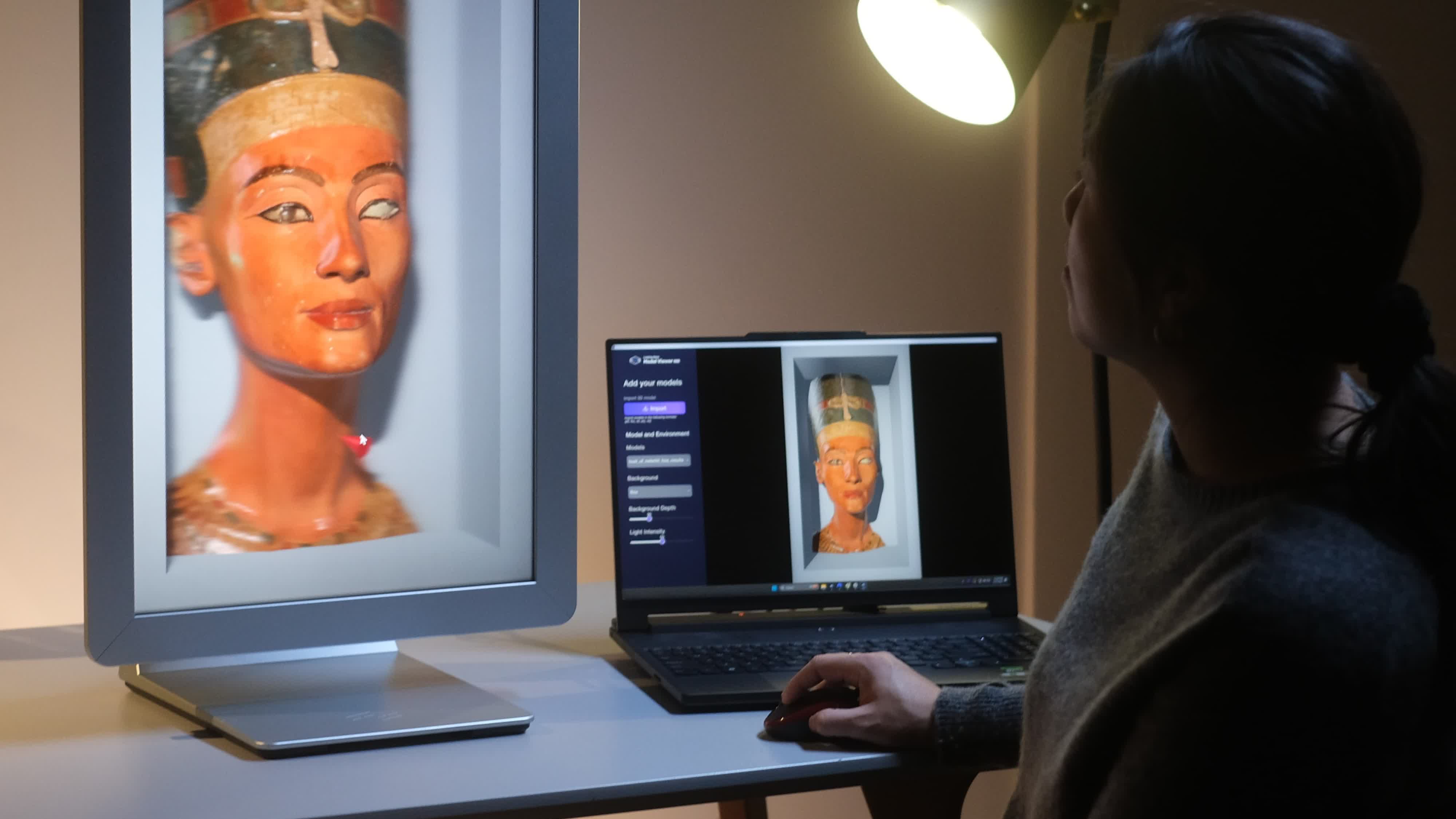
Pre-orders are now open for a series of screens that display holographic 3D media without requiring viewers to wear glasses. The new "Hololuminescent" displays from Looking Glass might be suited for signage, 3D rendering, or delivering presentations.

The screens, no thicker than traditional monitors, utilize the company's proprietary hybrid technology, which adds three-dimensional volume to digital objects with embedded holographic layers. A demonstration video (below) shows someone being displayed in 3D while being filmed live, suggesting that the technology might enable new kinds of showcase formats.

Looking Glass designed the system for maximum compatibility with existing hardware and workflows to improve accessibility compared to the company's earlier Light Field Displays. The screens support standard CMS platforms, video distribution software, HDMI, and USB.

To begin, users record a live or animated subject against a solid green or white background. Then, they can convert the footage using Cinema 4D, Unity, or Adobe Premiere Pro before exporting to the Hololuminescent display. Additionally, the 3D holograms can contain traditional 2D videos.
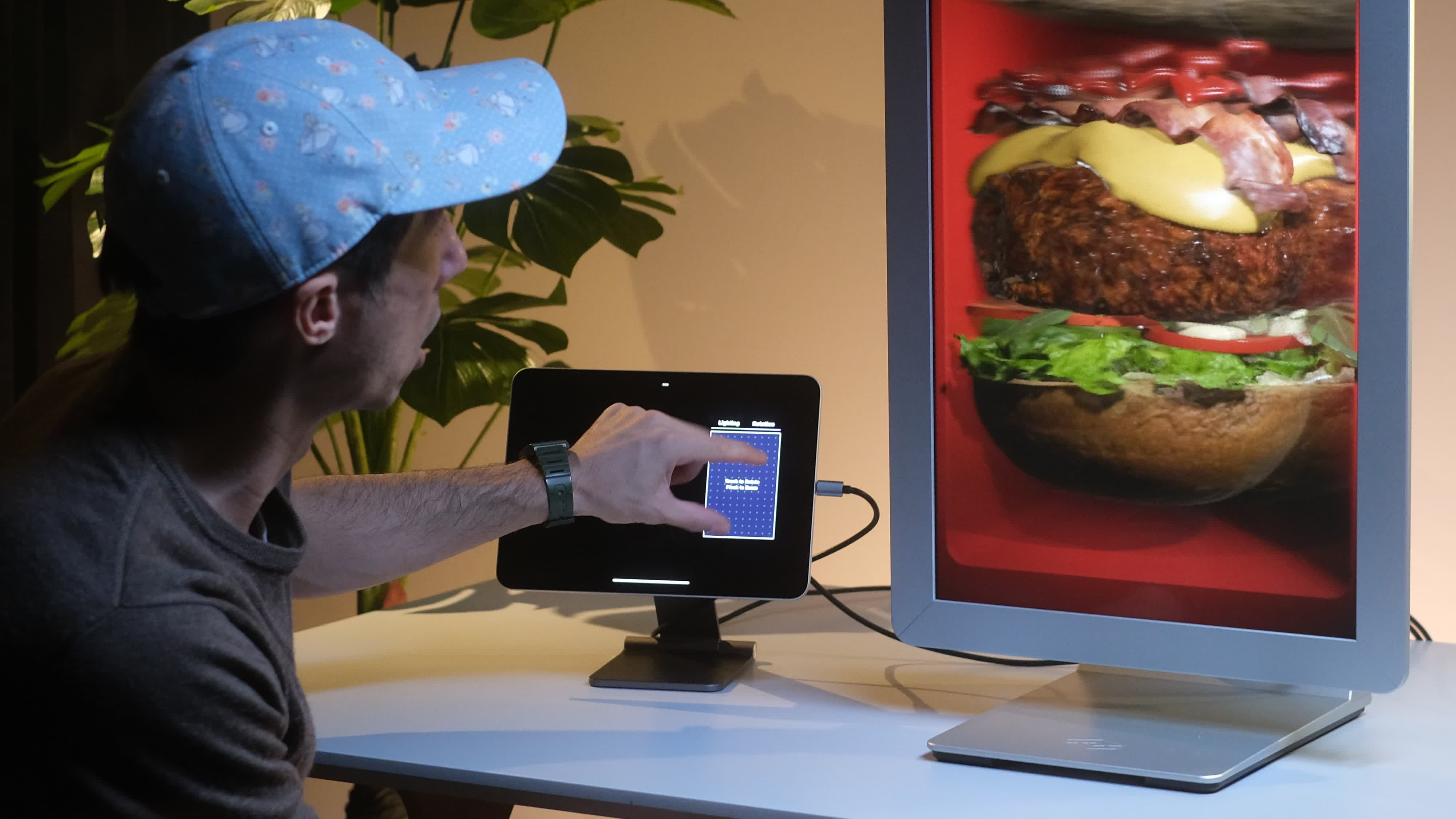
Looking Glass has introduced numerous methods for displaying holograms over the last several years.

In 2018, the company released a desktop display that connects to PCs to help 3D modelers view their creations from multiple angles. To broaden the technology's appeal, Looking Glass later introduced a smaller, more affordable version that captures 3D images from an iPhone camera.

The company also created a file format for displaying 3D animated images on PCs, smartphones, and VR headsets. It even attempted to hop onto the AI bandwagon by integrating a holographic display with an animated character powered by ChatGPT.

The screens are available in three sizes: a 16-inch 1080p monitor starting at $1,500, a 27-inch 4K screen ($3,000), and an 86-inch 4K display for full-body presentations ($15,000). The 16- and 27-inch monitors are expected to begin shipping in November and December, while the 86-inch variant ships in February. Pre-orders for the largest screen come with a 16-inch model at no additional cost. All variants display images in 9:16 portrait orientation only.

Permalink to story:

 
I wouldn't call this "holographic" because you cannot walk all around it like you could a photographic holograph. IMO, "Holographic" is just marketing spin trying to sell the display to people who worship bling.
 
I wouldn't call this "holographic" because you cannot walk all around it like you could a photographic holograph. IMO, "Holographic" is just marketing spin trying to sell the display to people who worship bling.

Sorry it doesn't meet your definition - but it does meet the definition that the vast majority of the World use. Think you've watched too much Star Trek.
 
I wouldn't call this "holographic" because you cannot walk all around it like you could a photographic holograph. IMO, "Holographic" is just marketing spin trying to sell the display to people who worship bling.
You are thinking of "Holographic Projection". This is Holographic Display.
 
You are thinking of "Holographic Projection". This is Holographic Display.

- I'm sure that's what virtually anyone who hears "holograph" thinks.

That said this is a cool first step, and like all cool first steps those with money pay for the novelty of it. Hopefully further refinement gives the screen a much larger viewing angle, smaller bezzels, and maybe even a good way to link 4 of them together in a rectangle to form a "virtual display case" of sorts.
 
It seems like you would have to move your head side-to-side to notice the 3D effect. This may be a good product for 3D modeling but not much else. Maybe one day I'll see this on display at Best Buy and actually consider buying it. It's hard to convey the 3D effect through 2D video. You'd have to see it in real life to see the difference. That may be the biggest marketing challenge for this company.
 
Well, this is at least one step cleared towards my goal of having my Home Assistant-powered home have a fully local, active (vs current reactive), and actively learning, multimodal AI interface with simulated personality, long-term event recall, and three-dimensional avatar in every room.

Granted, this would only fulfill the final, largely cosmetic requirement, and, based on the article, it will probably take a few iterations before it would properly work for even that, but baby steps and all that... There are plenty of larger technological hurdles that need to be overcome before that, anyway.
 
- I'm sure that's what virtually anyone who hears "holograph" thinks.

That said this is a cool first step, and like all cool first steps those with money pay for the novelty of it. Hopefully further refinement gives the screen a much larger viewing angle, smaller bezzels, and maybe even a good way to link 4 of them together in a rectangle to form a "virtual display case" of sorts.
I don't see a reason why you couldn't put together a "virtual display case" using these as is - each side would simply be loaded with a recording/render of the same subject, just rotated 90° in the appropriate direction, and the "back" one 180°.

You would need to account for the bezels and any space between where the monitors meet to create proper object continuity between screens, but aside from that, it should work - assuming that the viewing angle and maximum angle of the 3D effect, which I couldn't find mentioned in the article, are sufficient, at least.

If not, you might need to settle for a more expensive, more space consuming hexagonal, or even octagonal configuration (in which case, a slimmer and taller aspect ratio would help a lot). On the other hand, if they were to work at every angle, even three displays could do the trick.

If they do get it figured out, I would bet good money that you would eventually find the large versions in richer frat houses, as their own dedicated stripper display...😞
 
Impressive, but think the last thing the world needs is more blending of reality with fiction. We've got plenty as is.
 
It seems like you would have to move your head side-to-side to notice the 3D effect. This may be a good product for 3D modeling but not much else. Maybe one day I'll see this on display at Best Buy and actually consider buying it. It's hard to convey the 3D effect through 2D video. You'd have to see it in real life to see the difference. That may be the biggest marketing challenge for this company.
I imaging you'd be able to see 3D just like in the real world as you have two eyes. The only reason the camera is being moved is to portray the 3D on a 2D screen to the viewer
 
You are thinking of "Holographic Projection". This is Holographic Display.
If you've ever seen a hologram at, for instance, a museum or science museum, they look nothing like this. You can, literally, walk around the hologram and see all sides of the object unobstructed.

Not only that, but if you reach out to try to touch it, your hand goes right through it.
I don't see a reason why you couldn't put together a "virtual display case" using these as is - each side would simply be loaded with a recording/render of the same subject, just rotated 90° in the appropriate direction, and the "back" one 180°.
I highly doubt such an arrangement would even closely match a true hologram. Notably, you would not be able to put your hand through it, and with that kind of arrangement, there would be obvious discontinuities that would not exist in a true hologram.
Sorry it doesn't meet your definition - but it does meet the definition that the vast majority of the World use. Think you've watched too much Star Trek.
It sounds like you have never seen a true hologram, and I think you are thinking of Star Wars. In these "digital" days, photographic film based holograms are a rare find and even harder to make - if you can find the "recording" material, I.e., film or a photographic plate, and a suitable laser with a long enough coherence length and/or a narrow enough pulse width if recording of live subjects is desired.
 
Last edited:
Back