MacBook Neo demand is so strong it's creating supply headaches for Apple

Skye Jacobs

Posts: 2,030   +59
Staff
Rumor mill: Apple is facing an unexpected test of its supply chain strategy after surging sales of the MacBook Neo created shortages of key components originally intended to be recycled stock. Sources familiar with the matter tell Taipei tech journalist Tim Culpan that the company is in discussions with suppliers about whether to expand production or let inventories run down, a decision that could shape margins and influence Apple's broader hardware roadmap.
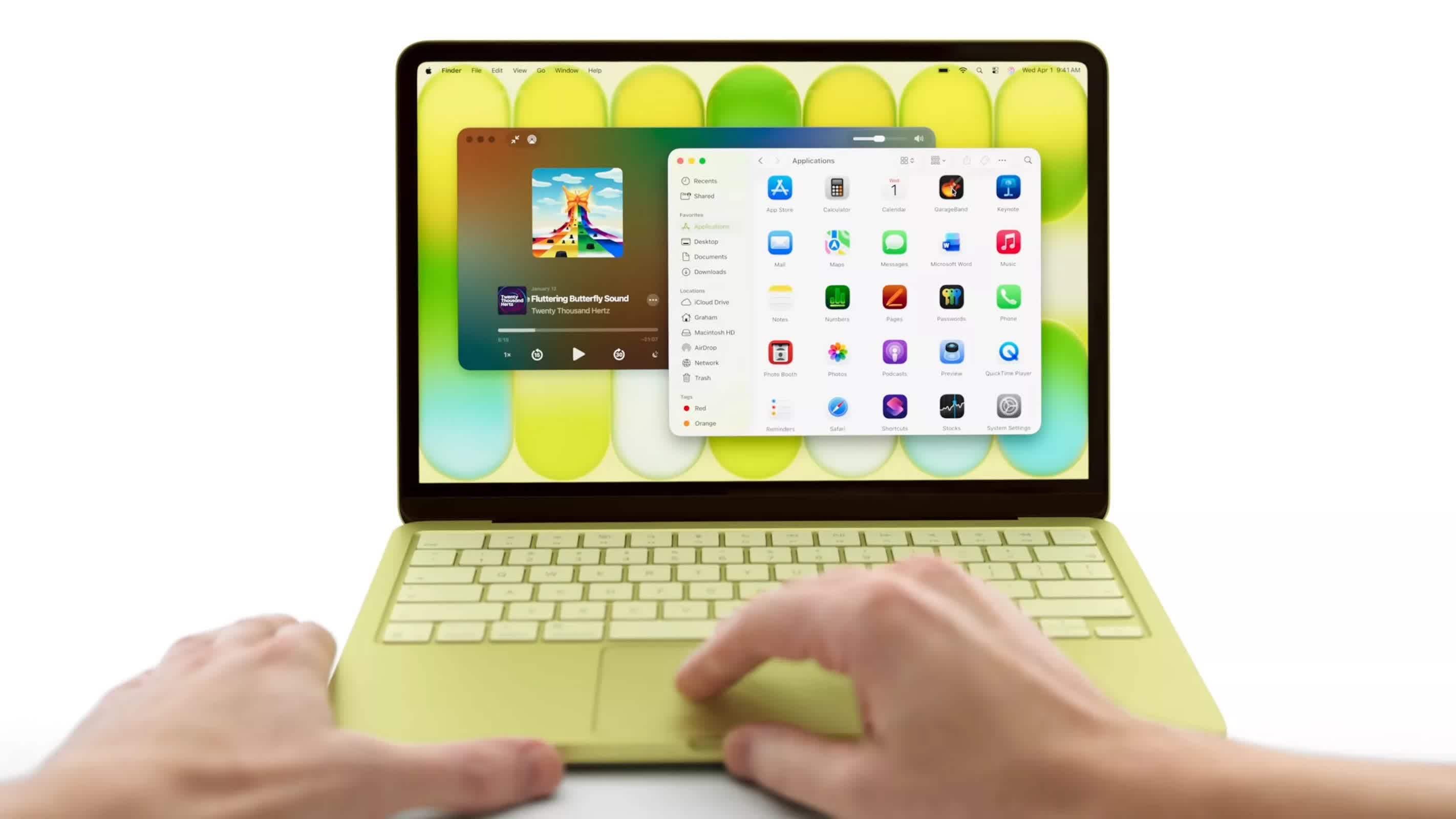
The lightweight laptop – available in four colors and two configurations – was built around Apple's A18 Pro processor, the chip that powered last year's iPhone 16 Pro. In the Neo, that silicon wasn't newly fabricated; instead, Apple repurposed remaining batches from the initial iPhone run, according to Ben Thompson of Stratechery.

He explained that the Neo uses an A18 Pro variant with one GPU core disabled: "You could make the case that some number of these chips are effectively free for Apple." This practice of "binning" chips with minor defects – salvaging usable dies rather than scrapping them – helped turn surplus iPhone silicon into the backbone of a low-cost Mac.

The approach was effective – perhaps too effective. Apple initially planned roughly five to six million Neo units assembled by Quanta and Foxconn at plants in Vietnam and China. Those volumes are now being reevaluated as the supply of usable A18 Pros dwindles.

A pivot to produce more systems would require significant cost adjustments, since TSMC's 3-nanometer process used to make the chip is already effectively at capacity. Buying new wafer lots or reallocating existing ones would raise expenses well above the near-zero cost of the original inventory.
Culpan points out that Apple could ask TSMC CEO CC Wei to prioritize a new batch of chips at a premium price, but doing so would likely erase the profit margins on its budget laptop.

A similar squeeze applies to other inputs, such as aluminum and memory, whose rising prices compound the problem.

To offset higher component costs, one possibility would be for Apple to narrow model options or slightly raise prices. Culpan suggests that the company could discontinue the $599 256GB version, keep only the $699 512GB model, or package added value like one-year trials of expanded iCloud storage. Such moves would protect margins while maintaining the Neo's appeal as an affordable entry point into macOS.
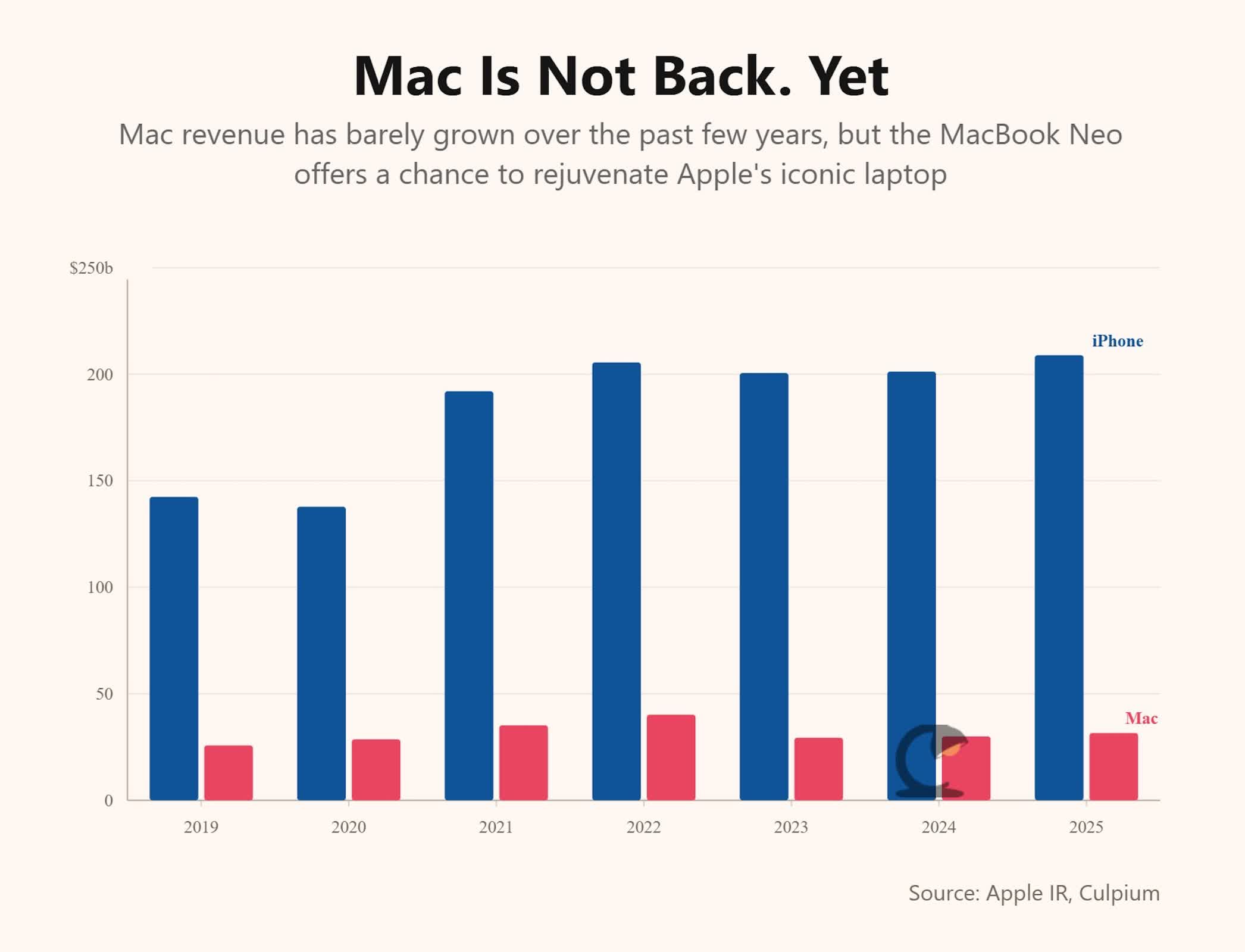
Image credit: Tim Culpan

Beyond the immediate production dilemma lies a strategic question. The Neo's popularity highlights the demand for less expensive Mac hardware. Although the Neo risks cannibalizing sales of the MacBook Air and Pro, Culpan argues the long-term effect may be to convert Windows users and expand Apple's footprint among mainstream and corporate customers.

It wouldn't be the first time a lower-cost product reshaped Apple's ecosystem. Two decades ago, the iPod became a seasonal staple and gateway into Apple's world of devices. The Neo's pricing and design could replicate that success – if Apple decides the economics of a second production run make sense.

Permalink to story:

 
Apple can just use nondefective chips without that big of a hit. Calling the defective ones free is just an accounting trick. The neo’s big sales are still minuscule compared to iPhone sales.

Having “low inventory” on the lesser model is the most likely solution to protect margins while upping average sale price.

Further, everything bleeding edge is about to shift to 2N which will free up 3N capacity.
 
Apple can just use nondefective chips without that big of a hit. Calling the defective ones free is just an accounting trick. The neo’s big sales are still minuscule compared to iPhone sales.

Having “low inventory” on the lesser model is the most likely solution to protect margins while upping average sale price.

Further, everything bleeding edge is about to shift to 2N which will free up 3N capacity.
Their non defective chips are slated for the iphones, not for neos.

No, it is not an "accounting trick", this hardware doesnt have sufficient GPU cores that work to match what is being advertised in the hardware it is sold in. This is called "binning" and has been in use in the industry for a very long time. Using hardware that doesnt fully function for lesser roles is just good business.
 
It's not that the Neo is underpriced.
It's that the other Macs are overpriced.
Mac Air starts at $1099 and Mac Pro at $1700.
I understand Apple demands a premium but that's ridiculous that they hadn't cracked the $500 barrier till now.

$500, $1000, $1500 should all have a device to meet their price points. Same goes for the phones and the ipads.
 
Yet you can get a barely used MacBook Air with 16GB, 1TB ssd and m4 cpu for not much more.

They would have never needed to create the NEO if they would have put a a MacOS lite on the iPad Pro and given it 2 usb-c ports, and mouse support.
 
It's not that the Neo is underpriced.
It's that the other Macs are overpriced.
Mac Air starts at $1099 and Mac Pro at $1700.
I understand Apple demands a premium but that's ridiculous that they hadn't cracked the $500 barrier till now.

$500, $1000, $1500 should all have a device to meet their price points. Same goes for the phones and the ipads.
Aren't you the guy on here who's happy to pay $2000 for a 2TB iPhone?
 
Aren't you the guy on here who's happy to pay $2000 for a 2TB iPhone?


Am I happy about it? NO

But there are plenty of people to tell me "you don't need that" and question my buying habits when I clearly need the storage for my vlogging. Apple is stingy with storage and RAM and that's why I don't have any Macs in my home.

As for the 2TB iPhone: it's the best of the best. I feel I don't need anything newer till iPhone 20. I'll upgrade then. Maybe there will be more storage offered, maybe not - but to be honest: 2TB of storage is something I've wanted so long I was willing to spend whatever it cost.
 
Although the Neo risks cannibalizing sales of the MacBook Air and Pro, Culpan argues the long-term effect may be to convert Windows users and expand Apple's footprint among mainstream and corporate customers.
The Neo was cheap enough I gave MacOS a go, and now I completely understand the Mac ecosystem and I get now why people pay the premium for the MacBooks.

If I was in the market for a £1000-£2000 laptop, I would normally have gone for a Windows laptop, usually HP, Dell, Lenovo, Asus. I wouldn't now, not after experiencing the Neo, I'd go for a MacBook Pro, and if I really needed Windows, I'd be running it as a virtual machine just to run those specific tasks, otherwise, the Windows laptops just simply aren't as good.
 
Back