Forward-looking: Engineers at the University of California, Berkeley, have unveiled a flying robot that mimics the agility and precision of a bumblebee. Weighing just 21 milligrams and measuring less than one centimeter in diameter, it is the world's smallest wireless robot capable of controlled flight.

Designing a small-scale flying robot posed significant challenges. Traditional flying robots rely on onboard power sources like batteries and electronic flight control systems – components that are difficult to miniaturize without adding excessive weight. To overcome this hurdle, Lin and his team used an external magnetic field to both power the robot and control its movements.
"Bees exhibit remarkable aeronautical abilities, such as navigation, hovering, and pollination, that artificial flying robots of similar scale fail to do," explained Liwei Lin, distinguished professor of mechanical engineering at UC Berkeley and senior author of the study. "This flying robot can be wirelessly controlled to approach and hit a designated target, mimicking the mechanism of pollination as a bee collects nectar and flies away." The research was published in Science Advances.

The robot's design is deceptively simple yet highly effective. Shaped like a tiny propeller, it features two small magnets that respond to an external magnetic field. As the field alternates, the magnets are attracted and repelled, causing the propeller to spin. This spinning motion generates enough lift for the robot to take flight. By adjusting the field's strength, researchers can precisely control its flight path.
At just one centimeter in diameter, this device is nearly three times smaller than its closest competitor, a 2.8-centimeter-diameter flying robot. Its compact size enables applications in environments where larger robots cannot operate.
"Tiny flying robots are useful for exploring small cavities and other complicated environments," said Fanping Sui, co-first author of the study and a recent Ph.D. graduate from UC Berkeley. Potential uses include artificial pollination and inspecting confined spaces, such as inside pipes.
However, the robot currently has limitations. It operates in passive flight mode, meaning it lacks onboard sensors to monitor its position or trajectory in real time. As a result, sudden environmental changes such as strong gusts of wind could disrupt its course.
Wei Yue, co-first author and a graduate student in Lin's lab, noted that future iterations aim to incorporate active control systems, enabling real-time adjustments to position and attitude.
Another challenge is the robot's reliance on a strong magnetic field generated by an electromagnetic coil for operation, although researchers believe that further miniaturization could address this issue. Reducing the robot's size to less than one millimeter could allow it to be powered by weaker magnetic fields, such as those from radio waves.
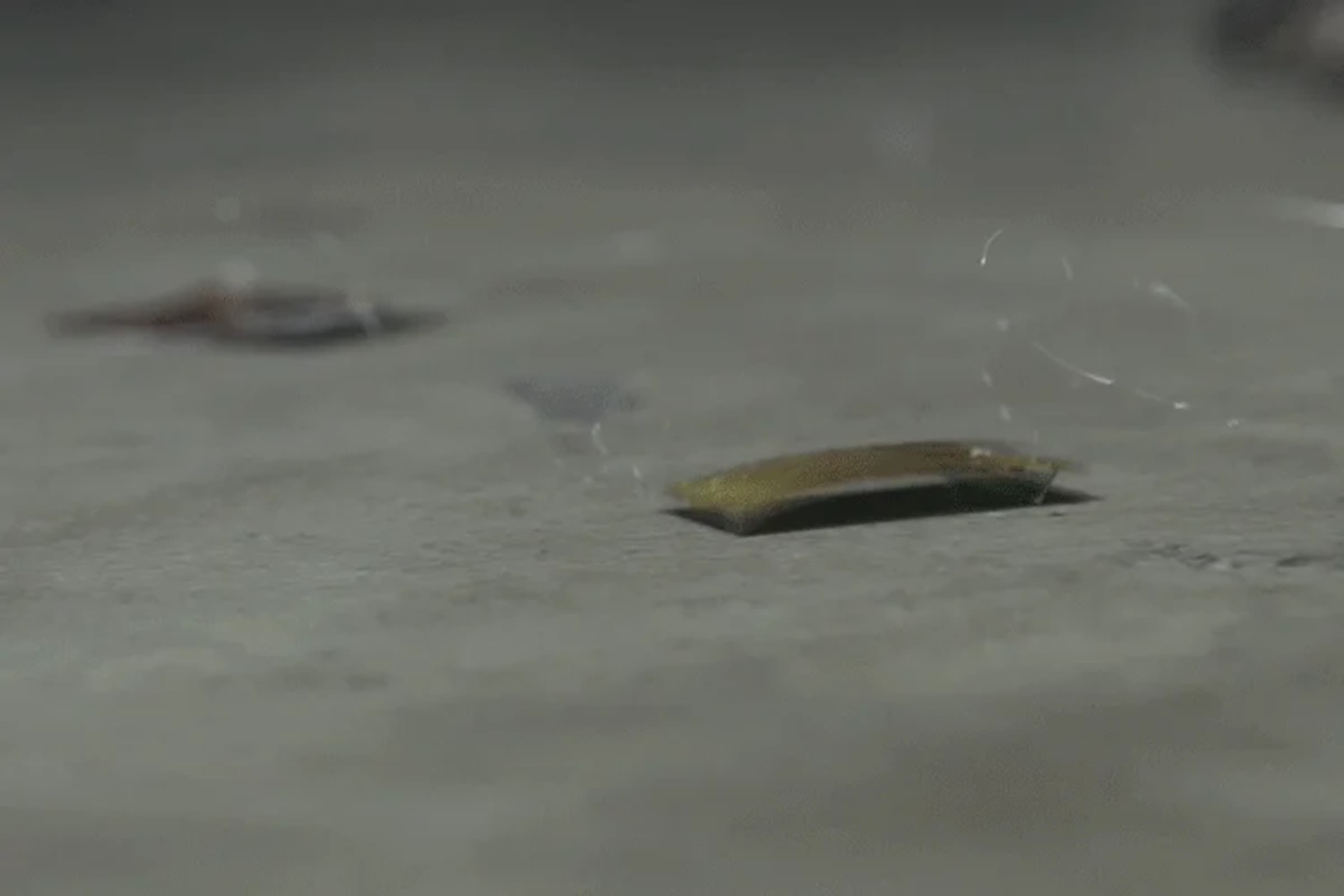
The bumblebee-inspired innovation is not the only achievement of Lin's team in bio-inspired robotics. They have also developed a cockroach-like robot (photo below) capable of withstanding extreme forces, such as being stepped on by a human.
Meanwhile, Yue is leading efforts to create "swarming" robots that can collaborate like ants to perform complex tasks beyond the capabilities of individual robots.
"I'm working with 5-millimeter-scale robots that can crawl, roll, and spin," Yue explained. "They can also work together to form chains and arrays or tackle harder tasks."

These swarming robots hold promise for applications such as minimally invasive surgery, where multiple units could be injected into the body to form stents or remove clots collaboratively.
Kamyar Behrouzi, Yuan Gao, and Mark Mueller from UC Berkeley co-authored the study, which was supported by the Berkeley Sensor and Actuator Center.
Miniature robot takes flight using magnetic fields, no onboard power


