WTF?! Gamers have experimented with liquid cooling for years, and immersion cooling can theoretically take the concept to the next level. Apparently, using transmission fluid in place of more traditional cooling stuff can also deliver surprising performance benefits.
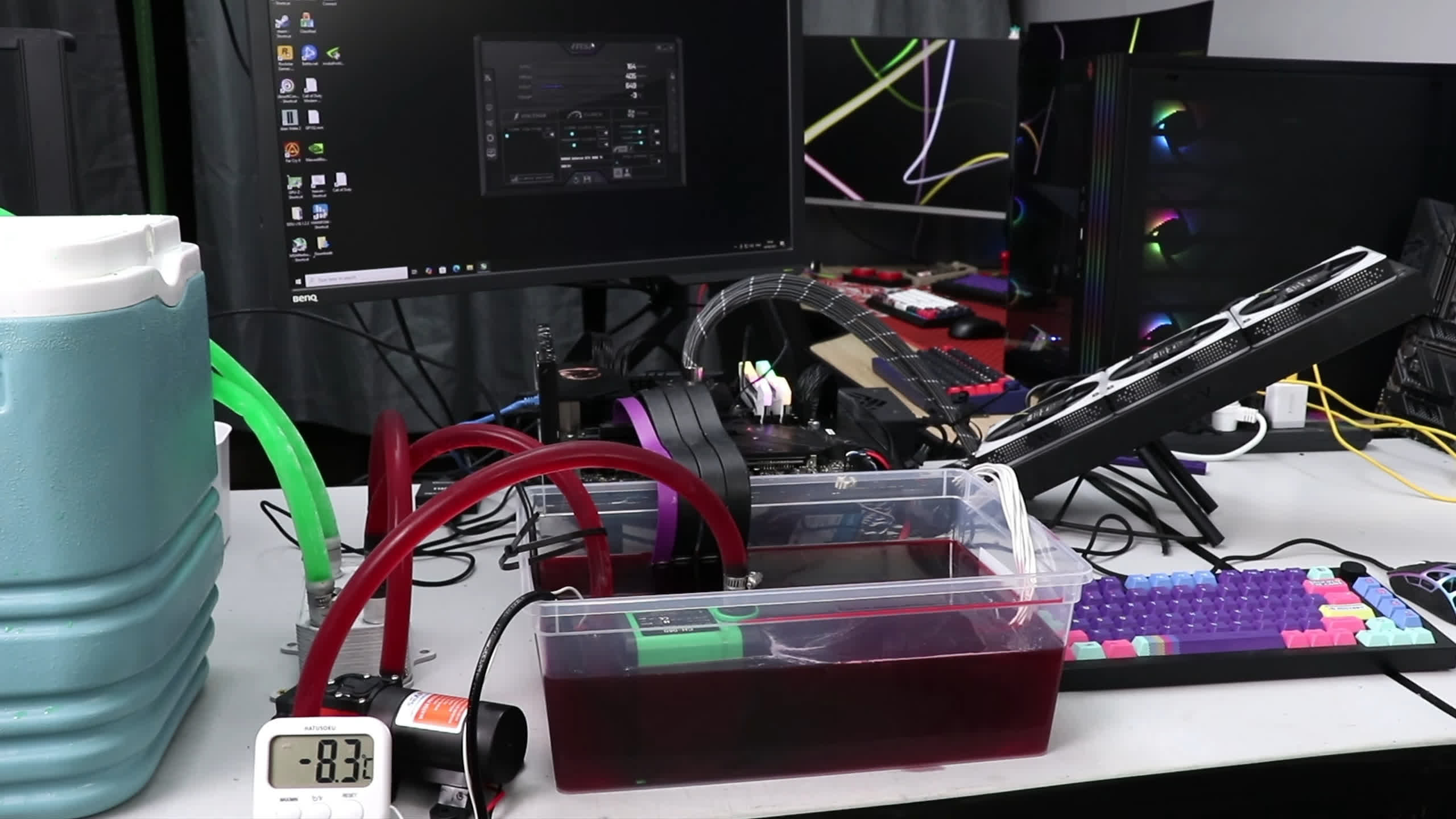
A Reddit user, inspired by the latest trends in immersion cooling, decided to try something different. While "traditional" immersion cooling setups typically use some form of mineral oil in data center environments, this modder experimented with automatic transmission fluid (ATF) instead to see what would happen.
He submerged two old Nvidia GeForce models in 8 liters of fresh ATF, setting up a submersible pump to circulate the thick fluid inside a plastic container. A second loop pumped chilled fluid (-18°C glycol) through an external Dodge Journey transmission cooler. The GPUs were connected to an external motherboard with a Core i7-14900K CPU via a PCIe riser cable.
For his first experiment, the modder chose to "sacrifice" a GeForce GTX 1080 Ti. He stripped the card of its fans and plastics before immersing it in the ATF bath. On air, the GPU maintained a steady 1960 MHz clock speed. Submerged in ATF, it reached 2114 MHz, resulting in a 7 percent FPS increase in several tested games.
The GTX 1080 Ti was already a power-hungry card, the modder noted, so the 7 percent gain wasn't a bad result. Achieving it, however, meant coating every inch of the PCIe card in sticky fluid. By contrast, the experiment with a barebones GeForce GTX 1060 went much better.
The 1060's stock frequency was 1886 MHz, but in the ATF bath it climbed to 2190 MHz. This 16 percent clock speed increase translated into a 10 percent FPS boost in games, while 3DMark benchmarks showed a 16 percent performance uplift.
"1080Ti didn't achieve much, this is oil after all not LN2, but the 1060 got 2nd place overall in Timespy and 1st place overall in Firestrike," the modder said. He also acknowledged that Intel's Raptor Lake CPU contributed significantly to the results.
Despite the performance gains, he conceded that transmission fluid isn't exactly a practical choice for custom immersion cooling. The ATF bath would likely ruin both the hardware and the modder's day, he said, although both GPUs appeared to have survived the ordeal in the end.
Modder dunks GeForce GPUs in transmission fluid to see how performance would improve


