
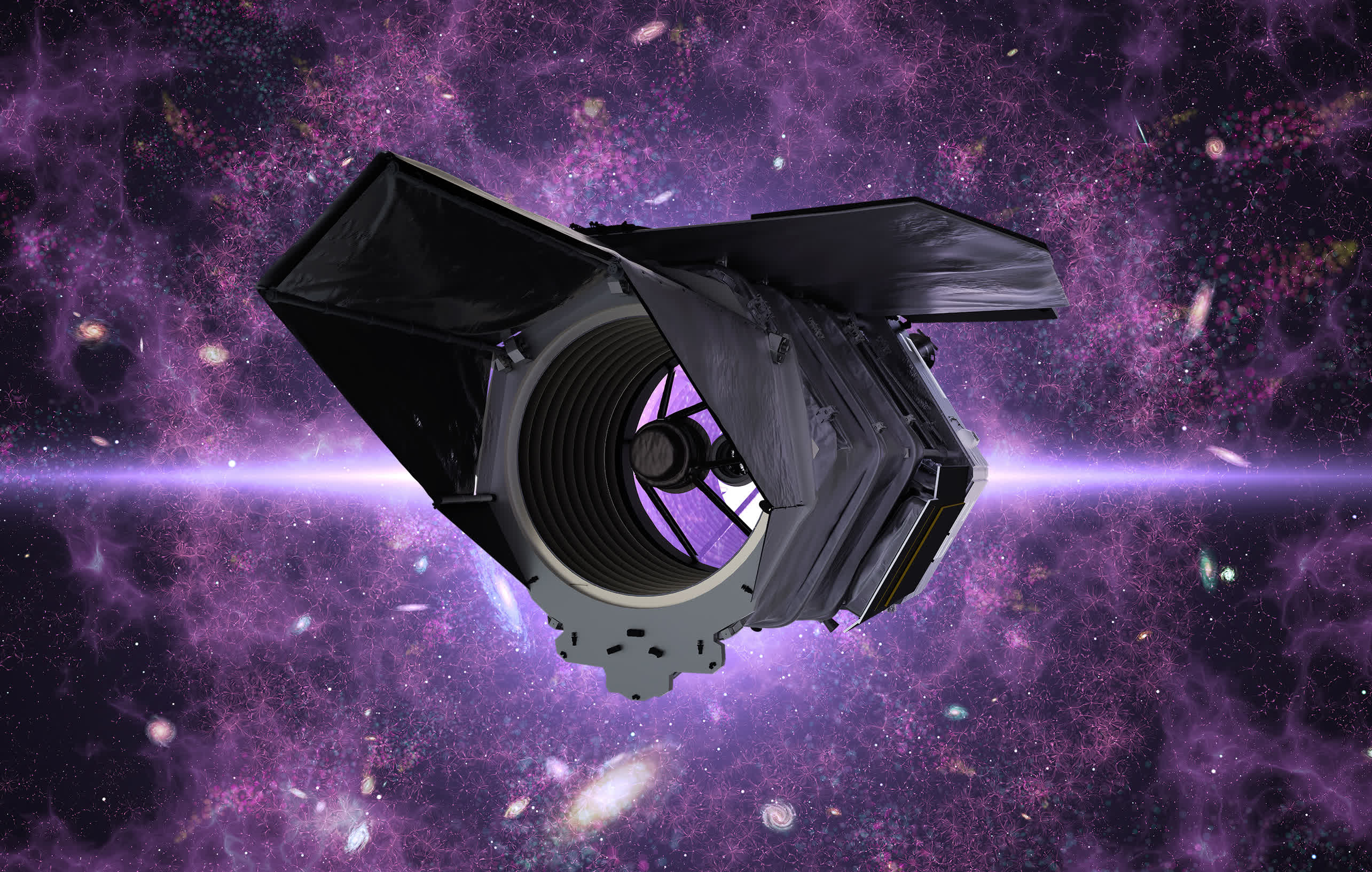
In brief: NASA is planning to launch its Nancy Grace Roman Space Telescope on August 30, a full eight months ahead of schedule and even earlier than the space agency's previous target of September. Engineers at NASA's Goddard Space Flight Center in Greenbelt, Maryland, are in the process of packing the telescope for its journey to Kennedy Space Center in Florida later this month.
Upon arrival, it'll go to the Payload Hazardous Servicing Facility to undergo a full post-travel inspection.
Leading up to launch, NASA engineers in Florida will perform routine testing and launch rehearsals including loading nearly 300 gallons of hydrazine fuel into its tanks. The observatory will then be outfitted with an adapter to attach it to a SpaceX Falcon Heavy Rocket, which will help send the telescope on its way to the second Sun-Earth Lagrange point. Known as L2, the destination is roughly four times farther away than the Moon is from Earth.
With the adapter in place, Roman will then be equipped with a protective nose cone to shield it during liftoff. From there, it'll go to a hanger to be attached to the Falcon Heavy Rocket before rolling out to Launch Pad 39A for launch.
Named after former NASA chief of astronomy Nancy Grace Roman, the telescope was first proposed in 2010 and approved in 2016. It'll carry two scientific instruments including a 300.8-megapixel multi-band visible and near-infrared camera with a field of view roughly 100 times larger than the imaging unit on Hubble. The observatory will also be able to block starlight for a better look at exoplanets and planet-forming disks, helping to settle essential questions about astronomy and our place in the universe.
The Nancy Grace Roman Space Telescope will have an initial mission period lasting five years. During that time, astronomers will survey billions of stars and galaxies, and take a look at thousands of exoplanets and hundreds of black holes. The total lifetime cost for the development, launch, and five-year mission duration is roughly $4.3 billion.
NASA's Roman Space Telescope is launching August 30, eight months ahead of schedule


