New AMD Ryzen 5 5500X3D could offer gamers a budget boost on AM4 platform

zohaibahd

Posts: 978   +19
Staff
Why it matters: Just when you thought AMD was ready to move on from the trusty old AM4 socket, Team Red seems to have one more trick up its sleeve. According to recent entries at the Eurasian Economic Commission, it looks like the company is prepping a new budget-friendly X3D processor with 3D V-cache for the long-running platform.
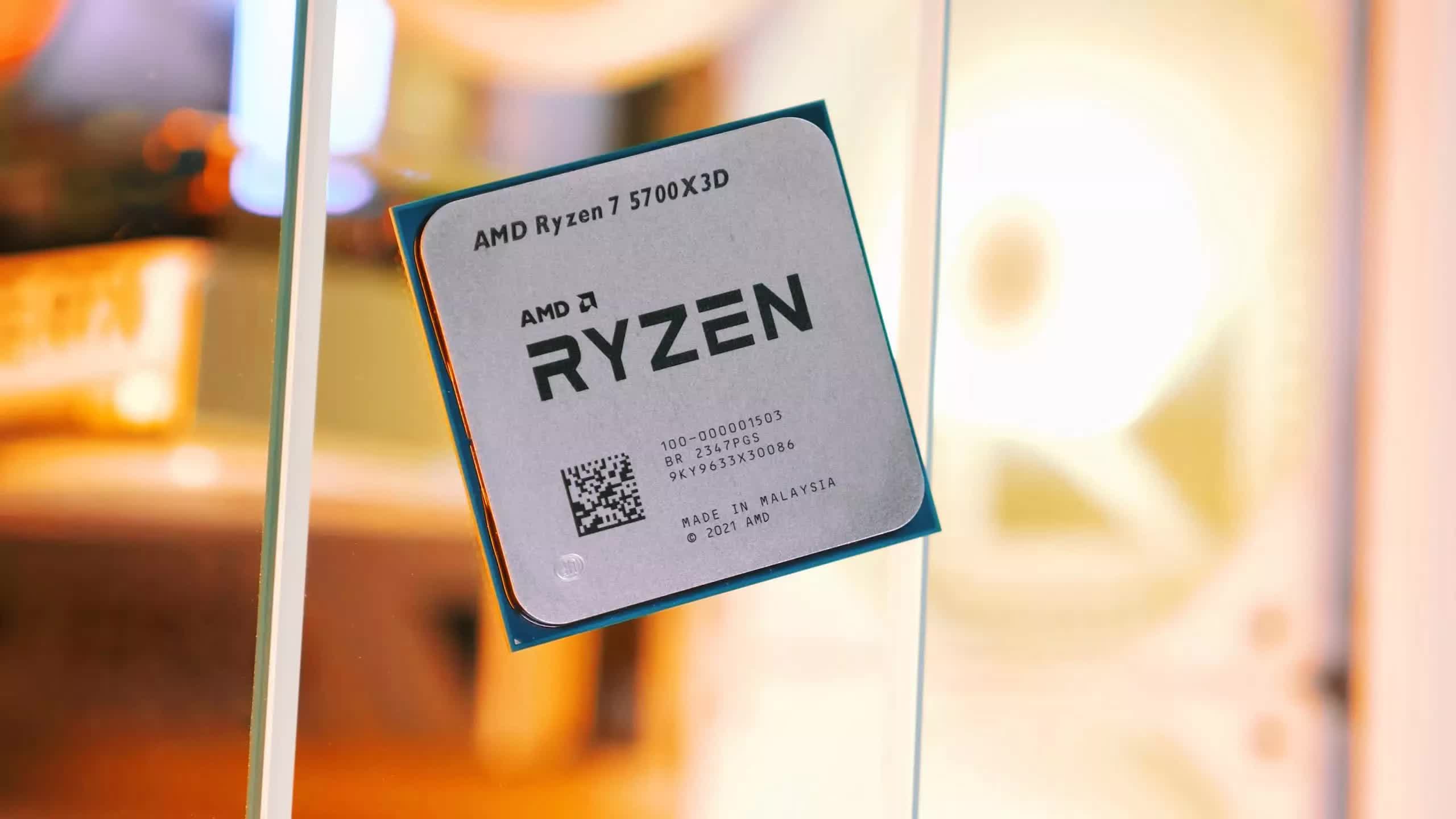
The processor in question is rumored to be called the Ryzen 5 5500X3D, as spotted by Sweclockers. If the whispers prove true, it will be the fourth X3D chip in AMD's Zen 3-based Ryzen 5000 series tailored for the aging AM4 socket. From what we're hearing, it could be a real value champion.

While official details are scarce, rumors suggest this new offering will pack 6 cores and 12 threads. Clock speeds are expected to land at a 3.0GHz base and 4.0GHz boost. But the real star of the show is likely to be the 96MB of stacked 3D V-cache, which should give gaming performance a healthy boost over standard Ryzen 5000 chips.

It will be interesting to see exactly where AMD positions the chip in its current X3D lineup. The existing Ryzen 5 5600X3D, with the same 6-core/12-thread configuration, offers higher clock speeds at 3.3GHz base and 4.4GHz boost. It launched last summer for $229 but is pretty hard to find now.
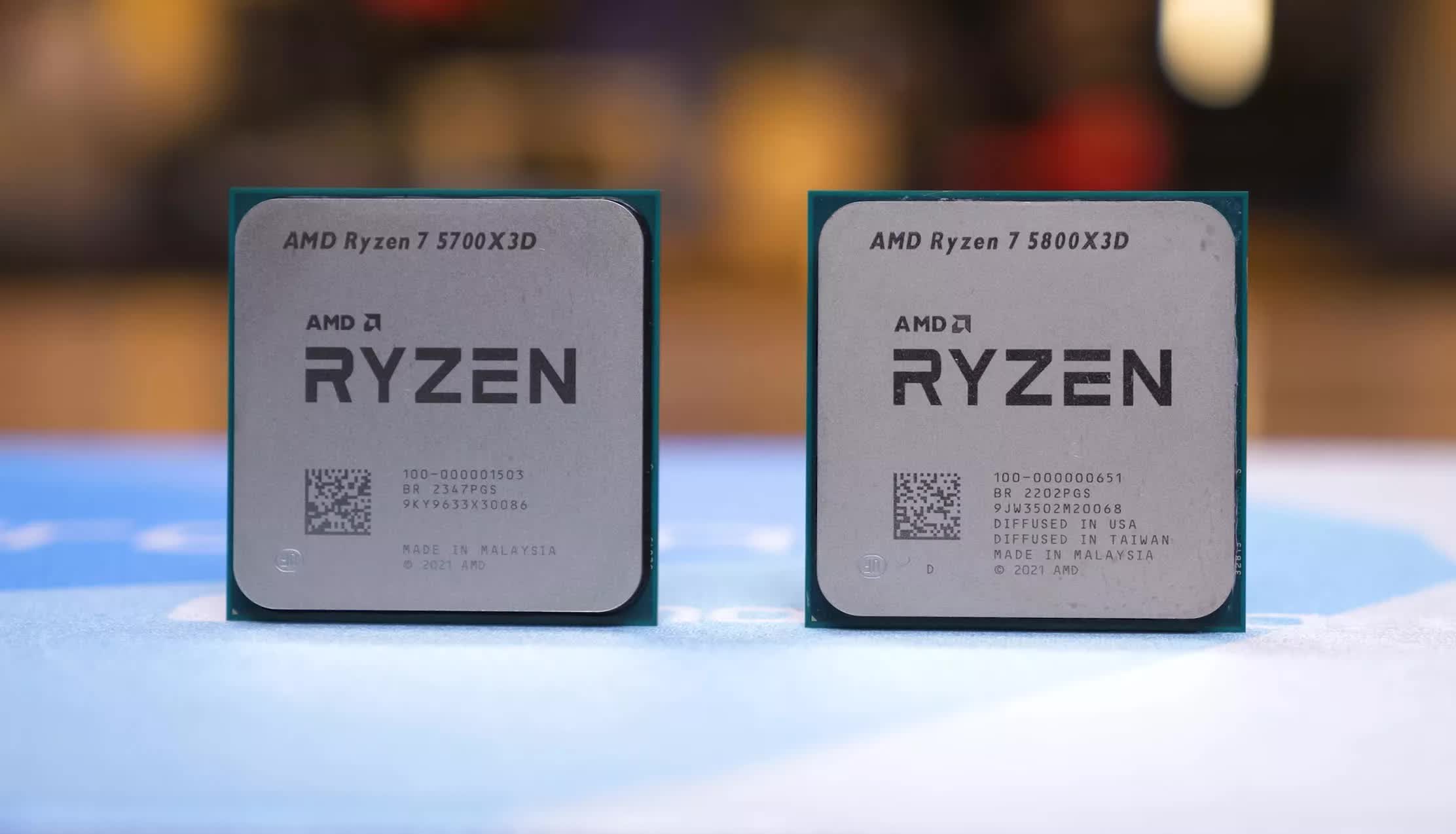
Then you have the Ryzen 7 5700X3D (8-cores/16-threads for around $210) and the flagship Ryzen 7 5800X3D (8-core/16-thread for $339). With its slightly lower specs, the new 5500X3D would presumably slot in below the 5700X3D on pricing, which means selling for below $200.

If AMD can bring this new kid on the block in under that price point, it could make the 5500X3D an insanely attractive option for budget gamers building on AM4 platforms.

That said, launching yet another Zen 3 processor in 2024 when Zen 4 is already widespread seems a bit odd, but AMD may have a surplus of these 3D V-cache chips to clear. Plus, its partners likely have piles of unsold AM4 motherboards that they need to shift.

There's also the possibility of the Ryzen 5 5500X3D never hitting the market since the EEU database does not guarantee that any listed products will actually launch.

Permalink to story:

 
I still wonder why there is no 7600X3D, that seems like the chip that would make gamers step up to AM5 platform. At $249 it would be an attractive entry gaming processor and would outperform just about anything non-X3D. Maybe there will be a 9600X3D.
 
I still wonder why there is no 7600X3D, that seems like the chip that would make gamers step up to AM5 platform. At $249 it would be an attractive entry gaming processor and would outperform just about anything non-X3D. Maybe there will be a 9600X3D.

AMD delayed the 5600X3D until they got enough nonworking 5800X3D dies and still limited it to Microcenter. It'll be a while longer until the 7600X3D shows up.
 
AMD delayed the 5600X3D until they got enough nonworking 5800X3D dies and still limited it to Microcenter. It'll be a while longer until the 7600X3D shows up.
I guess if they are specifically cutting down 7600 and 9600 parts to have another SKU rather than relying on defective chips that would make sense. The X3D parts are more expensive to manufacture so AMD would rather rely on bad yields than cutting down good units.
 
I think AMD could make a real impact with a stripped-down version of the Zen5 chiplet without graphics. Imagine one AM4 chiplet with one Zen5 4nm ccx in combination with the old Zen3 12nm CIOD for DDR4 and PCIe4!

It'd be a game-changer. There will be only one version (Ryzen 979x AM4 at an MSRP of around ~300-400$) with 8 cores, no 3D because it's something for the previous platform. The fact is, AMD doesn't sell motherboards or memory. It sells only CPUs. So there's absolutely no reason not to do it. I believe that 90% of the customers market is still on AM4 motherboards, and I bet they'll still be on around 50% even after 5 years. It is difficult to justify throwing away the CPU + motherboard + RAM when IPC gains are limited. So for a chiplet without RDN2 graphics support and the ability to integrate two CCXs in the chiplet I think that the AM4's pins will be sufficient to support only one 4nm Zen5 CCX and one 12nm cIOD.

AMD must bring AVX512 with the Zen5 to their AM4 customers. Supporting customers is what makes a company great.
 
I think AMD could make a real impact with a stripped-down version of the Zen5 chiplet without graphics. Imagine one AM4 chiplet with one Zen5 4nm ccx in combination with the old Zen3 12nm CIOD for DDR4 and PCIe4!

It'd be a game-changer. There will be only one version (Ryzen 979x AM4 at an MSRP of around ~300-400$) with 8 cores, no 3D because it's something for the previous platform. The fact is, AMD doesn't sell motherboards or memory. It sells only CPUs. So there's absolutely no reason not to do it. I believe that 90% of the customers market is still on AM4 motherboards, and I bet they'll still be on around 50% even after 5 years. It is difficult to justify throwing away the CPU + motherboard + RAM when IPC gains are limited. So for a chiplet without RDN2 graphics support and the ability to integrate two CCXs in the chiplet I think that the AM4's pins will be sufficient to support only one 4nm Zen5 CCX and one 12nm cIOD.

AMD must bring AVX512 with the Zen5 to their AM4 customers. Supporting customers is what makes a company great.

Are Zen5 chiplets compatible with 12nm IO die? If AMD didn't deliberately made them compatible, they still might be compatible but I highly doubt it. That is something AMD must have considered before designing 6nm IO die.

Also AGESA problens will arise, AM4 motherboards have limited memory space for AGESAs.

Therefore, wishful thinking but probably not going to happen.
 
Are Zen5 chiplets compatible with 12nm IO die? If AMD didn't deliberately made them compatible, they still might be compatible but I highly doubt it. That is something AMD must have considered before designing 6nm IO die.

Also AGESA problens will arise, AM4 motherboards have limited memory space for AGESAs.

Therefore, wishful thinking but probably not going to happen.
I was talking about the previous 12nm IO from Zen3 because they already have it and it will be very cost efficient (it's only the packaging and the software). But they could always design a new one and put a TPU (tensor cores) inside if it's possible (not rdna, which is confusing, systems already have GPUs, and if it isn't usable in real conditions with at least a performance of ~3060 or offer a competitive advantage like AV1 encode, it's just confusing).

Arrow Lake at 3nm is going to perform about 10% better than Zen5 and Intel is a strong name, so AMD needs to start accelerate their AVX512 competitive advantage as soon as possible. If there are enough compatible CPUs on the market, developers will have no choice but to use AVX512, if they don’t do it that their competitors will gain the upper hand by using it because there will be real market in existent not ideal market somewhere in a possible future. If only half of the AM4 base upgrades to a CPU with AVX512, it will set off a chain reaction. Almost all the developers will suddenly start using AVX512 because in a competitive environment, if you're not agile, you'll get left behind.

In a nutshell, they have to get the packaging done quickly before Arrow Lake, or they'll be in a spot of bother!
 
I think AMD could make a real impact with a stripped-down version of the Zen5 chiplet without graphics. Imagine one AM4 chiplet with one Zen5 4nm ccx in combination with the old Zen3 12nm CIOD for DDR4 and PCIe4!
I believe that 90% of the customers market is still on AM4 motherboards, and I bet they'll still be on around 50% even after 5 years. It is difficult to justify throwing away the CPU + motherboard + RAM when IPC gains are limited.

You're assuming that much of Zen 5's IPC lift isn't also dependent on DDR5's bandwidth to feed it data fast enough. I suspect that this is a big contributor and limiting a Zen 5 core to DDR 3200, or 3600 in the best systems, will cut much of it's performance. And that's before all the BIOS work that would be needed to get this working which I suspect is also considerable.

Sure, it's technically possible to do but it's a waste of effort when good options still exist all through the Zen 3 stack. The future should be based on AM5's advantages and not doubling effort in an attempt to shoehorn a fraction of Zen 5's performance improvements to AM4.
 
You're assuming that much of Zen 5's IPC lift isn't also dependent on DDR5's bandwidth to feed it data fast enough. I suspect that this is a big contributor and limiting a Zen 5 core to DDR 3200, or 3600 in the best systems, will cut much of it's performance. And that's before all the BIOS work that would be needed to get this working which I suspect is also considerable.

Sure, it's technically possible to do but it's a waste of effort when good options still exist all through the Zen 3 stack. The future should be based on AM5's advantages and not doubling effort in an attempt to shoehorn a fraction of Zen 5's performance improvements to AM4.

Here's a quick simplified comparison of the Zen4 and Zen5 IPCs: Scalar integer is about +30%, x87 FPU is about +10%, 128-bit SSE is about the same, 256-AVX is about +7%, and 512-AVX is about +100%.

It is difficult to ascertain precisely how much the marginally faster RAM, albeit with increased latency, contributes to these results. However, it seems reasonable to suggest that the gains from Zen2-3 will be at least 50-70% for everything, even with DDR4 3600, given that DDR4 4000+ memory kits are available.

Even if we assume that the total performance of the same CPU is 10-15% less when you compare the same chip with DDR5 6000 and DD4 3600, it's still a very reasonable upgrade from Zen2-3.

After all, you have to spend twice the price of the CPU on a new motherboard and new RAM, and you have the hassle of removing everything from the case. In the past I had purchased a new 4TB NVMe, but I had it in the drawer and did not use it for almost six months due to my initial reluctance to open the PC case, despite the fact that the previous 1TB NVMe had only a few GB left. So I can tell you from personal experience that it would have taken me six months to install just an NVMe, even though I had already bought it. It's a lot of hassle to take everything out of the PC case and put the new hardware one in, so don’t underestimate that inertia.
 
I was talking about the previous 12nm IO from Zen3 because they already have it and it will be very cost efficient (it's only the packaging and the software). But they could always design a new one and put a TPU (tensor cores) inside if it's possible (not rdna, which is confusing, systems already have GPUs, and if it isn't usable in real conditions with at least a performance of ~3060 or offer a competitive advantage like AV1 encode, it's just confusing).

I was talking about same. I doubt it (Zen3 IO die) is compatible with Zen5 chiplet. Designing new one won't happen because AM4 is very soon EOL. Zen5 also probably won't get new IO ever die but AMD might want some AI acceleration for Zen6 chiplet...
 
I was talking about same. I doubt it (Zen3 IO die) is compatible with Zen5 chiplet. Designing new one won't happen because AM4 is very soon EOL. Zen5 also probably won't get new IO ever die but AMD might want some AI acceleration for Zen6 chiplet...
I am unsure too as to whether it is compatible. However, given that engineers typically favour simplicity and tend not to alter components that are functioning well and integrated into the software drivers, BIOS, and so forth, I assume they have good changes to be compatible.

You mentioned EOL and make me to recall the period preceding Zen... 😅
 
Back